📚 50 Phrasal Verbs for Everyday English
8 min read
2026-06-27
Learn 50 essential phrasal verbs organized by everyday topics. Master work, travel, relationships, and communication vocabulary with definitions and examples.
EngSandbox Editorial Team
Written with AI assistance and reviewed by our editors — experienced PTE/IELTS tutors. Every article is fact-checked against official band descriptors, the Academic Word List and Cambridge assessment research, then field-tested with learners before publishing. Human reviewed + field tested. Questions? Contact us — see our Editorial Process.

If you have ever heard a native English speaker say something like "I'll pick you up at eight" or "We need to sort this out," you have already encountered phrasal verbs — and you probably understood the meaning from context. But when it comes to using them yourself, especially in a high-pressure exam like IELTS or PTE, things suddenly feel much harder. You are not alone in this struggle.
Phrasal verbs are one of the most common sources of frustration for English learners at the intermediate level. They seem unpredictable. There are thousands of them. And yet, they are everywhere — in everyday conversation, in academic lectures, in workplace emails, and yes, in your exam. The good news is that you do not need to memorize thousands. Learning even 50 well-chosen phrasal verbs and using them naturally can noticeably improve your fluency and your confidence.
In this article, we are going to learn 50 essential phrasal verbs organized into five everyday topics: work, travel, relationships, daily life and communication, and emotions. Each one comes with a clear definition, a natural example sentence, and a common collocation. By the end, you will have a practical vocabulary toolkit you can start using right away — on your exam and in real life.
What Exactly Is a Phrasal Verb?
A phrasal verb is a verb combined with one or two small words (usually a preposition or an adverb) to create a new meaning. For example, the verb "look" means to direct your eyes at something, but look into means to investigate. The meaning changes completely.
This is what makes phrasal verbs tricky — and also what makes them powerful. When you use them well, you sound natural and fluent. According to the British Council, the ability to use a range of vocabulary, including phrasal verbs and idiomatic expressions, is a factor in achieving a higher band score in IELTS Speaking and Writing.
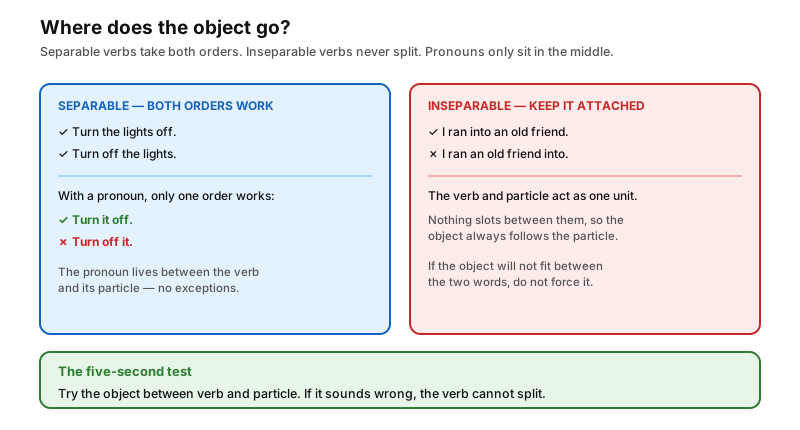
One important distinction: some phrasal verbs are separable (you can put the object between the verb and the particle), and some are inseparable (you cannot). Here is a quick reference:
| Type | Structure | Example |
|---|---|---|
| Separable | Verb + Object + Particle or Verb + Particle + Object | "Turn the lights off" or "Turn off the lights." |
| Inseparable | Verb + Particle + Object | "I ran into an old friend." (NOT "I ran an old friend into.") |
If you are unsure whether a phrasal verb is separable, try placing the object between the verb and the particle. If it sounds wrong, it is probably inseparable. With pronouns (it, them, him), always place the pronoun in the middle of a separable phrasal verb: "Turn it off," not "Turn off it."
Phrasal Verbs for Work
Whether you are describing your job in IELTS Speaking Part 1 or writing about workplace topics in the PTE Write Essay task, these phrasal verbs will help you sound professional and natural.
| Phrasal Verb | Meaning | Example Sentence |
|---|---|---|
| Carry out | To perform or complete a task | "The team carried out the research over three months." |
| Come up with | To think of an idea or plan | "She came up with a brilliant solution to the problem." |
| Look into | To investigate or examine | "The manager will look into the customer's complaint." |
| Bring up | To mention or raise a topic | "I'd like to bring up an important issue during the meeting." |
| Set up | To establish or arrange | "They set up a new branch in the city centre." |
| Take over | To assume control or responsibility | "The new director will take over the department next month." |
| Step down | To resign from a position | "The CEO decided to step down after twenty years." |
| Work out | To solve or find a solution | "We need to work out a budget before Friday." |
| Hand in | To submit (a document, assignment) | "Please hand in your report by the end of the day." |
| Fill in for | To substitute for someone temporarily | "Could you fill in for Sarah while she is on leave?" |
| Put off | To postpone or delay | "They put off the meeting until next week." |
| Call off | To cancel | "The company called off the deal at the last minute." |
Common mistake: Many learners confuse put off (postpone) with put up (build or erect) or put up with (tolerate). If you mean "delay," stick with put off. Example: "Don't put off studying until the night before your exam."
Phrasal Verbs for Travel
IELTS and PTE frequently include travel-related topics in both speaking and writing tasks. These phrasal verbs will help you describe journeys, holidays, and transportation with ease.
| Phrasal Verb | Meaning | Example Sentence |
|---|---|---|
| Set off | To begin a journey | "We set off early to avoid the traffic." |
| Get in | To arrive (for trains, planes, buses) | "What time does the flight get in?" |
| Pick up | To collect someone in a vehicle | "I'll pick you up from the station at six." |
| Drop off | To take someone somewhere and leave them | "Could you drop me off at the airport?" |
| Check in | To register at a hotel or airport | "We checked in to the hotel around noon." |
| Check out | To leave a hotel after paying | "We need to check out by eleven in the morning." |
| Take off | When a plane leaves the ground | "The plane took off twenty minutes late." |
| Get on | To board a vehicle (bus, train, plane) | "We got on the wrong bus and ended up in the suburbs." |
| Run into | To meet someone unexpectedly | "I ran into an old colleague at the airport." |
| Look around | To explore or visit a place casually | "We spent the afternoon looking around the old town." |
Tip for your exam: When describing a past trip in IELTS Speaking Part 2, try using two or three of these phrasal verbs naturally. For example: "We set off at dawn and arrived in the afternoon. After we checked into the hotel, we spent the evening looking around the city centre." This demonstrates range in your vocabulary, which directly contributes to a higher Lexical Resource score.
Phrasal Verbs for Relationships
Relationships — family, friends, colleagues — are one of the most common discussion topics in IELTS Speaking and PTE Respond to a Situation. These phrasal verbs will help you express complex interpersonal ideas simply and naturally.
| Phrasal Verb | Meaning | Example Sentence |
|---|---|---|
| Get along | To have a friendly relationship | "I get along really well with my neighbours." |
| Break up | To end a romantic relationship | "They broke up after being together for five years." |
| Make up | To become friendly again after a disagreement | "They argued but made up the next day." |
| Grow apart | To gradually become less close | "As we got older, we just grew apart." |
| Look up to | To admire or respect someone | "I have always looked up to my older sister." |
| Turn down | To reject or refuse an offer or invitation | "She turned down the invitation because she was busy." |
| Ask out | To invite someone on a date | "He finally asked her out after months of wanting to." |
| Put up with | To tolerate something unpleasant | "I can't put up with the noise from the construction site." |
| Count on | To rely on or trust someone | "You can always count on me if you need help." |
| Come between | To cause problems in a relationship | "Don't let a small disagreement come between you." |
Common mistake: Do not drop the preposition "with" when you mention the person. Say "I get along with my colleagues," never "I get along my colleagues." This is a frequent error that can affect your Grammatical Range and Accuracy score.
Phrasal Verbs for Daily Life and Communication
These are the phrasal verbs you will hear and use most often in general conversation. They are incredibly useful for IELTS Speaking across all three parts.
| Phrasal Verb | Meaning | Example Sentence |
|---|---|---|
| Figure out | To understand or solve something | "I finally figured out how the new software works." |
| Point out | To draw attention to something | "She pointed out that the deadline had changed." |
| Turn up | To arrive or appear, often unexpectedly | "He turned up at the party without an invitation." |
| Show up | To arrive, often late or unexpectedly | "She didn't show up for class this morning." |
| Come across | To find something by chance | "I came across an interesting article while browsing online." |
| Go over | To review or check something | "Let's go over the instructions one more time." |
| Find out | To discover or learn a piece of information | "I found out about the change through email." |
| Bring about | To cause something to happen | "The new policy brought about significant improvements." |
| Keep up with | To stay at the same pace or level as others | "It's hard to keep up with the latest technology." |
| Sort out | To organise or resolve something | "We need to sort out the schedule before Monday." |
Tip: Notice that show up and turn up are very similar, but show up often carries a slight sense of being late or unreliable, while turn up can simply mean "arrive." Compare: "He showed up an hour late" versus "She turned up at my door unexpectedly." Understanding these subtle differences is the kind of nuance that impresses examiners.
Phrasal Verbs for Emotions and Feelings
Expressing emotions clearly and naturally is essential for both IELTS and PTE, particularly in speaking tasks where you need to describe personal experiences.
| Phrasal Verb | Meaning | Example Sentence |
|---|---|---|
| Calm down | To become less upset or angry | "I took a few deep breaths to calm down before the interview." |
| Cheer up | To become happier or to make someone happier | "A phone call from my friend really cheered me up." |
| Look forward to | To feel excited about something in the future | "I'm looking forward to starting my new course." |
| Get over | To recover from something difficult | "It took me a while to get over the disappointment." |
| Break down | To become extremely upset; to stop functioning | "She broke down in tears when she heard the news." |
| Light up | To suddenly look happy or excited | "Her face lit up when she saw the surprise." |
| Wear out | To become extremely tired or exhausted | "The long journey really wore me out." |
| End up | To finally be in a particular situation or place | "We got lost and ended up in a completely different neighbourhood." |
Important note: The phrasal verb look forward to is followed by a gerund (the -ing form), not a base verb. Say "I look forward to hearing from you," not "I look forward to hear from you." This is one of the most common mistakes learners make, and examiners notice it.
Common Mistakes to Avoid
As you start using phrasal verbs in your speaking and writing, watch out for these frequent errors:
1. Using the wrong preposition. "Listen to" is correct; "listen at" is not. Similarly, "depend on" is correct, but "depend in" is wrong. Always learn the exact particle that goes with each phrasal verb.
2. Overusing phrasal verbs in formal writing. In IELTS Writing Task 2 or PTE Write Essay, some phrasal verbs sound too informal. For example, find out works well in speaking, but in academic writing, discover or determine may be more appropriate. Use your judgment based on the register.
3. Forgetting separability rules. As we discussed earlier, always place pronouns between the verb and particle in separable phrasal verbs. "Turn it off" is correct. "Turn off it" is not.
4. Translating directly from your native language. Phrasal verbs rarely translate word-for-word. The Spanish "llegar a" might seem like "arrive to," but in English, we say "get to" or "arrive at." Learn phrasal verbs as complete units, not word by word.
When Life Gets Busy: Micro-Learning Tips
You do not need to sit down for an hour-long study session to learn phrasal verbs. Here are strategies that work even when your schedule is packed:
- Learn three phrasal verbs a day. Write each one on a sticky note with an example sentence and place it somewhere you will see it — your mirror, your desk, your phone wallpaper.
- Group them by theme. As this article does, learning phrasal verbs by topic (work, travel, emotions) helps your brain create connections, making them easier to remember.
- Use them in a sentence immediately. Research on vocabulary acquisition suggests that using a new word in a meaningful context strengthens memory far more than simply reading it. Write a sentence about your own life — personal sentences stick better than generic ones.
- Listen for them. Podcasts, TV shows, and YouTube videos are full of phrasal verbs. When you hear one, pause and write it down. According to the Cambridge English teaching framework, encountering vocabulary in authentic contexts is one of the most effective ways to build lasting knowledge.
- Review on the go. Keep a small notebook or use a notes app on your phone. Before your commute, review five phrasal verbs from the previous day. Spaced repetition — reviewing at increasing intervals — is far more effective than cramming.
Practice Exercise
Before you finish, try this quick exercise. Fill each gap with the correct phrasal verb from this article — the word in parentheses tells you the meaning:
- The manager decided to (cancel) __________ the project due to budget cuts.
- I (found by chance) __________ an old photo while cleaning my room.
- She (resigned from) __________ her position after the scandal.
- We need to (resolve) __________ this issue before the deadline.
- His face (became happy) __________ when he heard the good news.
(Answers: 1. call off, 2. came across, 3. stepped down from, 4. sort out, 5. lit up)
Final Thoughts
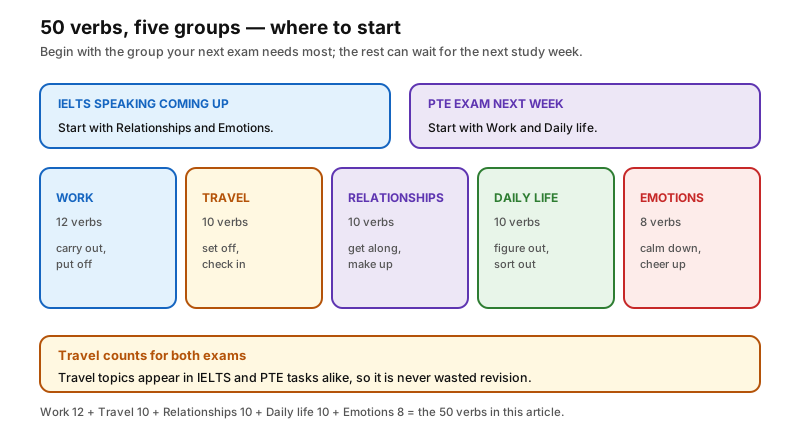
Learning 50 phrasal verbs might feel like a big task, but remember — you do not have to master all of them at once. Start with the topic that matters most to you right now. If you have an IELTS Speaking test coming up, focus on the relationships and emotions groups. If your PTE exam is next week, prioritise the work and daily life groups.
The most important thing is consistency. Use three new phrasal verbs in conversation today. Write one in your journal tonight. Listen for them in a podcast tomorrow. Small, regular efforts compound over time into real fluency. You already have everything you need — now go out and use it. You have got this.
Related Articles
🎓 100 Academic Words Every University Student Must Know
Master 100 essential academic words every university student needs. Learn key vocabulary for lectures, essays, and exams with definitions and usage examples.
🔀 30 Confusing Word Pairs in English (and How to Never Mix Them Again)
Affect vs effect, borrow vs lend, its vs it's: 30 pairs grouped into 6 error families, each with a two-second test and a pocket reference table.
📝 IELTS/PTE Writing: How to Use Articles (a, an, the) Correctly
Master the correct use of articles (a, an, the) in your IELTS and PTE writing. Learn the rules, common mistakes, and practical strategies to boost your grammar score.