🔀 30 Confusing Word Pairs in English (and How to Never Mix Them Again)
17 min read
2026-09-27
Affect vs effect, borrow vs lend, its vs it's: 30 pairs grouped into 6 error families, each with a two-second test and a pocket reference table.
EngSandbox Editorial Team
Written with AI assistance and reviewed by our editors — experienced PTE/IELTS tutors. Every article is fact-checked against official band descriptors, the Academic Word List and Cambridge assessment research, then field-tested with learners before publishing. Human reviewed + field tested. Questions? Contact us — see our Editorial Process.

Somewhere in a tutor's inbox right now sits a message like this one: "Can you borrow me your notes? The lecture effected me deeply, and I don't want to loose a single detail."
Every word was spelled correctly, yet three pairs had been swapped. Definitions were never the problem — after enough marked essays, a pattern emerges: these slips cluster into families, and each family breaks for a different reason.
So instead of a list of thirty words, we will work through six error families, five pairs at a time. Each pair gets a memory hook you can use under time pressure; every family ends with a short checkpoint; and a pocket-size table of all thirty pairs closes the article.
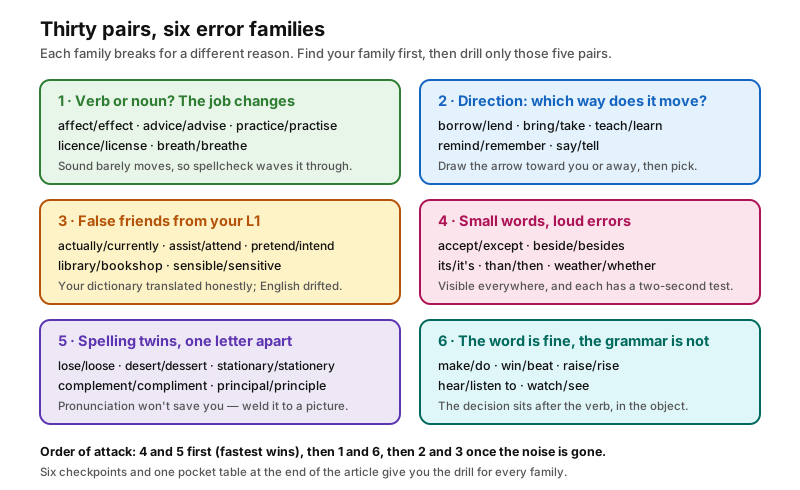
Thirty mistakes feel like thirty separate problems when you meet them one at a time. They are not: six problems, each with a different fix. A learner who memorises a flat list of thirty rules still swaps advice and advise three weeks later; a learner who learns the six reasons does not. Work them in the order the diagram gives — 4 and 5 return fastest, because their tests take two seconds, while 2 and 3 need months of exposure rather than drills.
Family 1: One Does the Job, One Names the Thing
English loves turning actions into things and back again, signalling each switch with a tiny sound change. These pairs sound nearly identical, so spellcheckers wave them straight through.
Affect / effect obey an everyday rule: affect is the verb, effect is the noun. Even small amounts of caffeine affect my sleep. / Caffeine has a noticeable effect on my sleep. The hook writes itself: Affect = Action, Effect = End result.
Advice / advise split the same way: -ice marks a thing, -ise marks a doing. She gave me honest advice. / I advise you to double-check the schedule. Your ear helps too: advice ends in a crisp /s/, while advise hums with a /z/.
Practice / practise repeat that split in British English: Piano practice pays off. / Practise in short daily sessions. American English uses practice for both jobs — Cambridge Dictionary labels the variants clearly. This one matters more than it looks in writing, because PTE Write From Dictation and the IELTS Writing papers both punish a -c/-s slip as a spelling error even when the grammar around it is perfect.
Licence / license mirror them, again in British English: Check the expiry date on your driving licence. / This restaurant is licensed to serve alcohol.
Breath / breathe change their sound with a final -e: Take a deep breath. / Breathe slowly and deeply. The silent -e stretches the vowel into a long "ee". Quick self-check: you can hold your breath, but never your breathe.
English loves nominalisation — turning verbs into nouns so a process becomes a thing you can possess and argue about, a habit the history of the English language traces from Old English onwards. If you want high-level academic vocabulary rather than just correct grammar, the same reflex serves both: reach for the -ment noun when the sentence is about a thing, and for the verb when it is about an action.
Checkpoint 1 — fill each gap:
- Lack of sleep ______ my concentration.
- The delay had a knock-on ______ on the whole schedule.
- Thank you for the ______ — it saved me hours.
- ______ regularly, and the chords will start to feel natural.
- The air felt icy after every ______ .
Answers: 1 affects · 2 effect · 3 advice · 4 Practise · 5 breath
Family 2: Words That Point in Opposite Directions
Several languages use one verb for both directions of an exchange — German leihen covers giving and getting alike. English refuses. Track the thing, not the people: draw an arrow toward or away, then pick the matching verb.
Borrow / lend: the object moves toward you when you borrow, away when you lend. Could I borrow your charger? / Sure, I'll lend it to you until Friday. Banks lend; everyone else borrows.
Bring / take anchor to the speaker's position: Bring your laptop to the workshop. / Take your laptop home afterwards.
Teach / learn send knowledge down opposite ends of one arrow. My colleague taught me the shortcut. / I finally learned the shortcut.
Remind / remember move a thought either into a mind or around inside one. Remind me to water the plants — you plant it in mine. I remembered to water them — it grew inside my own.
Say / tell: tell carries its listener inside it; say carries only the words. She told me she was busy. / She said she was busy. We tell stories, jokes and lies, but simply say sentences.
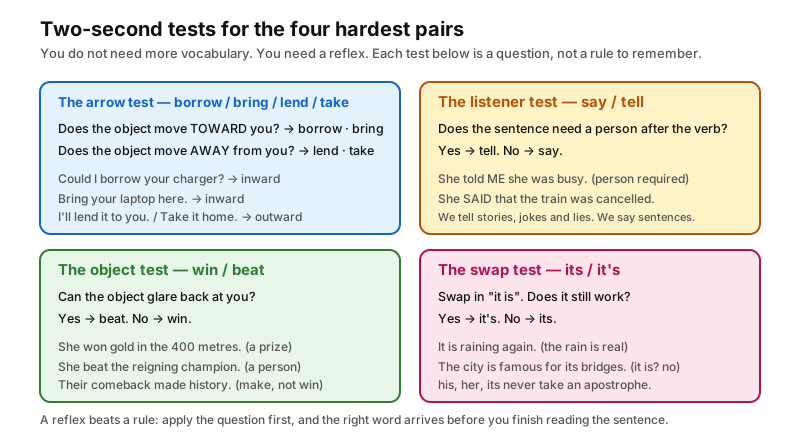
The four hardest pairs in this article all collapse to one question you can answer in two seconds — and the questions are worth more than the answers, because they travel to words you have not met yet. Does the object move toward you or away? Does the sentence need a person after the verb? Could the object glare back at you? If you can borrow the test, you never need to lend yourself a memorised rule. Same principle as the 50 everyday phrasal verbs: a working question beats a stored answer. Checkpoint 2 — fill each gap:
- May I ______ two chairs from the hall?
- The receptionist ______ me a map of the campus.
- Rain is forecast, so ______ an umbrella with you.
- Please ______ the guests where the exit is.
- She ______ that the train had been cancelled.
Answers: 1 borrow · 2 lent · 3 take · 4 tell · 5 said
Family 3: Traps Your First Language Planted
These five deserve sympathy, not embarrassment: your dictionary translated honestly for decades while English quietly drifted. Know where the paths fork, and the false friend loses its power.
Actually / currently: in Spanish, Portuguese and French, the long a- word means at present. English broke ranks: actually means in fact, often correcting an assumption. Actually, the museum opens at noon. / She's currently finishing her thesis.
Assist / attend: Romance cognates (asistir, assister) mean be present at; English assist means help. Volunteers assisted the nurses during the vaccination drive. / Will you attend the workshop on Thursday?
Pretend / intend: pretender and prétendre point toward plans; English pretend points toward make-believe. I intend to arrive before seven. / The kittens pretended to ignore the new toy.
Library / bookshop (bookstore): the bibliotheca/librería family is a classic trap — the word resembling library often means bookshop. Sort them by function: I returned the novel to the library. / I bought the novel at a bookshop.
Sensible / sensitive: Spanish sensible means sensitive, while sensato means sensible — English kept only the second meaning. Wear sensible shoes; the trail is rocky. / His teeth are sensitive to cold.
The defence against this family is not study but a habit of verification. When a word feels obvious, that is precisely when to check it — and a learner's dictionary is faster than a search engine, because it is already sorted into exactly the pair you are confused about.
Checkpoint 3 — fill each gap:
- ______ , I've never tried skiing before this weekend.
- He's ______ working nights, so mornings are tricky.
- Most of the students ______ the orientation session.
- The kids ______ to be asleep when we checked on them.
- Pack ______ walking shoes — the old streets are cobbled.
Answers: 1 Actually · 2 currently · 3 attended · 4 were pretending · 5 sensible
Family 4: Small Words, Loud Mistakes
These little words appear everywhere, so their errors are highly visible. Happily, each pair surrenders to a two-second micro-test.
Accept / except: to accept is to receive or agree; except carves something out — spot the ex- of exclude. We accepted the offer within a day. / The shop opens daily except Sundays.
Beside / besides: one letter decides between place and addition. Beside = next to: The keys are beside the fruit bowl. Besides = in addition: Besides English, she speaks some Czech. Alone, besides also means anyway: Besides, the tickets were non-refundable.
Its / it's: run the swap test. If it is fits, write the apostrophe — It's raining again. If not, take the possessive, which like his and her never takes one: The city is famous for its bridges.
Than / then: the vowels carry it. The a in than matches comparison: January was colder than December. The e in then matches temporal order: We finished the report, and then we celebrated.
Weather / whether: forecasts versus choices. The forecast promised mild weather. / I can't decide whether to walk or cycle. WHether presents WHich-options; weather happens outside your window.
These five appear in nearly every sentence of academic writing, so they matter more than their difficulty suggests. Than/then and weather/whether survive proofreading because a native eye slides over them — which is why the five most common grammar mistakes in IELTS writing keep costing marks. Fix is procedural: read the sentence back with the question, not with the eye.
Checkpoint 4 — fill each gap:
- Everyone enjoyed the boat trip ______ the twins, who get seasick.
- She sat ______ her cousin during the ceremony.
- The app lost ______ settings after the update.
- The return ticket costs less ______ the single.
- Let me know ______ you can join us on Friday.
Answers: 1 except · 2 beside · 3 its · 4 than · 5 whether
Family 5: Spelling Twins Separated by a Single Letter
Here the mistake is pure spelling, so pronunciation will not rescue you. Weld the decisive letter to a picture instead — images survive exam pressure far better than rules.
Lose / loose: loose has a spare o hanging off it, fittingly, since it means not tight: One screw was loose. Lose mislaid its extra letter: Don't lose your boarding pass. Sound seals it: lose rhymes with choose, loose with goose.
Desert / dessert: double s for seconds of sugar: We shared a lemon tart for dessert. The dry one makes do with one: Camels cross the desert before dawn.
Stationary / stationery: the paper one takes its e from envelope: Print the invitation on good-quality stationery. The still one keeps its a, as in at rest: Traffic remained stationary for miles.
Complement / compliment: the e-version completes something: A dry white wine complements grilled fish. The i-version says "i admire it": Guests complimented the host on the meal.
Principal / principle: your pal the principal is a person — and also anything first in importance: Patience is the principal ingredient in sourdough. A principle is a rule, and its ending echoes rule: Returning found money is a matter of principle.
Every hook above works the same way: it attaches the difference to an image or a sound you already hold rather than to a rule you must recall. That is also why the prefixes and suffixes guide matters here — -ary and -ery, -ipal and -iple are ending patterns, and once you read endings as job tags rather than as spelling, pairs like these stop being twenty isolated facts.
Checkpoint 5 — fill each gap:
- My belt grew ______ after I lost weight.
- Nothing grows easily in the ______ .
- Buses remained ______ while the marathon passed.
- Fresh basil ______ tomato soup beautifully.
- Honesty is a ______ I never bend.
Answers: 1 loose · 2 desert · 3 stationary · 4 complements · 5 principle
Family 6: The Word Is Fine — What Follows It Isn't
The last family hides in grammar, not meaning. You can know both words perfectly and still slip, because the decision sits after the verb — in the object, or whether one exists.
Make / do: ask whether something new appears. Producing takes make — make coffee, make mistakes. Performing takes do — do homework, do your best. A few fixed phrases break the logic (do damage, make the bed); learn those as chunks.
Win / beat: win takes the event or prize, beat takes the rival. She won gold in the 400 metres. / She beat the reigning champion. If the object can glare back at you, beat it.
Raise / rise: rise climbs by itself and refuses an object: Smoke rose from the chimneys. Raise lifts something else: Raise your hand if you have a question. Learner's dictionaries label these [I] and [T].
Hear / listen (to): hearing happens to you; listening is work you choose. I heard thunder during the night. / Listen to this track — the bass line is brilliant. Listen usually takes to, unless an adverb intervenes: listen carefully.
Watch / see: watching is sustained attention over time; seeing is instant perception. We watched the boats leave the harbour. / I saw a rainbow from the balcony. Films allow both verbs; photographs are seen, matches are watched.
This family connects directly to the verb-tense and transitivity work in the passive voice guide. If you can name whether a verb takes an object, you can already resolve raise/rise and make/do; the passive, in turn, only works with verbs that have one. Grammar taught as interlocking questions beats grammar taught as a list of choices.
Checkpoint 6 — fill each gap:
- Could you ______ me a favour?
- Their comeback ______ history in the final minutes.
- Our team ______ the league leaders away from home.
- Sales ______ sharply after the advert aired.
- Speak up — the audience at the back can't ______ you.
Answers: 1 do · 2 made · 3 beat · 4 rose · 5 hear
Your Turn: Ten Sentences to Proofread
Checkpoints test single pairs in isolation. Real writing is harder, because the mistake hides inside a longer sentence and nothing flags it. Find the planted errors below and rewrite the paragraph correctly. Time yourself at four minutes — roughly what an examiner allows per task, and a speed you build here rather than in the exam.
The team where I work recently effected a decision to loose the old lab, and my colleague reminded me of the deadline in a way that wasn't easy to advice. Honestly, I disagree with the plan: the cost rose sharply once we made the mistake of buying stationary from the wrong supplier, and its quality showed up in the first write batch. Beside that, nobody could except a cheaper quote, which is weather we could of expected.
Answers: affected (verb) · lose (one o) · reminded me of (not remind me to) · was not (no apostrophe) · advise (verb) · disagree (split) · rise (no object) · do (perform) · stationery (paper) · its (possessive) · first-write (hyphenate the adjective) · Besides (in addition) · except (carve out) · whether (choice) · could have (not could of).
That is fifteen slips in three sentences — roughly what most learners produce before a drill, and near zero afterwards.
Pocket Reference: Thirty Pairs at a Glance
Cover the right-hand columns and recite each hook before peeking. Learners who revisit this page weekly tend to see steadier progress — the table turns recognition into recall.
| # | Pair | Quick split | Memory hook |
|---|---|---|---|
| 1 | affect / effect | verb / noun | Affect = Action; Effect = End result |
| 2 | advice / advise | noun / verb | advice = a thing like ice; advise = what wise people do |
| 3 | practice / practise | noun / verb (BrE) | -ice noun / -ise verb split; AmE uses practice for both |
| 4 | licence / license | noun / verb (BrE) | the card is a licence; you are licensed to drive |
| 5 | breath / breathe | noun / verb | final -e stretches the vowel: breathe = long "ee" |
| 6 | borrow / lend | get / give | follow the arrow: toward me = borrow, away = lend |
| 7 | bring / take | here / there | bring moves things here; take moves them there |
| 8 | teach / learn | give / receive | knowledge flows teacher → learner; never swap the ends |
| 9 | remind / remember | into a mind / inside your own | re-MIND someone else; re-MEMBER by yourself |
| 10 | say / tell | words / person included | tell carries its listener: told me, said (that)… |
| 11 | actually / currently | in fact / at the moment | Romance look-alikes mean currently; actually corrects assumptions |
| 12 | assist / attend | help / be present | the false friend means attend; English assist means help |
| 13 | pretend / intend | make-believe / plan | pretender & pretendre = intend; English pretend = play-act |
| 14 | library / bookshop | borrow free / buy | biblioteca-family words point to the shop, not the shelves |
| 15 | sensible / sensitive | practical / feels deeply | Spanish sensible = sensitive; sensato = sensible |
| 16 | accept / except | agree to / leave out | ex-cept = EXcluded, like exit and exclude |
| 17 | beside / besides | next to / in addition | one s turns place into addition |
| 18 | its / it's | possessive / it is | swap test: if "it is" fits, add the apostrophe |
| 19 | than / then | comparison / time | comparative = than; temporal = then |
| 20 | weather / whether | forecast / choice | WHether offers WHich-options |
| 21 | lose / loose | misplace / not tight | loose has a spare o hanging loose; lose rhymes with choose |
| 22 | desert / dessert | dry land / sweet course | double s = seconds of sugar |
| 23 | stationary / stationery | still / paper goods | stationery = envelope; stationary = at rest |
| 24 | complement / compliment | completes / praises | complement completes; compliment = "i admire it" |
| 25 | principal / principle | main or person / rule | principal has your pal in it; principle ends like rule |
| 26 | make / do | create / perform | something new appears = make; an activity happens = do |
| 27 | win / beat | event or prize / rival | if it can glare back at you, beat it |
| 28 | raise / rise | lift something / go up alone | rise refuses an object; raise demands one |
| 29 | hear / listen (to) | automatic / deliberate | hear just happens; listen costs effort and takes to |
| 30 | watch / see | sustained / instant | you watch things unfold; you notice things in a blink |
FAQ: Four Questions About These Thirty Pairs
My spellchecker already catches most of these. Do I still need to study them?
Yes, and the reason is specific: spellcheckers flag unknown words, not valid-but-wrong ones. loose for lose, affect for effect, stationary for stationery and its for it's are all correctly spelled English words, so the tool has nothing to report. Only knowing which of two real words the sentence needs protects you here.
Which of the thirty should I fix first if I only have an hour?
Start with family 4. Accept/except, beside/besides, its/it's, than/then and weather/whether have tests that take under two seconds, and they appear in nearly every sentence you will ever write. Family 5 comes second for the same reason. Leave families 2 and 3 until month two — direction words and false friends do not improve under time pressure.
Does American English break any of these rules?
Two, and the difference is standard rather than an error. American English uses practice for both noun and verb, and license for both. Everything else is identical in both varieties, and in those two cases an American marker will not fault you — only a British marker or colleague will notice. Pick one variety and be consistent.
Will this be enough for a Band 7 in IELTS Writing Task 2?
On its own, no, and it would be a mistake to think so. Lexical resource is roughly a quarter of the Task 2 mark; the rest is task response, coherence and cohesion, and grammatical range. What this article does for a Band 7 candidate is remove the errors that make a strong argument look careless — a its for it's reads as a basic accuracy problem, and accuracy problems cap range. Fix these first, then spend your study time on structure.
Related Articles
🧩 Prefixes and Suffixes: Turn 1 Word Into 5 Word Families
Happy → unhappy → happily → happiness: how prefixes tweak meaning, suffixes assign word jobs, three spelling moves, and a 10-root family table to build.
✏️ The 5 Most Common Grammar Mistakes in IELTS Writing (That Are Ruining Your Band Score)
Identify and fix the most frequent grammar errors that hold back your IELTS Writing band score, from subject-verb agreement to article misuse.
📚 50 Phrasal Verbs for Everyday English
Learn 50 essential phrasal verbs organized by everyday topics. Master work, travel, relationships, and communication vocabulary with definitions and examples.