🔄 The Passive Voice: What It Is and When Native Speakers Actually Use It
13 min read
2026-09-18
Your parcel has been delivered — the four-step switch, the four jobs the passive really does, the double-object trap, and ten sentences to rewrite.
EngSandbox Editorial Team
Written with AI assistance and reviewed by our editors — experienced PTE/IELTS tutors. Every article is fact-checked against official band descriptors, the Academic Word List and Cambridge assessment research, then field-tested with learners before publishing. Human reviewed + field tested. Questions? Contact us — see our Editorial Process.

Your parcel has been delivered. The suspect was arrested early this morning. The ceiling was repainted in 1997, says the little card beside the fresco. Three ordinary sentences from three ordinary days — and not one of them tells you who did the delivering, the arresting, or the repainting. You read them without stumbling, because English keeps a second voice ready for exactly these moments.
That voice is the passive voice, and here is the strange part: most learners meet it first as a classroom transformation drill — change this sentence into the passive — and never hear why anyone would choose it. In my experience, the real problem is rarely the form itself. Students either avoid the passive completely, or convert half an essay into it because it sounds academic, and both habits grow from the same root: nobody showed them what the passive is actually for. So we will build the form quickly, then spend most of our time on its four real jobs, meet its tricky double-object cousin, and finish with the opposite danger — reaching for it too often.
The Four-Step Switch
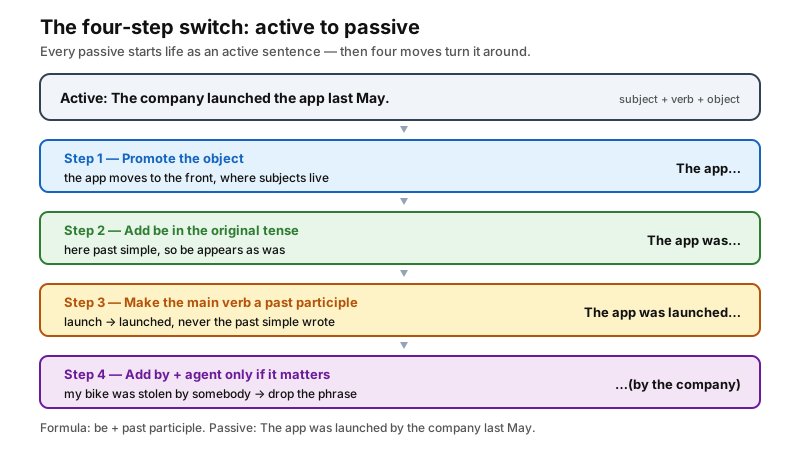
Every passive starts life as an active sentence. Take this one:
The company launched the app last May.
Four steps turn it around.
Step 1 — Promote the object. In the active sentence, the app is the direct object: it receives the action. Move it to the front, where subjects live: The app…
Step 2 — Add be in the original tense. Launched is past simple, so be appears as was.
Step 3 — Turn the main verb into its past participle. Launch becomes launched: The app was launched…
Step 4 — Add the old subject after by, but only if it still matters. Grammar calls the doer the agent, and agent + by forms a by-phrase: The app was launched by the company last May.
The entire machine rests on two parts: a form of be plus the past participle — the third form of the verb, exactly as dictionaries such as Oxford Learner's Dictionaries list it: write–wrote–written, launch–launched–launched. When either part slips, the structure collapses. I regularly see the room cleaned yesterday where the writer means the room was cleaned yesterday, or the report was wrote instead of was written.
Step 4 deserves its own warning, because it is where faithful students go wrong. Keep a by-phrase only when the agent carries real information:
- Hamlet was written by Shakespeare. (the name is the point)
- My bike was stolen last night. (nobody knows who; the sentence works perfectly without it)
My bike was stolen by somebody.(unnatural — drop the phrase)
When we practise transformations in lessons, this is the first habit to break: converting accurately but producing sentences no native speaker would ever say.
One Formula, Every Tense
Because be carries the tense, the passive travels through the whole tense system unchanged. Watch the same four-step switch run six times:
| Tense | Active | Passive |
|---|---|---|
| Present simple | Somebody cleans this office every evening. | This office is cleaned every evening. |
| Present continuous | They are repairing the bridge. | The bridge is being repaired. |
| Past simple | A falling branch hit the car. | The car was hit by a falling branch. |
| Present perfect | Someone has taken my umbrella. | My umbrella has been taken. |
| Future with will | They will announce the results on Friday. | The results will be announced on Friday. |
| Modal verb | Visitors must leave large bags at the entrance. | Large bags must be left at the entrance. |
Only be changes shape; the participle stays frozen. Questions are friendlier than they look, too, because only the be moves: Was the parcel delivered? Is this office cleaned at weekends? Master that one moving part and every row of the table follows.
Four Jobs the Passive Does Better
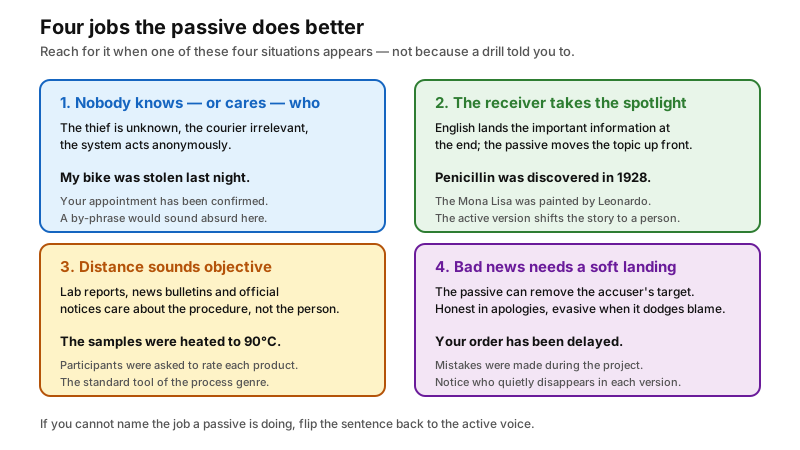
Form alone never justifies a choice — function does. Native speakers reach for the passive when one of four situations arises, and once you can name them, you will start predicting the passive before it even appears.
Job One: Nobody Knows — or Nobody Cares — Who Did It
Many actions have no available doer. The thief is unknown, the courier is irrelevant, the system acts anonymously, and forcing an agent would sound absurd:
- My bike was stolen last night.
- Our street is being dug up again.
- Your appointment has been confirmed.
In each case, the receiver of the action is the news. The passive lets you report it without inventing a cast of characters.
Job Two: The Receiver Deserves the Spotlight
English prefers to land the important information at the end of a sentence. When your topic is the thing done, the passive puts it up front and saves the agent — if you mention it at all — for the punchy final position:
- The Mona Lisa was painted by Leonardo da Vinci. (we are discussing the painting)
- Penicillin was discovered in 1928. (the discovery is the story)
Swap either one into the active voice — Leonardo da Vinci painted the Mona Lisa — and the spotlight shifts to Leonardo. Nothing becomes ungrammatical; the sentence simply becomes about a different person.
Job Three: Distance Makes Writing Sound Objective
Laboratory reports, official announcements, and news bulletins share a preference: the procedure matters more than the person performing it. The passive supplies that professional distance:
- The samples were heated to 90 degrees and then cooled slowly.
- Participants were asked to rate each product twice.
- A pedestrian was injured in the collision.
Science writing leans on this especially hard, because describing what happened to the samples reads as more neutral than describing what a scientist did to them. When you write up a process — a recipe, an experiment, a survey — the passive is the standard tool of the genre.
Job Four: Sometimes Blame Needs a Soft Landing
Spoken carefully, the passive can remove accusation from a sentence by removing the accuser's target:
- Your order has been delayed. (not: we delayed your order)
- Mistakes were made during the project.
- It has been decided that the office will close at noon on Friday.
Notice who disappears in each version: the delayer, the mistake-maker, the decider. That vanishing act can be evasive — mistakes were made is famous for dodging responsibility — but used honestly, it spares feelings in complaints, apologies, and awkward workplace news.
Two Objects, Two Possible Passives
Some verbs hand out two objects at once: give, send, offer, show, tell, lend, teach, pay. Look at the machinery in this sentence:
They offered Maria a promotion.
Maria is the indirect object (the person receiving), a promotion the direct object (the thing given). Either one can win the four-step promotion:
- Person as subject: Maria was offered a promotion.
- Thing as subject: A promotion was offered to Maria.
Both are correct, but the person-subject version is what native speakers overwhelmingly prefer, because English likes living things in the subject position and keeps the human focus intact. The same double play works throughout the family:
- Someone sent us a confusing email. → We were sent a confusing email. (preferred) / A confusing email was sent to us.
- The teacher gave the students extra time. → The students were given extra time. (preferred) / Extra time was given to the students.
Now the trap inside this trap: three common verbs — explain, describe, and suggest — refuse the person-subject passive entirely, even though learners reach for it constantly:
- The procedure was explained to the patients. (correct)
The patients were explained the procedure.(never)- The house was described to us in detail. (correct)
We were described the house.(never)
Here is a rule you can trust under exam pressure: when you are unsure whether a verb allows the person-subject passive, build the to-version instead. It is always grammatical, and it never leaves you stranded.
The Trap on the Other Side
One learner handed me an essay in which nearly every sentence hid its subject: it is believed…, it can be seen…, it was decided…. We read it aloud together, and by the third paragraph neither of us could answer the simplest question a reader asks — so who believes this? That essay was grammatically flawless and completely exhausting.
Passive overload thins out writing in three ways at once: sentences grow longer, agents vanish, and the energy drains away. Compare:
The experiment was conducted and the data was collected. Several patterns were identified. It was felt that further research was needed.
versus:
We conducted the experiment and collected the data ourselves. The results surprised us: participants responded faster than expected, so we recommend repeating the study with a larger group.
Same information, entirely different pulse. The second version lives because its verbs have owners. This matters doubly in timed exams: the publicly available IELTS writing criteria award marks for Grammatical Range and Accuracy together, which means variety pays nothing if it arrives wearing errors — and every unnecessary passive is one more chance for a be-form to disagree with its subject, one of the most common grammar mistakes in IELTS writing.
So set yourself a simple editorial filter. Write your draft mostly in the active voice, then keep a passive sentence only when it performs one of the four jobs above: unknown agent, deserved spotlight, objective distance, or softened blame. If you cannot point to the job a passive is doing, flip the sentence back. The reading-aloud test catches the rest — wherever who is doing this? matters and the sentence cannot answer, revise.
Your Turn: Ten Sentences That Want a New Voice
Rewrite each sentence in the passive, keeping a by-phrase only where the agent earns its place. Then compare with the key — and notice how few of the ten keep one.
- Someone has moved the meeting to Thursday.
- The council is repairing the bridge on Hill Road.
- They will publish the results in October.
- A courier delivered the parcel before noon.
- The technician must check the alarm every Friday.
- Someone stole three bikes from the station last week.
- The committee offered Dr Okafor the chair.
- The university sent all applicants a confirmation email.
- A fallen branch blocked the motorway for two hours.
- Someone had switched off the heating overnight.
Answer Key
- The meeting has been moved to Thursday. — nobody needs to know who moved it; a by-phrase adds nothing.
- The bridge on Hill Road is being repaired. — ongoing work, agent irrelevant.
- The results will be published in October. — announcement style, the deadline is the news.
- The parcel was delivered before noon (by a courier). — optional here: the courier adds a little detail, and the sentence still reads well without it.
- The alarm must be checked every Friday. — an instruction, with no individual inspector in mind.
- Three bikes were stolen from the station last week. — unknown thieves, so no by-phrase.
- Dr Okafor was offered the chair. (preferred) / The chair was offered to Dr Okafor. — the person-subject version is what native speakers choose.
- All applicants were sent a confirmation email. / A confirmation email was sent to all applicants.
- The motorway was blocked for two hours by a fallen branch. — this by-phrase earns its place: the branch explains what actually happened.
- The heating had been switched off overnight. — past perfect passive: had + been + participle.
That pattern — ten transformations, two by-phrases — is real English. The drill taught you the form; the choice belongs to the person writing.
The Pocket Card
Screenshot or copy this card; it compresses the whole system into eight rows.
| What you want to say | Form | Example |
|---|---|---|
| Nobody knows or cares who did it | be + past participle, no by-phrase | My bike was stolen. |
| The thing done is your topic | passive, by-phrase last if at all | The Mona Lisa was painted by Leonardo. |
| A report or procedure must sound neutral | passive throughout | The samples were heated to 90 degrees. |
| Bad news needs a soft landing | passive, agent removed | Your order has been delayed. |
| A person receives something | person as subject (preferred) | Maria was offered a promotion. |
| A thing receives something | thing as subject + to | A promotion was offered to Maria. |
| explain / describe / suggest | thing as subject + to only | The procedure was explained to the patients. |
| The tense changes | only be changes shape | is cleaned / was cleaned / has been cleaned / will be cleaned |
If you want the same one-pattern-at-a-time method for verb forms, work through all four conditionals next; the habit of naming the function before choosing the structure is exactly the same.
Quick Answers to Questions Learners Always Ask
Is the passive voice bad writing? Only when it has no job. Every style guide that says "avoid the passive" is really saying "avoid passive sentences that hide their subject for no reason" — the famous mistakes were made problem. A passive sentence that reports an unknown thief (my bike was stolen), keeps a topic in the spotlight (penicillin was discovered in 1928), or holds a procedure still (the samples were heated) is doing real work. Judge each sentence by the job it performs, not by the label attached to its grammar.
How do I decide whether to keep the by-phrase? Run the news test: does the agent tell the reader something they did not already know? Hamlet was written by Shakespeare keeps the name because the name is the point; my bike was stolen by somebody fails because somebody is empty. When the doer is unknown, obvious, or irrelevant, delete the phrase and the sentence gets stronger. In exams, an unnecessary by-phrase reads as padding rather than range.
Why is "we were explained the rules" wrong? Because explain, describe, and suggest cannot promote the person to the subject position, even though give, send, offer, tell, and teach can. We were given the rules is fine; we were explained the rules never is. The safe move under time pressure is to build the to-version — the rules were explained to us — which is grammatical with every one of these verbs. It costs you nothing and removes the whole decision.
Can I use the passive in IELTS Writing Task 2? Yes, and describing processes in Academic Task 1 almost requires it: the water is filtered, then heated, and finally stored in tanks is the natural register of a report. In Task 2, use it deliberately — for laws and policies (a fee should be introduced), for unknown actors (thousands of jobs have been lost), and for objective claims (it is widely accepted that) — then return to active verbs for your argument. Examiners reward control, so the danger is not the passive itself but a habit of leaning on it whenever a sentence feels difficult.
Two Voices, One Choice
Here is the view from the other side of all these drills: the passive was never an advanced accessory to wear for impressing examiners, and the active was never the "simple" voice you outgrow. They are two tools hanging side by side, and native speakers switch between them dozens of times a day without noticing — my bike was stolen at the police station, someone stole my bike when telling a friend. Fluency is not preferring one voice; it is knowing, sentence by sentence, which one the moment demands.
You already have everything you need to train that instinct. Sometime today, a passive sentence will cross your screen — a delivery notification, a headline, a museum plaque, an office announcement. Catch one, ask which of the four jobs it is doing, and notice how naturally it fits. Do that a few times this week and the passive stops being a transformation exercise from an old workbook and becomes what it is for everyone else: a quiet, precise choice you make on purpose.
Related Articles
⏱️ Present Simple vs Present Continuous: The Complete Guide
Stop guessing between present simple and present continuous — the window-and-dots model, stative verbs, signal words, and a 20-sentence check-up.
🕵️ Modal Verbs of Deduction: Must, Might, Could and Can't for Speculation
She must be stuck on the tram — the confidence dial, must's two obligation and conclusion jobs, modal + have + past participle, and ten sentences to re-dial.
✏️ The 5 Most Common Grammar Mistakes in IELTS Writing (That Are Ruining Your Band Score)
Identify and fix the most frequent grammar errors that hold back your IELTS Writing band score, from subject-verb agreement to article misuse.