🔀 All Four Conditionals Explained With Real-Life Examples
13 min read
2026-09-14
If I will see him is wrong — the distance-from-reality ladder for zero, first, second, third and mixed conditionals, with examples and practice.
EngSandbox Editorial Team
Written with AI assistance and reviewed by our editors — experienced PTE/IELTS tutors. Every article is fact-checked against official band descriptors, the Academic Word List and Cambridge assessment research, then field-tested with learners before publishing. Human reviewed + field tested. Questions? Contact us — see our Editorial Process.

If I will see him tomorrow, I will tell him.
Say that sentence aloud and it feels perfectly tidy: a future event, a future consequence. It is also wrong — wrong in exams, wrong in emails, wrong in every careful piece of English writing — because English refuses to put will inside the if-clause. The corrected version, If I see him tomorrow, I'll tell him, puzzles learners everywhere, and the confusion is not really about grammar. It is about what conditionals actually measure.
Here is the idea that changed how my students handle every conditional at once: English conditionals run on distance from reality, not position in time. Each step back in tense — present to past, past to past perfect — moves the situation further from what is real. Once you trust that principle, four separate grammar topics become one system viewed from four distances.
One Street Corner, Four Different Worlds
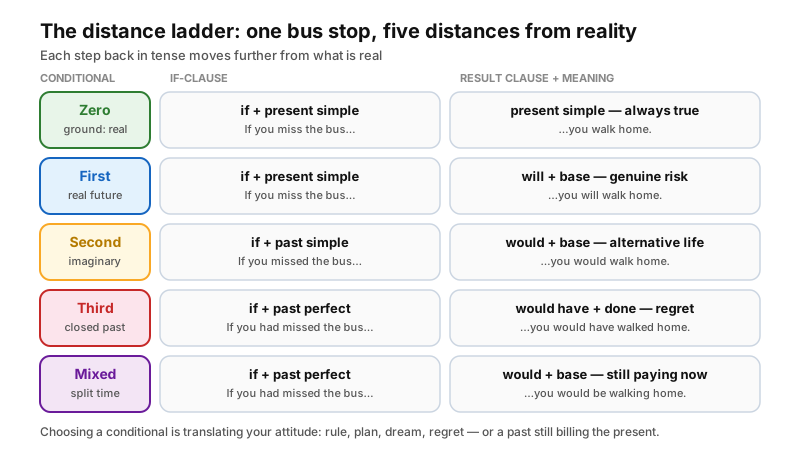
Watch what happens to a single situation — the last bus leaves at midnight, and you are running — when only the grammar changes:
| Conditional | If-clause | Result clause | What it means | Example |
|---|---|---|---|---|
| Zero | present simple | present simple | a rule that is true every time | If you miss the last bus, you walk home. |
| First | present simple | will + base verb | a real future possibility | If you miss the last bus, you'll walk home. |
| Second | past simple | would + base verb | an imaginary present or future | If you missed the last bus, you would walk home. |
| Third | past perfect | would have + past participle | a finished past that cannot change | If you had missed the last bus, you would have walked home. |
| Mixed | past perfect | would + base verb | a past cause with a present result | If you had missed the last bus, you would be walking home now. |
Same corner, same bus — four different worlds. The zero version states the law of your life. The first treats tonight as a genuine risk. The second plays an imaginary film. The third remembers a night when it actually happened. The mixed version stands in the present, still paying for that past mistake.
Call this the distance ladder. Present tense sits at ground level: facts and rules. Will reaches into a future we believe in. The past simple lifts us into imagination, which is why If I lived in Lisbon says nothing about the past — it describes a present that isn't true. The past perfect climbs to the highest rung: a past that closed without us. Choosing a conditional, then, is simply translating your attitude toward the situation.
Two mechanical details before we climb. When the if-clause comes first, separate it with a comma: If you hurry, you'll catch it. Reverse the order and the comma disappears: You'll catch it if you hurry.
Zero Conditional: Rules That Never Blink
The zero conditional — if + present simple, present simple — describes things that happen every single time: scientific truths, personal laws, workplace policies. There is no risk, no hope, no regret involved, because the outcome is never in doubt.
- If you press this button, the alarm goes off.
- If the hostel includes breakfast, we eat before setting off.
- If my phone drops below twenty percent, the battery-saver mode switches on automatically.
- If a client cancels less than a day ahead, we charge a cancellation fee.
A quick test I use in lessons: try replacing if with when. When you press this button, the alarm goes off survives intact, because the event repeats reliably. If the swap makes the sentence strange, you are probably dealing with a first or second conditional instead. Notice, too, how useful the zero conditional is for sounding calm and professional — instructions, FAQs, and house rules almost always live on this bottom rung.
First Conditional: Plans With Real Stakes
Climb one rung and the future opens up. The first conditional — if + present simple, will + base verb — makes an honest forecast about a real possibility. This is the grammar of bookings, deadlines, promises, and warnings, and it is probably the conditional you need most in ordinary life.
- If my visa arrives this week, I'll book the flight for March.
- If the embassy delays it, I'll push the trip back to April.
- If you don't check in online, you'll pay extra at the desk.
The result clause does not have to use will, as long as the meaning stays real and future-shaped:
- If the morning flight is full, we can take the afternoon one.
- If the gate changes, listen for the announcement.
That last pair matters more than it looks. Learners often believe the first conditional is a rigid formula, when really it is a relationship between a real condition and any reasonable result — ability, permission, advice included. One partner deserves special mention: unless, which means if... not. Unless you check in online, you'll pay extra at the desk compresses a warning into three words — but never stack it with another negative, because unless you don't check in reverses your meaning entirely.
Second Conditional: The Life Running Next Door
The second conditional — if + past simple, would + base verb — describes imaginary or highly unlikely presents and futures. Remember the ladder: the past simple here is not telling you the time; it is telling you the distance. Nothing has happened yet. You are watching an alternative life from the outside.
- If I spoke Portuguese, I would sort out the rental contract myself.
- If rent were cheaper, we would move closer to the coast.
- If I won the lottery next week, I would still finish my degree.
This rung covers a wide range of attitudes, from nearly possible to flatly impossible, and the grammar stays identical: If I won the lottery next week imagines an unlikely future, while If I were taller, I would reach the top shelf without a chair contradicts a permanent present fact. Both belong here.
The second conditional is also the engine of advice, which brings us to the most famous conditional phrase in English: If I were you.
- If I were you, I'd buy the refundable ticket.
- If I were in your position, I would call the bank today.
Why were instead of was? Because the situation is imaginary, English keeps the older subjunctive form — one of the few places it survives in daily speech. In conversation you will hear If I was you often enough, but in writing, exams, and anywhere a native reader judges care, choose were. It costs you nothing and it never looks wrong. Advice conditionals like this one also earn easy marks in Task 2 essays — see the foolproof 4-paragraph essay structure for Band 7 for exactly where to place them.
Third Conditional: The Museum of Might-Have-Been
At the top of the ladder sits the third conditional — if + past perfect, would have + past participle. Its territory is the finished past: events that did not happen, and consequences that never arrived. We visit it for regrets, explanations, blame, and occasionally relief.
- If I had booked in May, I would have paid half that fare.
- If we hadn't missed the connection, we would have arrived before the ceremony.
- If you hadn't checked the timetable, we would have wasted the whole morning.
Swap would have for could have or might have and the regret gains nuance: If we had left sooner, we could have caught the midday ferry — ability lost; might have caught — possibility lost. The structure holds; only the attitude changes.
In fast speech, had and would shrink until sentences nearly collapse: If I'd known, I'd have told you. Train your ear to hear those little 'ds, because they carry the entire meaning. And when you write, spell them out — had known, would have told — never would of, which is purely a mishearing of the contracted form. The same fix-one-pattern-at-a-time habit sorts most of the most common grammar mistakes in IELTS writing: hunt a single error type per pass.
Mixed Conditionals: When Cause and Result Live in Different Times
Real life rarely keeps its causes and consequences in one tidy time zone. Sometimes the cause happened years ago and the damage is ongoing; sometimes the weakness is present and the loss already behind you. Mixed conditionals let each clause take the grammar of its own moment.
Pattern one — past cause, present result: past perfect in the if-clause, would + base verb in the result.
- If I had started saving last year, I wouldn't be worrying about the deposit now.
Pattern two — present cause, past result: past simple in the if-clause, would have + past participle in the result.
- If I weren't afraid of flying, I would have visited my sister in Australia long ago.
The diagnostic question is always the same: when does the result live? Match the if-clause to the time of the cause, match the result clause to the time of the effect, and you can build any mixture the situation demands. Crossing the rows on purpose is advanced English; crossing them by accident is the error waiting in the next section.
Six Expressions You Can Borrow Whole
Most conditionals you assemble word by word, but a few arrive pre-built, worn smooth by centuries of use. These are worth learning as complete units — they are the exception to the usual advice that memorising systems beats memorising sentences.
- If I were you, I'd... — the standard opener for advice: If I were you, I'd delete that comment.
- If all else fails,... — the last resort: If all else fails, restart the router.
- If need be,... — formal but alive: If need be, we can sleep at the airport.
- If it hadn't been for..., ... would still... — gratitude with a third-conditional spine: If it hadn't been for your map, we would still be lost.
- What if...? — a first-conditional question in disguise: What if it rains on Saturday?
- Even if... — concedes a hypothetical and refuses it: Even if it rains, the match will go ahead.
That last one earns its place through a frequent mix-up. Even if it rains, the match will go ahead means the rain is hypothetical and powerless either way. Compare Even though it rained, the match went ahead, where the rain actually fell and the match survived anyway. Even if imagines; even though reports. Choosing between them tells your listener whether you are discussing weather forecasts or yesterday's storm.
Will Never Lives Inside the If-Clause
Now back to the sentence that opened this article, because the mistake it contains deserves its own spotlight. The rule is blunt: will and would belong in the result clause, never in the if-clause. The condition must stay tense-simple; only the consequence carries the future or the hypothesis.
- ✗ If I will see him, I'll tell him. → ✓ If I see him, I'll tell him.
- ✗ If I would have known, I would have called. → ✓ If I had known, I would have called.
The second pair is worth dwelling on, because if I would have known slips into casual speech constantly — and straight onto examiner red pens just as fast. Whatever the surrounding sentence does, the if-clause itself steps back: past simple for the second conditional, past perfect for the third. Nothing else lives there.
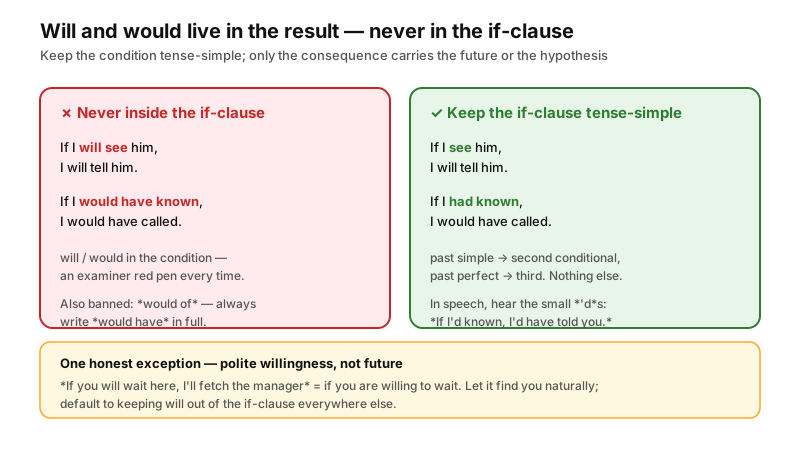
One honest exception exists, and you will meet it in hotels and airports: If you will wait here, I'll fetch the manager. Here will does not point at the future; it politely asks for willingness — if you are willing to wait. Since the polite reading depends entirely on context, my advice to learners is simple: default to keeping will out of the if-clause, and let the exception find you naturally.
Rewrite Practice: Six Situations, Six Conditionals
Reading about conditionals builds recognition; building them yourself builds fluency. Below are six everyday cues. Cover the answers, decide which distance each situation demands, and construct the sentence before you look.
- State a kitchen law: milk left out of the fridge always spoils.
- Warn a friend sprinting for the last train.
- Imagine a language skill you do not have and the job it might bring.
- You stayed silent in a meeting because you came unprepared. Explain the cost.
- You skipped lunch at noon and you are starving right now.
- Advise a friend who has just posted an angry comment.
Compare yours with these:
- If you leave milk out of the fridge, it goes off. (zero — true every time)
- If you don't run now, you'll miss the train. (first — real and imminent)
- If I spoke Japanese, I would apply for the Tokyo office. (second — imaginary present)
- If I had prepared properly, I would have contributed to the discussion. (third — unchangeable past)
- If I had eaten lunch, I wouldn't be so hungry now. (mixed — past cause, present result)
- If I were you, I would delete it. (second — advice through were)
Score yourself generously on wording — many correct versions exist — but strictly on structure: did each if-clause land on the right rung of the ladder?
A Ten-Minute Evening Routine That Sticks
Conditionals fade without contact, so give them ninety seconds a day rather than a marathon once a month. The same logic runs through how to build a 3-month study plan — short daily reps inside a longer plan beat last-minute grammar marathons every time. Each evening, write two lines about your real life: one true first conditional about tomorrow — If the parcel arrives, I'll collect it after work — and yesterday's single biggest annoyance rewritten as a third conditional. Naming the regret in perfect grammar is strangely satisfying, and it retires the feeling along with the sentence.
On weekends, extend the routine. Add one second conditional about the life you are considering, and deliver yourself one piece of advice starting If I were you... — spoken aloud, because advice you hear tends to land harder than advice you read. Once a week, hunt for conditionals in the wild: signs, FAQ pages, app notifications. Every If you forget your password... you spot is the ladder working in public.
Do this for a month and something quiet shifts: you stop translating conditionals word by word and start reaching for them the way you reach for tenses — by feel. The four distances become four familiar rooms, and you will know exactly which door to open: making a plan, issuing a warning, nursing a regret, or imagining the life next door.
Quick Answers to Questions Learners Always Ask
Can I ever put will inside the if-clause? Almost never. Keep the condition tense-simple and let the result carry the future: If I see him, I'll tell him. The only everyday exception is polite willingness — If you will wait here, I'll fetch the manager — where will requests cooperation, not the future.
How do I choose between the second and third conditional? Ask when the situation lives. An imaginary present or future takes the second conditional (If I spoke Portuguese, I would sort it out myself). A finished, unchangeable past takes the third (If I had booked in May, I would have paid half).
When do I actually need a mixed conditional? When the cause and the result live in different times. A past cause with a present result pairs the past perfect with would + base verb: If I had eaten lunch, I wouldn't be so hungry now. Match each clause to the time of its own half and the mixture builds itself.
What is the difference between even if and even though? Even if imagines a hypothetical that changes nothing: Even if it rains, the match will go ahead. Even though reports a real past that changed nothing: Even though it rained, the match went ahead. Forecast versus report.
Related Articles
⏱️ Present Simple vs Present Continuous: The Complete Guide
Stop guessing between present simple and present continuous — the window-and-dots model, stative verbs, signal words, and a 20-sentence check-up.
✏️ The 5 Most Common Grammar Mistakes in IELTS Writing (That Are Ruining Your Band Score)
Identify and fix the most frequent grammar errors that hold back your IELTS Writing band score, from subject-verb agreement to article misuse.
✍️ IELTS Writing Task 2: The Foolproof 4-Paragraph Essay Structure for a Band 7+
Master the IELTS Writing Task 2 with a simple, foolproof 4-paragraph essay structure. Learn how to plan, write, and polish your essay for a Band 7 or higher.