⏱️ Present Simple vs Present Continuous: The Complete Guide
12 min read
2026-09-10
Stop guessing between present simple and present continuous — the window-and-dots model, stative verbs, signal words, and a 20-sentence check-up.
EngSandbox Editorial Team
Written with AI assistance and reviewed by our editors — experienced PTE/IELTS tutors. Every article is fact-checked against official band descriptors, the Academic Word List and Cambridge assessment research, then field-tested with learners before publishing. Human reviewed + field tested. Questions? Contact us — see our Editorial Process.

In a March IELTS Writing mock, a Band 6.5 candidate described a Porto holiday in three sentences — and put every verb on the wrong side of the present simple / present continuous border:
Hello from Porto! This week I stay in a guesthouse by the river. Every morning I am drinking a coffee at the same little café, and right now I watch the boats go past. I love this city!
Nothing there breaks basic grammar rules, yet a native reader flinches three times. The writer made three tense decisions, and all three landed on the wrong side of the present simple / present continuous border. We will come back and repair that message together, but first we need to see the border itself clearly — because once you can draw it, you stop guessing.
The Window and the Dots: How Each Tense Draws Time
When we work on this in lessons, I ask learners to stop thinking about "present" as one place on the map and start thinking about two shapes of time.
The present continuous draws a window: an action that started before now, is still open, and will close later.
PAST ───────────[▒▒▒▒ NOW ▒▒▒▒]──────────► FUTURE
            action unfolding around this moment
I am reading a novel about Lisbon. — The reading began recently and is not finished; right now, mid-page, it is happening.
The present simple draws dots across a wide stretch of time: habits, routines, and facts that stay true whether or not you are doing them at this exact second.
PAST ──●────●────●────●────●──► FUTURE
    repeated actions / standing facts
I read novels on trains. — Not at this moment, perhaps, but whenever the situation appears, this is what I do.
Here is the reframe that fixes most confusion: the simple is not "less present" than the continuous. It is present in a wider sense — it describes your whole life, your schedule, your permanent reality. The continuous narrows the lens to this moment or this season. Neither tense is about distance from now; they are about the shape of what you are describing.

Reading the Signals: Helpful Words and Tricky Words
Certain words lean hard toward one tense, and spotting them turns a guessing game into a checklist.
| Signal word / phrase | Usual partner | Example |
|---|---|---|
| usually, often, rarely, never | Present simple | She rarely checks social media before noon. |
| every day, once a week, on Fridays | Present simple | We close the office early on Fridays. |
| right now, at the moment, currently | Present continuous | He is reviewing his notes at the moment. |
| today, this week, this term | Present continuous (temporary) | I am taking the bus this week because of the strike. |
| these days | Present continuous (trend) | More people are commuting by bike these days. |
Two cautions before you trust the table completely. First, signal words are strong hints, not laws — "Look!" and "Listen!" also announce actions in progress (Listen — the kettle is whistling). Second, some words play for both teams, and always is the famous one.
When "always" means "and it annoys me"
Compare these two perfectly correct sentences:
- My brother always borrows my charger. — A neutral statement of habit.
- My brother is always borrowing my charger! — The same habit, now wrapped in irritation.
With the continuous, always exaggerates: he does it constantly, endlessly, and frankly I've had enough. When I rehearse dialogues with students, we practise putting the annoyance into the voice — the grammar carries the complaint, but the tone seals it. The same trick colours other frequency words: He's forever losing his keys paints a hapless character far more vividly than He forever loses his keys.
These days deserves a final word, because learners often miss its flavour. It never describes a permanent fact; it frames a chapter — a habit that is new, changing, or expected to end. I'm getting up earlier these days quietly tells your listener: this is recent, and I'm not promising it lasts.
Why Your Instinct Keeps Reaching for -ing
In my experience, the single most common tense error intermediate learners ship is not a missing article or a dropped -s — it is stretching the continuous over sentences that call for the simple: I am agreeing with you, This soup is tasting salty, She is having a car. Three forces push you there.
First, many first languages handle every present meaning with a single verb form, so English's split feels arbitrary — your ear has no anchor for it. Second, coursebooks usually introduce the continuous with lively pictures of running, cooking, and dancing, which quietly teaches that -ing is the "real, active present" and everything else is second-rate. Third, spoken English leans heavily on the continuous, so you hear it constantly and copy the surface pattern without checking the conditions.
The antidote is a two-question filter. Before choosing, ask:
- Am I describing a routine, general truth, or standing situation? If yes → simple.
- Am I describing something unfinished around now, or a temporary arrangement? If yes → continuous.
Test the filter against three sentences:
- Water boils at 100 degrees Celsius. — Routine? No. General truth? Yes → simple. ✓
- She speaks four languages. — Standing fact about her → simple. ✓
- I'm staying with friends until I find a flat. — Unfinished and temporary → continuous. ✓
Notice that the third sentence passes question 2 even though it describes weeks, not seconds. "Around now" stretches comfortably across a season — the window stays open as long as the situation does.
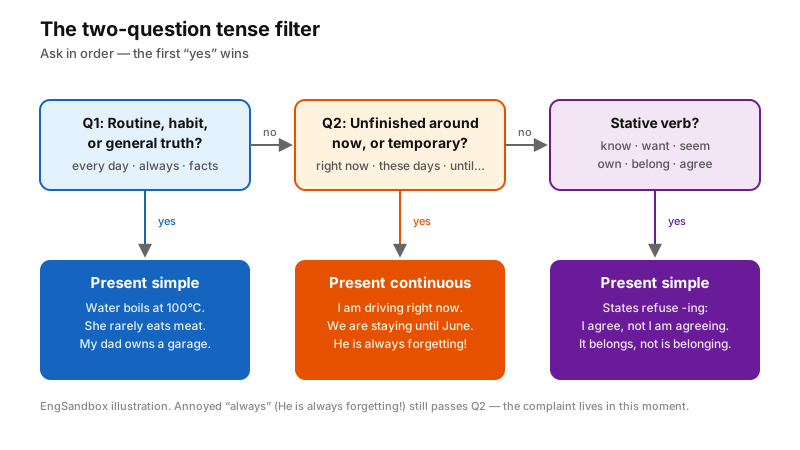
Stative Verbs: The Verbs That Refuse -ing
Some verbs describe things that do not unfold — they simply exist. Thoughts, emotions, senses, possessions, measurements. These stative verbs almost always reject the continuous, no matter how "now" the sentence feels:
I am believing you.→ I believe you.She is owning two apartments.→ She owns two apartments.What is this word meaning?→ What does this word mean?
A compact starter set covers most everyday mistakes: know, believe, understand, remember, mean, want, need, prefer, love, own, belong, seem. If you ever doubt a specific verb, the grammar reference on the British Council's LearnEnglish site keeps a fuller list — though honestly, these twelve resolve the vast majority of errors I mark. Perception verbs belong here too: you hear music upstairs, you don't are hearing it.
Watch out for one learner trap in particular: I am agree with you. Agree is stative, and the sentence must run I agree with you — yet I have corrected this exact slip hundreds of times, because many languages build the equivalent phrase with a helper verb that looks continuous-shaped. It sits near the top of the most common grammar mistakes I mark in IELTS writing, alongside dropped articles and missing third-person -s. If this one trips you, write I agree at the top of your notebook until your hand trusts it.
Then there are the double agents — verbs that live two lives depending on meaning:
| Verb | State → simple | Activity → continuous |
|---|---|---|
| think | Opinion: I think this plan works. | Deliberating: I'm thinking about changing jobs. |
| have | Possession: She has a small garden. | Experience: We're having dinner. |
| taste | Flavour: The soup tastes too salty. | Testing: The chef is tasting the soup again. |
| smell | Giving off odour: The kitchen smells wonderful. | Sniffing: She's smelling the fresh basil. |
The logic underneath the chaos is consistent: if the verb reports a condition, use the simple; if it reports an action someone performs, the continuous unlocks. The soup tastes salty describes the soup; the chef is tasting the soup describes the chef.
Temporary Chapters, Permanent Truths: Two Versions of "Live"
The same verb can wear either tense, and the choice tells your listener whether a situation is furniture or a visit.
-
I live in Warsaw. — Home base, no endpoint in view.
-
For the next six months I'm living in Kraków. — A chapter with a closing date.
-
He works in marketing. — His professional identity.
-
He's working at his cousin's bakery this winter. — A detour, not a destination.
Here is the practical rule I give students: bolt on a time container — this month, for a few weeks, these days, until Friday — and the continuous snaps into place, because containers imply an exit. Remove the container, and the simple asserts permanence. Compare They're building a new library on Elm Street with My parents live in Naples: the building site is temporary by nature, your parents' address is permanent by implication — and both statements remain true right now, even though nobody is pouring concrete at this second.
This is also why the opening message felt wrong. "This week I stay" announced a container (this week) but chose the permanent-tense verb. "Every morning I am drinking" took a routine marker and stretched it into a window. And "right now I watch" pointed at the exact moment the lens should widen. Same city, same coffee — three mismatched shapes of time. Corrected, it reads:
Hello from Porto! This week I'm staying in a guesthouse by the river. Every morning I drink a coffee at the same little café, and right now I'm watching the boats go past. I love this city!
Notice the last sentence never needed rescuing: love is stative, so the simple was right all along.
Your Turn: A 20-Sentence Check-Up
Fill each gap with the correct form of the verb in brackets. Answers with explanations follow below the divider — no peeking until you have committed to all twenty.
- Listen! The neighbours next door ______ (argue) again.
- My sister ______ (speak) four languages fluently.
- Shh! The baby ______ (sleep).
- Water ______ (boil) at a lower temperature at high altitude.
- I ______ (not / understand) this exercise at all.
- ______ you ______ (believe) in ghosts?
- These days, more and more people ______ (work) from home.
- The museum ______ (open) at ten every morning.
- I can't talk right now — I ______ (drive)!
- My uncle ______ (own) three vintage motorcycles.
- We ______ (stay) with my grandparents until our new flat is ready.
- My grandmother ______ (rarely / eat) meat.
- Why ______ you ______ (wear) a coat indoors?
- This jacket ______ (belong) to my brother.
- Look at the sky — it ______ (rain) again!
- I ______ (think) you're right about the traffic.
- Quiet please — everyone ______ (take) the exam at the moment.
- My dad ______ (always / forget) his keys — it drives me crazy!
- They ______ (build) a new library in our town this year.
- I ______ (prefer) tea to coffee, honestly.
Answers, With Reasons
- are arguing — "Listen!" announces an action unfolding as you speak.
- speaks — A standing ability, not a current activity.
- is sleeping — In progress at this very moment.
- boils — Scientific facts take the simple.
- don't understand — Understand is stative; states refuse -ing.
- Do … believe — Beliefs are states, however timeless the question sounds.
- are working — These days marks a temporary trend, not a permanent fact.
- opens — A fixed daily routine; schedules live in the simple.
- am driving — An unfinished action that explains why conversation must wait.
- owns — Possession is a classic state.
- are staying — Temporary accommodation with a built-in endpoint (until…).
- rarely eats — Frequency adverbs pair with the simple.
- are … wearing — Behaviour visible and in progress right now.
- belongs — Belonging is stative, always.
- is raining — Weather happening before your eyes.
- think — Here think means "my opinion is"; I'm thinking would mean "I'm deliberating".
- is taking — Everyone takes a singular verb, and the action is in progress.
- is always forgetting — The trailing complaint (it drives me crazy) demands annoyed-always.
- are building — An ongoing project, unfinished by definition.
- prefer — Preferences are states; the simple stands firm.
Scoring yourself: sixteen or more suggests the border is becoming automatic. Between twelve and fifteen, revisit the two-question filter and the stative list above. Below twelve is genuinely useful information — it means you should walk back through the window-and-dots section slowly, because everything else builds on that shape.
A Five-Minute Plan for Busy Weeks
You do not need an hour of grammar drills to make this stick. You need small, honest repetitions woven into texts you were writing anyway. If you want the bigger picture, build a 3-month study plan around reps like these rather than cramming grammar the week before the exam.
Daily: rewrite one line. Open any message or post you wrote in English today, pick one sentence, and say it aloud twice — once as a general habit, once as right-now. I send invoices on Mondays versus I'm sending the invoice right now. Feel which details shift: the time marker, the object, the mood. Thirty seconds, twice a day, teaches the contrast faster than any worksheet.
Twice a week: run a signal hunt. Take anything from your daily reading habit — a news app, subtitles, a recipe — and underline every signal word you meet: usually, right now, these days, always, at the moment. Label the surrounding verb S or C. Within a couple of sittings, you start predicting the tense before you see the verb.
Sunday: reread your week. Skim the sentences you rewrote and marked. Most learners discover their errors cluster around one or two favourite situations — often temporary arrangements or stative verbs — and knowing your pattern beats studying the whole grammar book again. Steady five-minute reps like these are exactly how learners who practise consistently tend to turn a shaky tense choice into an instinct — and one quiet Sunday soon, that Porto message would come out right on the first try.
Related Articles
✏️ The 5 Most Common Grammar Mistakes in IELTS Writing (That Are Ruining Your Band Score)
Identify and fix the most frequent grammar errors that hold back your IELTS Writing band score, from subject-verb agreement to article misuse.
📖 The Benefits of Daily Reading for Language Acquisition
Discover how a simple daily reading habit can dramatically improve your vocabulary, comprehension, and overall English proficiency.
📚 How to Build a 3-Month Study Plan for PTE or IELTS (From Beginner to Exam-Ready)
A complete, step-by-step guide to creating a 3-month study plan for PTE or IELTS, from diagnostic test to exam day. Includes backward planning, skill-building, mock exams, and mindset strategies.