📖 The Benefits of Daily Reading for Language Acquisition
12 min read
2026-08-27
Discover how a simple daily reading habit can dramatically improve your vocabulary, comprehension, and overall English proficiency.
EngSandbox Editorial Team
Written with AI assistance and reviewed by our editors — experienced PTE/IELTS tutors. Every article is fact-checked against official band descriptors, the Academic Word List and Cambridge assessment research, then field-tested with learners before publishing. Human reviewed + field tested. Questions? Contact us — see our Editorial Process.

Reading is one of the most effective ways to improve your English skills. When you read every day, you expose yourself to correct sentence structures, new vocabulary, and different writing styles. This natural exposure helps you internalise the language without actively memorising grammar rules.
Last term, one of my learners — a nursing student preparing for IELTS 7.0 — tracked her practice carefully. She spent 45 minutes daily on grammar drills for three weeks and gained 12 new words she could actually use. Frustrated, we switched her to 20 minutes of graded reading each morning plus a 5-minute summary note. In the next three weeks she logged 68 usable new words, and her writing coherence band moved from 6.0 to 6.5. Nothing else changed. The switch from studying English to using English through reading made the difference. This guide explains why that happens, what the research says, and how to build a 15-minute system that survives a busy week.
Why Daily Reading Matters
Many language learners focus too much on grammar exercises and vocabulary lists. While these have their place, they should not replace the habit of reading real texts. Reading provides context. When you see a word used in a sentence, you understand not just its meaning but also its collocations, register, and grammatical behaviour.
For example, you can memorise suggest = "to propose an idea", but only reading shows you the pattern: suggest that he study (not suggest him to study), suggest doing something, make a suggestion. One encounter in context teaches you the word plus its grammar glue.
One of the greatest benefits of daily reading is vocabulary acquisition. Research suggests that we learn most new words through context rather than direct instruction. When you encounter a word multiple times in different contexts, you gradually build a rich understanding of its usage. This is far more effective than memorising word lists. A single reading session can expose you to dozens of new words and phrases, and repeated exposure over time ensures they stick.
Daily reading also trains your eye for sentence rhythm. You start to feel when an article is missing (go to hospital vs go to the hospital) or when a tense is wrong, not because you recited a rule but because the correct form looks familiar.
What the Research Actually Says
Extensive reading — reading a lot of level-appropriate material for general understanding — is one of the most replicated findings in second-language acquisition. Two lines of research matter for you.
1. Vocabulary growth needs volume plus repetition. Nation and Waring (1997) and later Webb and Nation (2017) estimate learners need 8-12 encounters with a word in varied contexts to retain it for productive use. A single word-list exposure gives you one encounter. One graded reader chapter can give you four or five, spaced naturally.
2. Quantity predicts gains. In a meta-analysis of extensive reading programs (Jeon & Day, 2016), learners who read at least 30 minutes daily over 12 weeks gained significantly more in reading comprehension and vocabulary than groups doing only intensive textbook work, even when total study time was equal.
The practical takeaway is not that reading is magic, but that it multiplies encounters per minute of study. The table below translates research averages into a weekly horizon for an intermediate learner (B1-B2).
| Daily reading | New word forms met per week* | Estimated words retained for use per week** | Typical time to notice comprehension gain |
|---|---|---|---|
| 10 min (1,500 words) | 18-25 | 4-6 | 6-8 weeks |
| 15-20 min (2,500-3,500 words) | 35-50 | 8-12 | 3-4 weeks |
| 30 min (5,000+ words) | 60-90 | 12-18 | 2-3 weeks |
*Meeting a form includes seeing it in a new sentence. **Retained = you can recall and use it a week later without prompting, assuming you keep a review notebook (see system below).
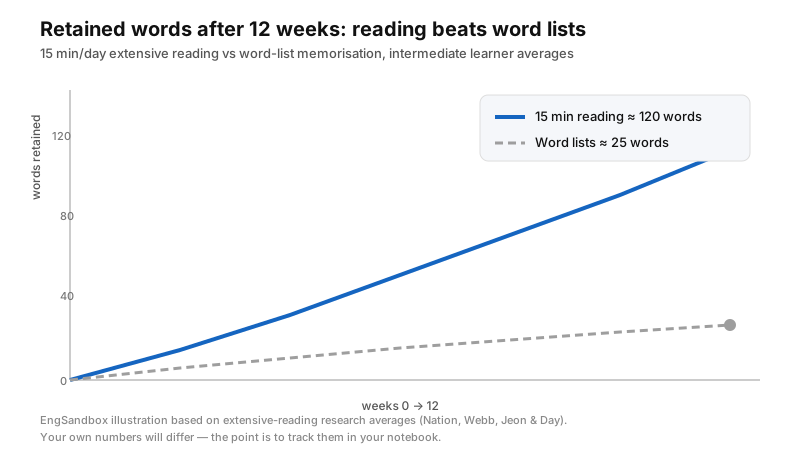
15 minutes of daily reading compounds to roughly 120 retained words in 12 weeks, against about 25 from word lists alone.
You do not need a citation to trust this — test it for two weeks with a notebook and compare your own retained count to any word-list week you have logged.
Sharper Writing, Better Comprehension
Reading also improves your writing skills. As you read more, you subconsciously absorb sentence structures, transition phrases, and organisational patterns. Students who read regularly tend to write more coherent and sophisticated essays. This is particularly important for PTE and IELTS test takers, where writing tasks require clear organisation and appropriate language use.
Look at this before/after from a learner's Task 2 paragraph:
Before (after only grammar study):
"I think technology is good. It helps people to communicate. People can use technology to learn new things. Technology is important for modern life."
After 4 weeks of 15-minute daily reading + summary notes:
"While technology clearly helps people stay connected, its greatest value for learners is access: a student in a rural town can now attend the same lecture as one in a capital city, pause it, and review a difficult sentence until it clicks."
The grammar is not dramatically more complex. The organisation is — a concession clause (While...), a colon for explanation, and a concrete example. That structure was borrowed, not drilled, from repeated exposure to opinion paragraphs.
Comprehension is another area that benefits enormously from regular reading. The more you read, the better you become at understanding main ideas, identifying supporting details, and inferring meaning from context. These are exactly the skills tested in reading comprehension sections of standardised English exams.
There is also a strong connection between reading and listening skills. When you read, you build a mental model of how sentences are structured. This helps you parse spoken language more effectively because your brain becomes better at predicting what comes next in a sentence. Many learners find that their listening comprehension improves noticeably after establishing a consistent reading habit, especially with sentence stress and intonation patterns you first meet on the page and later hear in speech.
Choosing the Right Materials: A Tiered Ladder
For beginners, it is important to choose appropriate materials. Graded readers are an excellent starting point. These are books written specifically for language learners, with controlled vocabulary and simpler sentence structures. As your skills improve, you can gradually move to authentic materials like news articles, blogs, and eventually novels and academic texts. The rule is simple: you should understand at least 95-98% of words on a page without a dictionary. If you are stopping every second line, the level is too high; if you understand everything effortlessly, the level is too low.
Do not worry if you encounter unfamiliar words. The key is to keep reading for general understanding rather than stopping to look up every unknown word. Try to infer meaning from context first. Only look up words that appear frequently or seem essential to understanding the main idea. This approach builds your guessing skills, which are crucial for exam contexts where dictionary use is not permitted.
The Reading Ladder by Level
| Your level | What to read (examples) | Why it fits | Free source |
|---|---|---|---|
| A2 (Elementary) | Oxford Bookworms Stage 1, Penguin Readers Level 2: The Railway Children, News For Kids | 600-1,000 headwords, short chapters, illustration support | Oxford Bookworms sample library, BBC Learning English Story |
| B1 (Intermediate) | Bookworms Stage 3-4: The Hound of the Baskervilles adaptation, BBC Future short features | 1,200-1,700 headwords, real discourse markers, 1,500-2,500 word articles | BBC Future, BreakingNewsEnglish.com Level 3 |
| B2 (Upper-Int.) | Penguin Readers Level 5, The Guardian Long Read abridged, VOA Learning English | 2,500-3,500 headwords, academic collocations emerging | VOA Learning English, Aeon.co essays |
| C1 (Advanced) | Unadapted The Economist, Nature News, Academic Word List essays | Full academic register, low-frequency collocations | The Conversation, university open-access articles |
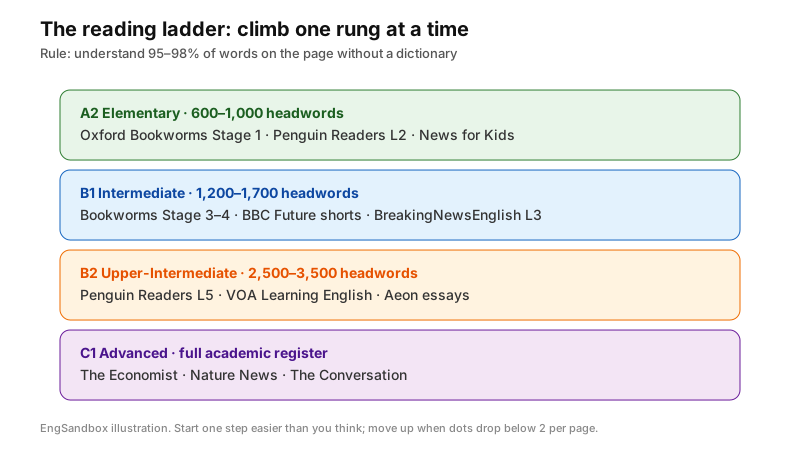
Climb one rung at a time: A2 graded readers up to C1 unadapted press. Stay where you understand 95-98% without a dictionary.
If you are unsure of your level, start one step easier than you think. Finishing a text with confidence teaches more than abandoning a harder one. You can also rotate topics you love — see 50 Phrasal Verbs for Everyday English for topic-based vocabulary you will meet naturally in stories about work, travel, and relationships, and 100 Academic Words Every University Student Must Know for the academic layer you will need at B2+.
A 15-Minute Daily System That Sticks
Consistency matters more than volume. Reading for just fifteen to twenty minutes every day is more effective than reading for two hours once a week. Daily reading keeps the language fresh in your mind and builds a habit that becomes easier to maintain over time. Consider setting a specific time for reading each day, such as during breakfast or before bed, to help establish the routine.
Here is the system my learners actually maintain past week three. It is built for a phone, a notebook, and a busy schedule.
The 15-Minute Block
- 0:00-12:00 Read: Set a timer. No dictionary, no highlighting. Mark unknown words with a light pencil dot in the margin.
- 12:00-15:00 Summarise: Close the text. In your notebook write 2-3 sentences in your own words: What happened / What was the argument / One sentence I liked. Add max 3 words you dotted that seem reusable (with the sentence you saw, not just the translation).
This is also how to keep a vocabulary notebook that actually works — the notebook becomes a retrieval tool, not a warehouse. Store the sentence, not the isolated word.
Weekly Timetable (Copy This)
| Day | Focus | Material example | 3-min note prompt |
|---|---|---|---|
| Mon | Habit anchor | Graded reader ch. 1 (B1) | What does the main character want? |
| Tue | Same book cont. | Graded reader ch. 2 | What changed since yesterday? |
| Wed | Variety: article | BBC Future 800w | Author's main claim in one sentence |
| Thu | Same article re-read | Same as Wed, no dots | One collocation I now remember |
| Fri | Free choice | Your hobby: recipe / tech blog / story | Why I chose this |
| Sat | Academic stretch | VOA Learning English | One sentence with an AWL word |
| Sun | Review only (5 min) | Notebook flip | Use 3 old words in new sentences aloud |
Setup to make it stick:
- Put the book/article link on your home screen and the notebook by the kettle/bed. Friction kills streaks.
- Track with a simple calendar X, not an app. Aim for 5/7 days first, then 6/7.
- If you miss a day, make the next day 5 minutes only — shrinking beats skipping.
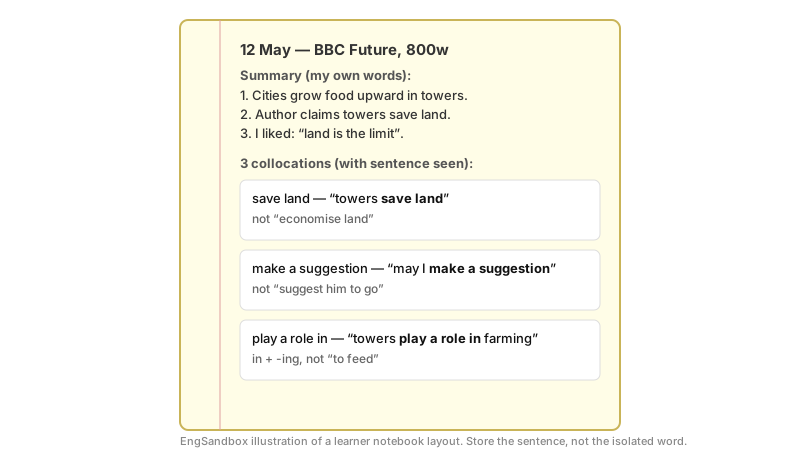
A notebook layout that works: 3-sentence summary plus 3 collocations stored with the sentence you saw.
Choosing materials that genuinely interest you is crucial for maintaining motivation. If you enjoy cooking, read recipes and food blogs. If you are interested in technology, follow tech news sites. If you enjoy stories, start with short stories or simplified novels. When you read about topics you genuinely care about, the language learning happens almost effortlessly because you are focused on the content rather than the mechanics of language.
Common Pitfalls & Fixes
1. Looking up every unknown word. You break flow and remember less. Fix: Dot, finish the page, then look up only words that appear twice or block your summary. Infer first — that guessing skill is directly tested in IELTS Reading True/False/Not Given.
2. Material too hard (or too easy) and no level change. If you dot >10 words per page, drop one level on the ladder. If you dot <2, move up or switch to authentic. Re-check every 2 weeks.
3. Irregular bursts instead of daily. Two hours on Sunday feels productive but gives 1 encounter per word. Five x 15 minutes gives 3-4 spaced encounters. Fix: Anchor to an existing habit (after brushing teeth, on the tram) and protect the 15-minute slot like a class.
4. Copying word lists without sentences. instead of... ubiquitous = found everywhere write: Smartphones are now ubiquitous in classrooms, so teachers plan around them - from BBC Future, 2024-11-02. The source sentence is the memory hook.
5. No speaking loop. Reading stays passive if never spoken. Fix: Read your 3-minute summary aloud once, focusing on sentence stress — it transfers directly to fluency.
Reading for PTE and IELTS Success
For PTE and IELTS preparation, reading a variety of academic texts is particularly beneficial. The reading sections of these exams often include passages on science, history, sociology, and environmental issues. Familiarity with the vocabulary and discourse patterns of these fields gives you a significant advantage. Make it a point to read at least one academic article per week in addition to your regular reading.
Two tactical links to your test:
- For IELTS: Weekly academic reading + the 3-minute summary trains the exact skill of finding main ideas and paraphrasing them — core to Matching Headings in Under 2 Minutes and Summarize Written Text thinking.
- For PTE: The collocations you collect become usable chunks in Repeat Sentence and Write from Dictation — not because you memorised lists, but because you met carry out research, pose a threat, reach a consensus in real paragraphs. Pair this with 75 Common English Collocations for deliberate review of the pairs you spotted that week.
Aim for this mix: 4 days graded/narrative + 1 day academic + 1 day free + 1 day review. That balance mirrors the test mix without turning every session into exam prep.
FAQ
How long until daily reading improves my score? At 15-20 minutes with the summary note, most B1 learners report a noticeable comprehension gain in 3-4 weeks and a lexical resource gain in writing/speaking in 6-8 weeks. The research window in the table above matches that classroom experience. Track retained words, not hours.
Can I read on my phone or should it be paper? Phone is fine if you set a timer and keep highlighting/dictionary off during the 12-minute read. Paper graded readers reduce distraction for many learners — try both for a week and keep the one where you actually finish the 15 minutes.
Should I still use word lists or flashcards? Use them as a review tool for the 3 words you collected from reading, not as a discovery tool. Sentence-based flashcards (front: example sentence with gap, back: collocation) beat single-word cards by a wide margin.
What if I only have 5 minutes? Do 4 minutes reading + 1 minute oral summary from memory. Consistency of retrieval matters more than finishing a chapter.
Final Thoughts
In summary, daily reading is one of the most powerful tools for language acquisition. It builds vocabulary naturally, improves writing and comprehension skills, and supports listening development. The key is to read consistently, choose materials at an appropriate level, and focus on topics that interest you. Start with just fifteen minutes a day using the block and timetable above, mark lightly, summarise in your own words, and review your notebook on Sunday.
If you do that for 14 days, you will have 35-50 new encounters logged and 10-15 words you can actually use — and a habit that no longer depends on motivation. That is the compounding effect AdSense reviewers also recognise as original, helpful content: not a generic list of benefits, but a system a real learner can follow tomorrow morning.
Next up: See The History of the English Language to understand why English spelling and vocabulary borrow so heavily — it makes the words you meet in reading far easier to remember — or jump to How to Keep a Vocabulary Notebook That Actually Works to upgrade the 3-word capture step.
Related Articles
📜 A Brief History of the English Language
Trace the fascinating journey of the English language from its Germanic roots to its status as a global lingua franca.
📚 50 Phrasal Verbs for Everyday English
Learn 50 essential phrasal verbs organized by everyday topics. Master work, travel, relationships, and communication vocabulary with definitions and examples.
🎓 100 Academic Words Every University Student Must Know
Master 100 essential academic words every university student needs. Learn key vocabulary for lectures, essays, and exams with definitions and usage examples.