📝 IELTS Reading: How to Solve 'Matching Headings' Questions in Under 2 Minutes
13 min read
2026-09-02
Master the IELTS Matching Headings task with a proven under-2-minutes-per-paragraph strategy. Learn to skim topic sentences, avoid keyword traps, and boost your Reading band score.
EngSandbox Editorial Team
Written with AI assistance and reviewed by our editors — experienced PTE/IELTS tutors. Every article is fact-checked against official band descriptors, the Academic Word List and Cambridge assessment research, then field-tested with learners before publishing. Human reviewed + field tested. Questions? Contact us — see our Editorial Process.

You are halfway through a Reading passage about city farming. Deep in paragraph B, tucked inside one ordinary sentence, you spot the words indoor plants do not use sunlight. Your eyes flick up to the list of headings, and there they are again: iv. Why sunlight is better than artificial light. Same words, easy point, or so it seems. You circle iv, move on, and only discover at the answer key that the real heading was ii, and that iv was never meant to be used at all.
If that has happened to you, please hear this: you were not being careless. You fell into the single most common trap in Matching Headings, and it catches confident readers every day. I have seen this exact mistake in countless mock tests, and I still have to guard against it myself. The good news is that the fix is mechanical. Once you learn a reliable routine, the trap stops working.
What the Task Is Actually Asking
A Matching Headings task gives you a reading text divided into paragraphs, plus a numbered list of headings, usually around ten. Your job is to choose the heading that expresses the main idea of certain paragraphs. Crucially, there are always more headings than paragraphs, so several headings are distractors: they look plausible, but they belong nowhere.
Notice what the task is not asking. It does not want you to find repeated words, and it does not reward detailed understanding of every sentence. It asks one narrow question: what is this paragraph mostly about?
Headings are written as summaries, so you should expect paraphrase rather than repetition. A paragraph about elderly people moving to seaside towns might carry the heading Changing retirement patterns, with barely a shared word. If you insist on word-for-word echoes, every distractor on the page wins.
Why the Wrong Answer Feels So Right
Two things work against you in this task, and both are completely normal.
The first is the limit of your working memory, the mental scratchpad you use while reading. It can only hold a few ideas at once. If you read a 200-word paragraph slowly, trying to store every detail, the details crowd out the main point. By the time you reach the heading list, you remember fragments, such as skyscrapers, vegetables, something about time, instead of the central theme, so you grab whichever heading contains a fragment you recognise.
The second is deliberate design. Because extra headings always exist, test writers have room to build distractors around words lifted straight from the paragraph, which is exactly the sunlight trick above. Across all the practice tests I review with students, keyword mismatches like this are the error I mark most often, especially among strong readers who trust their eyes over the argument.
So our goal is simple: stop hunting for words and start tracking the theme.
The Routine I Teach for Every Paragraph
There are two ways to read. Intensive reading means working through every word for exact detail, and it is the right mode for True/False/Not Given questions. Quick gist reading, usually called skimming, means moving fast for the overall message. Matching Headings belongs entirely to skimming. Here is the routine, step by step. Done calmly, it takes under two minutes per paragraph.
- Read the headings before the text. Underline the key nouns and verbs in each heading. This gives your brain a map of possible themes before you meet the paragraphs.
- Skim the first sentence of the paragraph. In well-written academic English, most paragraphs open with a topic sentence that announces the main idea. Ask yourself: who or what is this about, and what is being said about it?
- Skim the last sentence. Writers often close by summarising or extending the opening idea. If the last sentence agrees with your impression of the first, your theme is probably solid.
- Sweep the middle once for contrast words. Glide your eyes down the middle of the paragraph, looking only for signals such as however, but, although and in contrast. If one appears, read just that sentence, because the writer may be steering towards their real point.
- Choose the heading that matches the meaning, then cross it out. Never choose a heading because it shares a word with the paragraph. Cross out each heading as you use it, because every heading is used only once.
Before we break down a full practice text together, try the logic on your own with this simulator. It lets you map headings onto paragraphs under gentle time pressure, which makes it a safe place to make your first mistakes.
Practice: Match the Headings
Read the headings first. Then, read the first and last sentences of each paragraph. Drag the correct heading into the box below each paragraph.
List of Headings
Paragraph A
As global populations expand, finding enough space to grow food has become a major crisis for city planners. Instead of looking outward for more land, architects are now looking upward. By building vertical farms inside tall skyscrapers, cities can produce thousands of tons of vegetables without needing massive fields. While the initial building process takes time, the ultimate result is a highly efficient way to feed millions of urban residents using very little ground space.
Paragraph B
To make these indoor farms work without natural sunlight, scientists rely on advanced LED lighting systems. These lights are specially designed to emit only the exact colors of the spectrum that plants need for photosynthesis, mainly red and blue. Because they do not waste energy producing heat or unnecessary light waves, they keep the temperature of the room perfectly stable. This innovative equipment is the secret to making indoor farming possible.
Practice Walkthrough: Eliminating Distractors
Let us walk through exactly how this works. Imagine you are given an article called The Rise of Urban Vertical Farming. Read the headings first:
- i. The high cost of modern farming
- ii. Growing food in crowded cities
- iii. The technology behind green walls
- iv. Why sunlight is better than artificial light
- v. Traditional farming methods
Now, here is Paragraph A:
"As global populations expand, finding enough space to grow food has become a major crisis for city planners. Instead of looking outward for more land, architects are now looking upward. By building vertical farms inside tall skyscrapers, cities can produce thousands of tons of vegetables without needing massive fields. While the initial building process takes time, the ultimate result is a highly efficient way to feed millions of urban residents using very little ground space."
Applying the routine together:
- First sentence: "...finding enough space to grow food has become a major crisis for city planners." Theme so far: cities struggling to find growing space.
- Last sentence: "...a highly efficient way to feed millions of urban residents using very little ground space." Theme confirmed: feeding city populations in small spaces.
- Contrast sweep: I notice "Instead" and "While", but neither flips the main subject. From start to finish, the paragraph stays about urban growing space.
- Match by meaning: We want a heading that combines cities with food production in limited space.
- Does it match i (high cost)? No, because money never appears in the paragraph. Eliminate.
- Does it match ii (Growing food in crowded cities)? Yes. This one idea captures "urban residents", "expanding populations" and "very little ground space". Strong candidate.
- Does it match v (Traditional farming methods)? No, because everything here is futuristic skyscraper farming. Eliminate.
- Does it match iv (sunlight versus artificial light)? No, because light is never compared anywhere in the paragraph. Eliminate.
The answer is ii, and notice how it was chosen: although words such as growing, food, and cities do appear in the paragraph, the heading earns its place by summarising the whole argument, not by echoing one eye-catching word. That is the whole game: headings paraphrase the theme, they do not repeat a detail.
The Keyword Trap in Action
Now imagine paragraph B contains this single sentence somewhere in the middle: "Because these crops grow indoors, they rely on artificial lighting rather than sunlight."
Readers in a hurry see sunlight, spot heading iv. Why sunlight is better than artificial light, and choose it. But look at the meaning. The paragraph says the plants avoid sunlight, while the heading claims sunlight is better. The word matches; the message is nearly the opposite. This is why we anchor every decision to the first and last sentences, where the theme lives, and treat mid-paragraph vocabulary as decoration until proven otherwise.
Three Practice Paragraphs — Solve Them Live
Apply the 4-step routine to each paragraph before checking the answer. Each targets a different trap type.
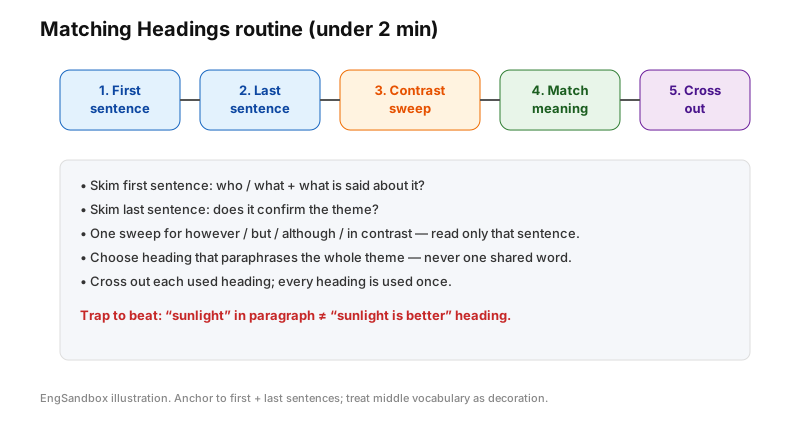
The 4-step routine in order: first sentence, last sentence, contrast sweep for however, but and although, match by meaning, cross out.
Practice 1: The Reef as Climate Infrastructure (Trap: Detail masquerading as theme)
Headings for this set:
- i. A fragile system that helps regulate the planet
- ii. Tourist revenue from reef visits
- iii. How coral builds its limestone skeleton
- iv. The financial cost of coral bleaching
- v. Ancient fishing techniques on reefs
Paragraph:
"Coral reefs occupy less than one percent of the ocean floor, yet they sustain a quarter of all marine species and buffer coastlines against storm surge. The living veneer secretes calcium carbonate, building a limestone framework that stores carbon and dampens wave energy at the same time. Although tourists often visit for the colours, the deeper value is functional: by cycling nutrients and sheltering juvenile fish, the reef maintains food security for half a billion people. Losing that framework would not merely be aesthetic."
Solve it:
- First sentence: tiny area but huge ecological and coastal role.
- Last sentence: loss is about system function, not beauty.
- Contrast sweep: "Although tourists often visit..." is a subordinate detail; the clause after although returns to functional value.
- Match: i (fragile system that helps regulate the planet) paraphrases "sustain... buffer... stores carbon". ii and iv share words but are details. iii is one middle sentence, not the theme.
Answer is i. If you chose ii or iv, you matched a detail tucked into a subordinate clause.
Practice 2: When Crowds Misjudge Risk (Trap: Opposite meaning with same words)
Headings:
- i. Why group pressure improves accuracy
- ii. How collective caution can become collective risk
- iii. The history of crowd psychology research
- iv. Individual strategies for decision-making
- v. The mathematics of voting systems
Paragraph:
"Groups are often assumed to be wiser than individuals, yet under uncertainty they can amplify the very errors they are meant to cancel. When members see others hesitate, caution spreads quickly; people suppress private doubts to stay aligned, so early hesitation hardens into uniform inaction. Psychologists call this informational cascading, and it explains why committees postpone evacuation orders or why markets freeze before a crash. The danger is not boldness but synchronized caution."
Solve it:
- First sentence: groups assumed wiser, yet amplify errors — paradox.
- Last sentence: danger is synchronized caution, not boldness.
- Contrast sweep: "yet" in sentence one signals the turn; no later however redirects away.
- Match: ii (collective caution becomes collective risk) captures "caution spreads... synchronized caution." i (group pressure improves accuracy) reuses words with opposite claim.
Answer is ii. Watch for headings that reuse vocabulary with a flipped verb.
Practice 3: Remote Work — From Emergency to Design (Trap: Old vs new comparison)
Headings:
- i. The emergency adoption of home working in 2020
- ii. Designing work around intentional presence
- iii. The technology that enables video calls
- iv. Why offices will disappear entirely
- v. Traditional approaches to office management
Paragraph:
"The initial shift to remote work was an emergency workaround, judged by whether video calls stayed connected. Five years on, successful organisations no longer ask where people sit, but when being together adds value. Teams now reserve offices for collaborative problem-solving and protect quiet work for home, measuring output rather than attendance. In this model, the office is not abandoned but assigned a specific purpose."
Solve it:
- First sentence: emergency workaround — background.
- Last sentence: office not abandoned but assigned a specific purpose — present design.
- Contrast sweep: "no longer" and "now" mark shift from emergency to intentional design.
- Match: ii (designing work around intentional presence) paraphrases "when being together adds value." i (emergency adoption in 2020) is background. iv (offices will disappear) contradicts the last sentence.
Answer is ii. Distractors often anchor to opening history; the heading must match the closing position.
Summary:
| Paragraph | Correct | Trap | Why trap fails |
|---|---|---|---|
| Reef | i. Fragile system that regulates the planet | ii / iv Tourist / Cost | Detail in subordinate clause, not theme |
| Crowds | ii. Collective caution becomes risk | i. Improves accuracy | Same words, opposite claim |
| Remote work | ii. Intentional presence | i / iv Emergency / Disappear | History as background; overclaim |
Copy this into your error log and note which trap column you fell into.
This gist-reading skill also helps in IELTS Reading: How to Tackle True / False / Not Given Questions and The Benefits of Daily Reading for Language Acquisition.
Keeping Calm Enough to Think
One more thing, and I say this gently after many lessons on this task: panic ruins technique. When your inner voice starts repeating "this is too hard, I am running out of time", part of your mind is busy worrying instead of reading, and worried readers reach for shortcuts. That is precisely the moment the sunlight trap strikes.
Three habits protect you:
- Breathe before you begin. Take three slow breaths before any timed practice and remind yourself: "This is a puzzle, and I know the rules of the puzzle." Calm reading keeps your working memory clear for the actual text.
- Treat every wrong answer as data. When you fall for a distractor, ask why. Did you match a keyword? Did you skip the topic sentence? Each mistake you diagnose in practice is one you are far less likely to repeat on test day.
- Protect the streak, not the marathon. On an exhausting day, do one paragraph and one heading, which takes about five minutes. Learners who practise little and often tend to make steadier progress than those who cram occasionally.
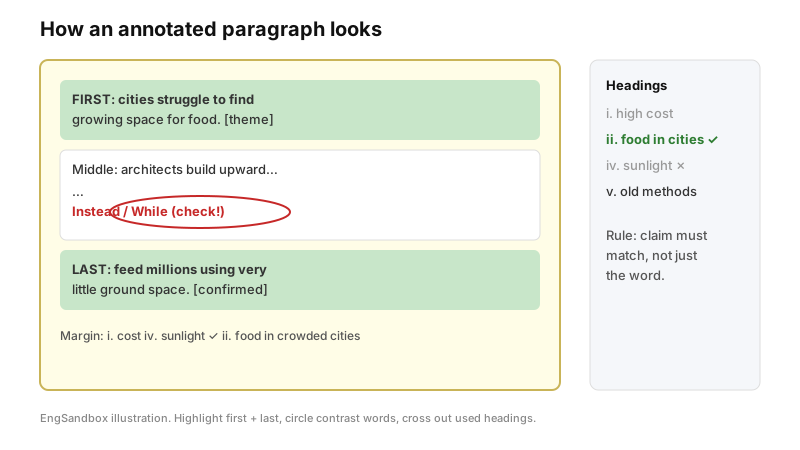
Mark-up habit: highlight first and last sentences, circle Instead and While, cross out used headings — the claim must match, not just the word.
FAQ
Should I read the paragraphs or the headings first? Headings first for this task. Underline the head noun in each heading — cost, food in crowded cities, sunlight — then skim. For True / False / Not Given the order is reversed, but for Matching Headings the heading list is your compass.
What if two headings both seem to fit? Return to first and last sentences only. One matches the whole theme; the other matches a detail or opposite. In Practice 1, only the latter covers first and last sentences together. If stuck, mark and return later.
How do I avoid the keyword trap when short on time? Cross out the keyword as you check it. When sunlight appears in both paragraph and heading, put a line through it and ask "does the claim match, not just the word?" That pause helps in The Benefits of Daily Reading too.
Can I use the same routine for PTE? Yes. IELTS Matching Headings requires strict paraphrase; PTE Summarize Written Text rewards the same first-last check but allows a keyword as anchor. The however/although sweep transfers directly.
Where This Leaves You
Skimming for a theme can feel wrong at first, because school trained most of us to read every word carefully. That instinct served you well, but this task rewards a different muscle, and muscles respond to training. Give the routine two weeks of honest practice — the three paragraphs above plus one new paragraph a day — and you will start noticing topic sentences jump out at you, distractors revealing themselves on sight, and the clock feeling less like an enemy.
Be patient with yourself. Every skilled reader you admire once circled the wrong heading too. You now know the trap, you know the routine, and paragraph by paragraph, the technique becomes yours.
For your next session, test the routine against the contrasting logic in IELTS Reading: How to Tackle True / False / Not Given Questions where intensive reading replaces skimming, or reinforce the vocabulary layer that makes gist reading feel faster with 50 Phrasal Verbs for Everyday English and 75 Most Common English Collocations.
Related Articles
🎧 IELTS Listening: How to Avoid Distractors and Identify the Correct Answer in Multiple-Choice Questions
Learn how to spot and avoid common distractors in IELTS Listening multiple-choice questions. Master strategies to identify the correct answer and boost your band score.
✍️ IELTS Writing Task 2: The Foolproof 4-Paragraph Essay Structure for a Band 7+
Master the IELTS Writing Task 2 with a simple, foolproof 4-paragraph essay structure. Learn how to plan, write, and polish your essay for a Band 7 or higher.
🔗 20 Linking Words That Boost Your IELTS Writing Score
Master 20 essential linking words to improve your IELTS Writing coherence and cohesion. Learn how to connect ideas smoothly and boost your band score.