📝 PTE Summarize Written Text: How to Write a One-Sentence Summary
8 min read
2026-06-27
Master the PTE Summarize Written Text task with a step-by-step strategy. Learn to identify main ideas, use clause connectors, and write a perfect one-sentence summary.
EngSandbox Editorial Team
Written with AI assistance and reviewed by our editors — experienced PTE/IELTS tutors. Every article is fact-checked against official band descriptors, the Academic Word List and Cambridge assessment research, then field-tested with learners before publishing. Human reviewed + field tested. Questions? Contact us — see our Editorial Process.

If the idea of reading an entire passage and squeezing its meaning into a single sentence makes your stomach tighten, you are not alone. Many PTE test takers find Summarize Written Text one of the most intimidating tasks in the entire exam. You sit there, watching the timer count down from ten minutes, and wonder: How can I possibly capture all of that in just one sentence?
Here is the good news — this task is not about being a literary genius. It is about being strategic. Once you understand how to spot the main idea of a passage and how to link smaller points using the right clause connectors, the entire process becomes manageable and even predictable.
In this guide, we will walk through exactly how to approach the Summarize Written Text task step by step. You will learn how to identify what matters most in a passage, how to combine ideas into a single grammatically correct sentence, and what common mistakes can cost you marks. We will finish with five practice passages so you can test yourself right away.
Understanding the Task
Before we dive into strategy, let us make sure we know exactly what we are dealing with.
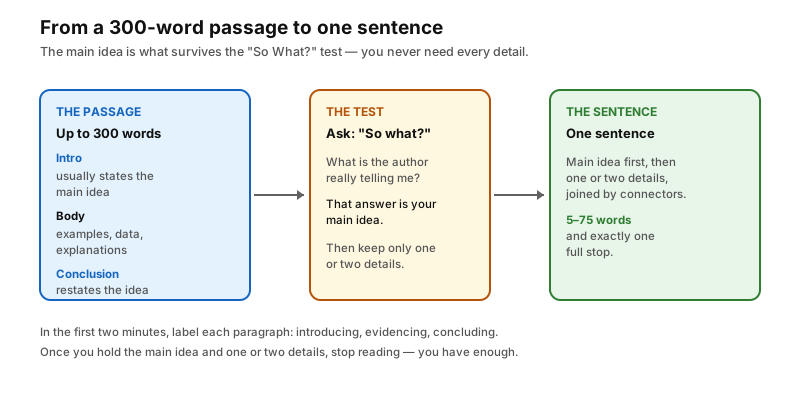
In the PTE Academic exam, the Summarize Written Text task asks you to read a passage of up to 300 words and write a summary that captures its key points. Your summary must be one single sentence between 5 and 75 words. You have ten minutes per passage.
According to Pearson's official scoring criteria, your response is evaluated on four areas:
| Scoring Criterion | What It Measures | Maximum Points |
|---|---|---|
| Content | Whether you include all the main ideas from the passage | 2 |
| Form | Whether your summary is one sentence within the word limit | 1 |
| Grammar | Whether your sentence structure is accurate | 2 |
| Vocabulary | Whether you use appropriate and precise words | 2 |
That is a total of 7 points per item. Notice that content and grammar carry the most weight. You can lose points quickly by either missing a key idea or writing a sentence that falls apart structurally. So our strategy needs to address both.
How to Find the Main Idea in Any Passage
The biggest mistake test takers make is trying to include everything. You cannot, and you are not supposed to. Your job is to find the main idea — the central point the author is making — and one or two supporting details that are essential to understanding it.
Here is a simple method called the "So What?" Test. After you read the passage, ask yourself: So what? What is the author really trying to tell me? The answer to that question is your main idea.
Most academic passages follow a predictable structure:
- The main idea is usually stated in the first or last paragraph.
- Supporting details appear in the body paragraphs. These often include examples, data, or explanations.
- The conclusion often restates or reinforces the main idea.
Your job during the first two minutes of reading is to mentally label each paragraph. You can even ask yourself one question per paragraph: What is this paragraph doing? Is it introducing the topic, giving evidence, offering a counterargument, or concluding?
Once you have the main idea and one or two supporting details, stop collecting information. You have enough.
Building Your One-Sentence Summary
Now comes the part that worries most people: how do you combine several ideas into one sentence that actually makes sense?
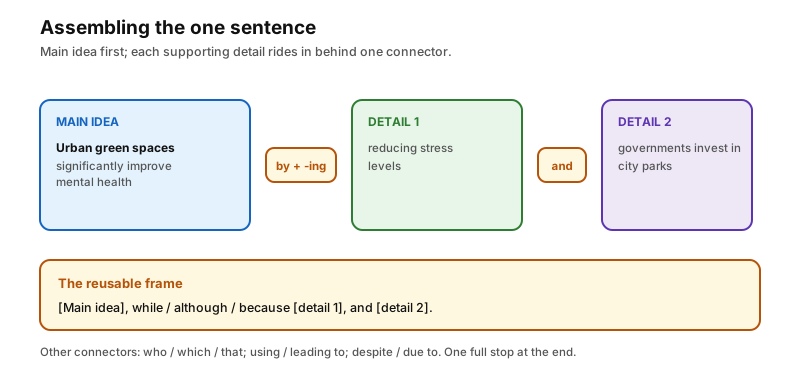
The secret lies in clause combining. A clause is simply a group of words that contains a subject and a verb. A single sentence can hold multiple clauses as long as you connect them properly.
Here are the most useful connectors for this task:
| Connector Type | Examples | When to Use It |
|---|---|---|
| Subordinating conjunctions | although, while, because, since, whereas | When one idea contrasts with or explains another |
| Relative pronouns | who, which, that | When you want to add detail about a noun |
| Coordinating conjunctions | and, but, so | When joining ideas of equal importance |
| Participial phrases | using..., resulting in..., leading to... | When adding a result or method |
| Prepositional phrases | despite, due to, in addition to | When adding context concisely |
A Reliable Template
If you are not sure where to start, this structure works for most passages:
"[Main idea], while/although/because [supporting detail 1], and [supporting detail 2]."
Let us see this in action with an example. Imagine the passage argues that urban green spaces improve mental health, provides evidence about stress reduction, and mentions that governments are investing in city parks. Your summary might look like this:
"Research indicates that urban green spaces significantly improve mental health by reducing stress levels, and governments worldwide are increasingly investing in city parks to promote public well-being."
Notice how the main idea comes first, the supporting evidence follows with "by" + gerund, and the second detail connects with "and." One sentence, all the key points, grammatically correct.
Step-by-Step Walkthrough
Let us practise this process together with a short passage.
Sample Passage:
Climate change is causing glaciers around the world to melt at an unprecedented rate. Scientists have observed that some glaciers have lost up to half their volume in the past few decades. This melting contributes to rising sea levels, which threaten coastal communities. In response, several international agreements have been proposed to reduce carbon emissions and slow the warming trend.
Step 1: Read and identify the main idea. The passage is about glacier melting caused by climate change and the response to it.
Step 2: Identify supporting details.
- Glaciers are melting at an unprecedented rate.
- This causes rising sea levels that threaten coastal communities.
- International agreements aim to reduce emissions.
Step 3: Combine into one sentence.
"Climate change is causing glaciers worldwide to melt at an unprecedented rate, which contributes to rising sea levels and threatens coastal communities, prompting several international agreements aimed at reducing carbon emissions."
Step 4: Check your summary against the checklist.
- Is it one sentence? Yes.
- Is it between 5 and 75 words? Yes (31 words).
- Does it capture the main idea and key supporting points? Yes.
- Is the grammar correct? Yes.
That is the entire process. Simple, structured, repeatable.
Common Mistakes to Avoid
Now that you know what to do, let us talk about what not to do.
1. Writing more than one sentence. This is the most common reason students lose the form mark. Even if your sentence is long, it must be one sentence. If you catch yourself about to write a full stop, combine the ideas using a connector instead.
2. Copying sentences directly from the passage. Paraphrasing shows the examiner that you understand the meaning, not just the words. Change the vocabulary and sentence structure where you can.
3. Including minor details. If the passage mentions that a study was conducted in 2018 at a university in Melbourne, you probably do not need the year or the city. Focus on what was found, not where or when.
4. Going over the 75-word limit. Pearson's system will cut off your response at 75 words. If your sentence is not complete by then, you will lose marks. Keep your summary tight — aim for 30 to 50 words.
5. Starting with "This passage is about..." This wastes words and adds no content. Go straight into the ideas themselves.
Five Practice Passages
Here are five passages for you to practise with. For each one, give yourself ten minutes, read the passage, and write your one-sentence summary. A model answer is provided below each passage — but try each one before you look!
Practice Passage 1: Technology in Education
The integration of technology in classrooms has transformed the way students learn and teachers instruct. Interactive whiteboards, tablets, and online resources allow for more personalised learning experiences, enabling students to progress at their own pace. However, critics argue that excessive screen time can reduce attention spans and limit face-to-face social interaction among young learners. Despite these concerns, many educational institutions continue to invest heavily in digital tools, believing that the benefits outweigh the drawbacks when technology is used thoughtfully.
Model Answer:
"While the integration of technology in classrooms has enabled more personalised learning experiences through digital tools, critics warn that excessive screen time may reduce attention spans and social interaction; nevertheless, many educational institutions continue to invest in technology, believing its benefits outweigh the drawbacks when used thoughtfully."
Practice Passage 2: Sleep and Cognitive Performance
A growing body of research demonstrates that sleep plays a critical role in cognitive performance, particularly in memory consolidation and decision-making. During deep sleep stages, the brain processes and stores information gathered during the day, making it easier to retrieve later. Studies have shown that individuals who consistently sleep fewer than six hours per night exhibit poorer concentration and slower reaction times compared to those who achieve seven to eight hours. Health professionals therefore recommend maintaining a regular sleep schedule as a simple but effective strategy for improving academic and professional performance.
Model Answer:
"Research shows that sleep is essential for cognitive performance because the brain consolidates memories during deep sleep, and individuals who sleep fewer than six hours per night experience poorer concentration and slower reaction times, leading health professionals to recommend regular sleep schedules for improved performance."
Practice Passage 3: Urbanisation and Housing
Rapid urbanisation in developing countries has created a severe housing shortage, as millions of rural residents migrate to cities in search of employment and better living conditions. In many cases, the supply of affordable housing has not kept pace with demand, leading to the growth of informal settlements with inadequate sanitation and limited access to essential services. Governments face the challenge of balancing economic development with the need for sustainable urban planning that includes affordable housing, public transportation, and green spaces for growing populations.
Model Answer:
"Rapid urbanisation in developing countries has led to a severe housing shortage because the supply of affordable housing has not kept pace with rural-to-urban migration, resulting in the growth of informal settlements and forcing governments to balance economic development with sustainable urban planning."
Practice Passage 4: Antibiotic Resistance
The overuse and misuse of antibiotics in both human medicine and agriculture have accelerated the development of antibiotic-resistant bacteria, which the World Health Organization has identified as one of the greatest threats to global health. When antibiotics are used unnecessarily or patients fail to complete their prescribed course, bacteria can adapt and become resistant to treatment. This means that common infections that were once easily cured may become life-threatening. Experts urge stricter regulation of antibiotic prescriptions and greater investment in the development of new antimicrobial treatments to address this growing crisis.
Model Answer:
"The overuse and misuse of antibiotics in medicine and agriculture have accelerated the development of antibiotic-resistant bacteria, which the World Health Organization identifies as a major global health threat, and experts are calling for stricter prescription regulations and greater investment in new antimicrobial treatments."
Practice Passage 5: Remote Work
The shift toward remote work, accelerated by global events in recent years, has fundamentally altered traditional workplace dynamics. Many employees report higher productivity and improved work-life balance when working from home, as they save time on commuting and have greater flexibility in managing their schedules. Employers have also benefited from reduced overhead costs and access to a wider talent pool unrestricted by geography. Nevertheless, challenges remain, including feelings of isolation among remote workers, blurred boundaries between personal and professional life, and difficulties in maintaining team cohesion and company culture.
Model Answer:
"The shift toward remote work has improved productivity and work-life balance for many employees while reducing costs for employers, although challenges such as worker isolation, blurred personal-professional boundaries, and weakened team cohesion continue to present difficulties."
When Life Gets Busy: Micro-Learning Tips
Let us be honest — you probably have a lot going on. Between work, family, and other study commitments, finding a full hour to practise Summarize Written Text might feel impossible. The good news is that small, consistent practice beats occasional long sessions.
Here are some ways to fit this skill into your daily routine:
- Read one short article each morning (from BBC News, The Guardian, or National Geographic). After reading, spend two minutes writing a one-sentence summary on your phone's notes app. This trains your summarising instinct.
- Use the "one-sentence challenge" with any text you encounter. Email from your boss? Summarise it in one sentence. Long group chat? One sentence. This builds the habit of identifying what matters.
- Review one model answer before bed. Do not try to memorise it. Just read it, notice the structure, and let it sink in. Over time, the patterns will feel natural.
- Practise clause combining in isolation. Take any two simple sentences you see and combine them into one using "although," "while," "which," or "because." This takes thirty seconds and strengthens your grammar for the task.
Even five minutes a day, done consistently over several weeks, can make a real difference in your comfort level with this task.
Final Thoughts
Summarize Written Text can feel like an impossible puzzle at first, but it is actually one of the most learnable tasks on the PTE exam. There is a clear process: find the main idea, choose one or two key supporting details, and combine them into a single well-structured sentence using the right connectors. Every time you practise, that process gets a little faster and a little more natural.
Do not aim for perfection on your first try. Start with the template we discussed, get comfortable with the rhythm of clause combining, and gradually challenge yourself to paraphrase more freely. You already have everything you need to improve — the strategies are in your hands now. The only thing left is to practise, and you absolutely can do that. Good luck, and keep going!
Related Articles
✍️ PTE Essay Writing: How to Score 70+ with a Simple Template
Master the PTE essay with a simple, repeatable template. Learn how the automated scoring works, manage your 20 minutes effectively, and use a proven structure to score 70+.
📚 PTE Reading: Re-order Paragraphs — Step-by-Step Method
Master the PTE Re-order Paragraphs task with a clear step-by-step method. Learn to find topic sentences, trace pronoun references, and spot logical connectors.
📝 PTE Write from Dictation: 100 Most Common Sentences
Boost your PTE Write from Dictation score with 100 high-frequency sentences. Practice with grouped difficulty levels and memory techniques.