✍️ PTE Essay Writing: How to Score 70+ with a Simple Template
8 min read
2026-06-27
Master the PTE essay with a simple, repeatable template. Learn how the automated scoring works, manage your 20 minutes effectively, and use a proven structure to score 70+.
EngSandbox Editorial Team
Written with AI assistance and reviewed by our editors — experienced PTE/IELTS tutors. Every article is fact-checked against official band descriptors, the Academic Word List and Cambridge assessment research, then field-tested with learners before publishing. Human reviewed + field tested. Questions? Contact us — see our Editorial Process.

If you are preparing for the PTE Academic exam, the essay section might feel like the scariest part of the whole test. Twenty minutes, a topic you have never seen before, and a blank screen staring back at you — it is enough to make anyone nervous. You might be wondering: How can I possibly write a strong essay under that kind of pressure?
Here is the good news: the PTE essay is one of the most predictable parts of the exam. The topics follow patterns, the structure you need is repeatable, and the scoring system rewards a clear, well-organised response over a flashy one. You do not need to be a literary genius. You need a plan.
In this guide, we will walk through exactly how to build that plan. We will look at how the PTE essay is scored, break down a simple template you can use for nearly any prompt, practise time management so you never run out of minutes, and study a full model essay line by line. By the end, you will have a reliable strategy you can practise today and carry with you into the exam room.
How the PTE Essay Is Scored
Before you write a single word, you need to understand what the machine is looking for. Unlike IELTS, where a human examiner reads your essay, PTE Academic uses automated scoring. A computer algorithm evaluates your response based on very specific criteria. This is actually good news — algorithms are consistent, and once you understand the rules, you can work with them.
According to Pearson's official score guide, the Write Essay task is evaluated across several dimensions:
| Scoring Criterion | What It Means | How to Score Well |
|---|---|---|
| Content | Does your essay address the topic directly? | Answer the specific question asked. Stay on topic in every paragraph. |
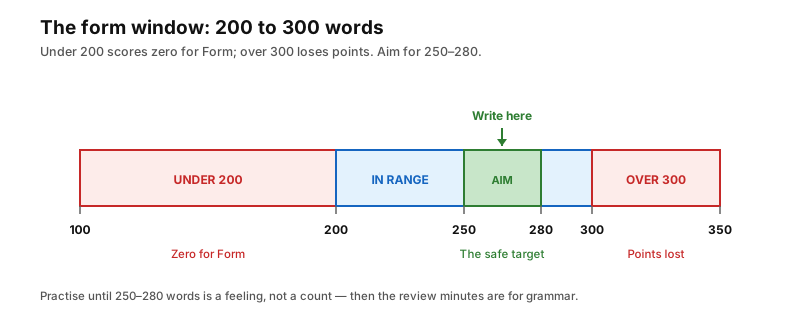
| Form | Is your response between 200 and 300 words? | Aim for 250–280 words. Never go under 200 or over 300. |
| Development, Structure & Coherence | Is your essay logically organised? | Use clear paragraphs with a beginning, middle, and end. Use linking words. |
| General Linguistic Range | Is your language clear and varied? | Mix simple and complex sentences. Avoid repeating the same phrases. |
| Grammar Usage & Mechanics | Is your grammar accurate? | Proofread for subject-verb agreement, tense consistency, and article use. |
| Vocabulary Range | Do you use appropriate and varied vocabulary? | Use topic-specific words. Avoid repeating the same basic vocabulary. |
| Spelling | Is your spelling correct? | Stick to British or American English — but be consistent. Do not mix them. |
The most important thing to notice here is that the algorithm does not care how clever your ideas are. It cares that your ideas are relevant, clearly organised, and expressed in accurate language. This levels the playing field. You do not need brilliant ideas. You need a solid structure and clean English.
The Simple Template That Works for Almost Any PTE Essay
Now let us build your go-to framework. Most PTE essay prompts fall into a few categories: agree or disagree, discuss both views, advantages and disadvantages, and problem and solution. The template below works for all of them with small adjustments.
The Four-Paragraph Structure
Here is the template broken down step by step:
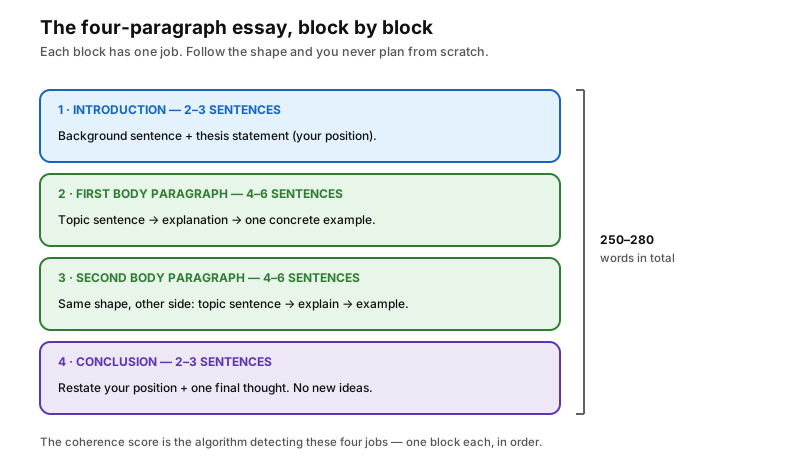
Paragraph 1 — Introduction (2–3 sentences)
Your introduction should do two things: restate the topic in your own words and clearly state your position or the direction of your essay.
Formula: Background sentence + your thesis statement.
Example prompt: "Some people believe that university education should be free for everyone. Others argue that students should pay for their own education. Discuss both views and give your own opinion."
Sample introduction: "The question of whether higher education should be funded by governments or by individuals is widely debated. While there are valid arguments on both sides, I believe that a shared funding model offers the best balance between accessibility and personal responsibility."
Paragraph 2 — First Body Paragraph (4–6 sentences)
This paragraph supports one side of the argument (or the first reason for your position). Follow this internal structure:
- Topic sentence — state the main idea of this paragraph.
- Explanation — clarify what you mean.
- Example — make it concrete.
Sample body paragraph 1: "On the one hand, free university education can significantly reduce social inequality. When tuition fees are eliminated, students from low-income families have the same opportunity to pursue degrees as their wealthier peers. For instance, in several European countries where public universities charge no tuition, higher education participation rates are notably more even across different income groups. This suggests that removing financial barriers can create a more level playing field."
Paragraph 3 — Second Body Paragraph (4–6 sentences)
Now present the other side, or your second reason. Use the same internal structure: topic sentence, explanation, example.
Sample body paragraph 2: "On the other hand, asking students to contribute to their education costs can foster a greater sense of personal investment. When people pay for something, they tend to value it more and work harder to make the most of it. A graduate who has invested financially in their degree may be more motivated to complete their studies and pursue relevant employment afterward. Furthermore, tuition revenue can help universities maintain high-quality teaching facilities and resources."
Paragraph 4 — Conclusion (2–3 sentences)
Summarize your position. Do not introduce new ideas here.
Formula: Restate your position + one final thought.
Sample conclusion: "In conclusion, while both perspectives have merit, I believe that a combination of government funding and reasonable student contributions creates the most sustainable and fair system. This approach ensures access for all while encouraging personal commitment to learning."
That is it. Four paragraphs. Each one has a clear job. Once you internalise this structure, you can apply it to almost any prompt without wasting precious minutes thinking about how to organise your thoughts.
Time Management: How to Survive Twenty Minutes
Twenty minutes is tight, but it is enough if you divide your time deliberately. Here is a breakdown that works:
| Time | Task | What You Are Doing |
|---|---|---|
| Minutes 1–2 | Read and plan | Understand the prompt. Decide your position. Jot down two main ideas. |
| Minutes 3–14 | Write | Draft all four paragraphs using the template. Do not stop to edit yet. |
| Minutes 15–18 | Review and edit | Check grammar, spelling, word count, and coherence. |
| Minutes 19–20 | Final polish | Fix any remaining errors. Confirm you are within the 200–300 word range. |
The most common time-management mistake is spending too long on planning. You do not need a detailed outline. You need a thesis and two supporting points. Write them down in shorthand and start typing.
The second most common mistake is trying to write a perfect first draft. Your first draft does not need to be clean. Get your ideas down, then use the review phase to fix errors. The algorithm scores the final version you submit, not your first attempt.
A Planning Trick That Saves Minutes
When you read the prompt, ask yourself two questions immediately:
- What is my position? (Pick a side — do not be neutral. A clear position scores better on content.)
- What are my two main reasons?
Write the answers in a simple note at the top of your screen:
Position: Shared funding is best.
Reason 1: Free education reduces inequality.
Reason 2: Student investment increases motivation.
This takes thirty seconds and gives you a roadmap for the entire essay. Everything else flows from here.
Vocabulary That Boosts Your Score
One area where many test takers lose marks is vocabulary range. The algorithm looks for variety and precision. You do not need rare or complicated words — you need the right words used correctly.
Here are some high-value phrases organised by essay function. Each one includes a definition and an example sentence so you can see exactly how to use it.
| Function | Phrase | Meaning | Example Sentence |
|---|---|---|---|
| Introducing a view | It is often argued that | Some people believe that | It is often argued that technology has made our lives easier. |
| Adding a point | Furthermore | In addition | Education develops critical thinking. Furthermore, it prepares students for the workforce. |
| Giving an example | For instance | For example | Some countries have adopted renewable energy. For instance, Denmark generates a significant share of its electricity from wind power. |
| Showing contrast | On the other hand | From a different perspective | Free education benefits society. On the other hand, it places a heavy burden on taxpayers. |
| Concluding | In conclusion | To summarize | In conclusion, the benefits of early childhood education outweigh the costs. |
Use two or three of these linking phrases per essay, but do not overload your writing with them. The algorithm detects natural-sounding discourse, and stuffing your essay with transition words can actually lower your score. Quality matters more than quantity.
Collocations to practise:
- play a crucial role (not "play an important role" every time)
- gain access to (not "get access to")
- address the issue of (not "solve the problem of" in every sentence)
- a growing number of (a natural way to say "more and more")
- pose a significant challenge (more precise than "is a big problem")
Each of these pairs sounds natural to a fluent speaker and signals range to the scoring algorithm.
Common Mistakes That Cost You Points
Even strong writers make predictable errors in the PTE essay. Here are the ones that hurt your score the most, along with how to fix them.
Mistake 1: Not answering the question.
This sounds obvious, but it happens more often than you think. Some test takers prepare an essay in their head before fully reading the prompt and end up writing something slightly off-topic. Read the prompt carefully. If it asks you to discuss both views, you must present two sides — not just one.
Mistake 2: Writing fewer than 200 words or more than 300 words.
The form criterion is strict. If your essay is under 200 words, you receive zero points for form. If it exceeds 300 words, you also lose points. Train yourself to write 250–280 words. With practice, you will develop an instinct for how long that looks on screen.
Mistake 3: Writing one giant paragraph.
The algorithm evaluates development, structure, and coherence. If your entire essay is a single block of text, the scoring system cannot detect a logical structure. Always use the four-paragraph format with clear paragraph breaks.
Mistake 4: Inconsistent spelling.
Choose either British or American English at the start and stick with it throughout. If you write "organisation" in one sentence and "organization" in another, the algorithm flags the inconsistency. This is an easy fix that many students overlook.
Mistake 5: Memorising a pre-written essay.
Some students try to memorise full essays and adapt them on test day. This almost never works. The prompts are specific enough that a memorised essay will not fit naturally, and the algorithm can detect unusual patterns in writing. Use the template for structure, but write the actual content fresh each time.
When Life Gets Busy: Micro-Learning Tips
You do not need two-hour study sessions to prepare for the PTE essay. In fact, short, focused practice is often more effective. Here are some ways to fit essay practice into a packed schedule:
The five-minute brainstorm. Pick a PTE essay prompt — there are many free ones available on Pearson's official practice platform and various PTE preparation websites. Set a timer for five minutes. Read the prompt, decide your position, and write down your thesis and two reasons. Do not write the full essay. This trains the planning skill that saves you time during the real test.
The ten-minute paragraph. Choose a prompt and write only the introduction and one body paragraph. Focus on accuracy — correct grammar, clear topic sentence, one specific example. This builds your paragraph-writing muscles without requiring a full twenty-minute commitment.
The weekend full essay. Once a week, set aside twenty minutes to write a complete essay under timed conditions. Afterward, spend ten minutes reviewing it. Check for: word count, paragraph structure, spelling errors, and whether you actually answered the prompt. This is your dress rehearsal.
The reading habit. Read one short English article per day — news, opinion pieces, or even Wikipedia entries on topics that commonly appear in PTE essays (education, technology, environment, health). Exposure to well-written English improves your grammar, vocabulary, and sense of natural sentence flow. You do not need to study the articles formally. Just reading them regularly makes a difference.
The key is consistency. Fifteen minutes of focused practice every day will improve your essay writing more than one long session once a week. Small steps, taken regularly, cover a lot of ground.
Putting It All Together: A Checklist for Test Day
When you sit down in the exam, use this mental checklist to keep yourself on track:
- Read the prompt twice. Make sure you understand exactly what is being asked.
- Decide your position in thirty seconds. Pick a side. Commit to it.
- Write two reasons. These become your body paragraphs.
- Follow the four-paragraph template. Introduction, body 1, body 2, conclusion.
- Use linking words naturally. Two or three per essay is enough.
- Watch your word count. Aim for 250–280 words.
- Save three minutes for editing. Check spelling, grammar, and coherence.
- Stay within one spelling convention. British or American — not both.
Print this checklist, tape it to your wall, and review it before every practice session. Over time, it becomes second nature.
Final Thoughts
Preparing for the PTE essay does not have to be overwhelming. You now have a clear understanding of how the essay is scored, a reliable four-paragraph template, a time management strategy, and practical micro-learning tips for busy days. These tools work because they align with what the scoring algorithm actually rewards: clarity, structure, relevance, and accurate language.
The most important step is the next one — practice. Open a PTE essay prompt today, set a timer for twenty minutes, and write your first essay using this template. It will not be perfect, and that is completely fine. Your second attempt will be better. Your tenth will feel natural. Every essay you write is a step closer to the score you need.
You have the strategy. You have the structure. Now go and write. You are more ready than you think.
Related Articles
📝 PTE Summarize Written Text: How to Write a One-Sentence Summary
Master the PTE Summarize Written Text task with a step-by-step strategy. Learn to identify main ideas, use clause connectors, and write a perfect one-sentence summary.
🎙️ PTE Retell Lecture: Template and 10 Practice Topics
Master the PTE Retell Lecture task with a proven template and 10 practice topics. Learn how to organise your notes, structure your response, and score higher.
🗣️ PTE Speaking: How to Ace 'Describe Image' with a 3-Step Template (2026 Strategies)
Master the PTE Describe Image task with a simple, modern 3-step template. Learn how to structure your response, use adaptable frameworks, and speak confidently for a high score.