📝 PTE Write from Dictation: 100 Most Common Sentences
8 min read
2026-06-27
Boost your PTE Write from Dictation score with 100 high-frequency sentences. Practice with grouped difficulty levels and memory techniques.
EngSandbox Editorial Team
Written with AI assistance and reviewed by our editors — experienced PTE/IELTS tutors. Every article is fact-checked against official band descriptors, the Academic Word List and Cambridge assessment research, then field-tested with learners before publishing. Human reviewed + field tested. Questions? Contact us — see our Editorial Process.

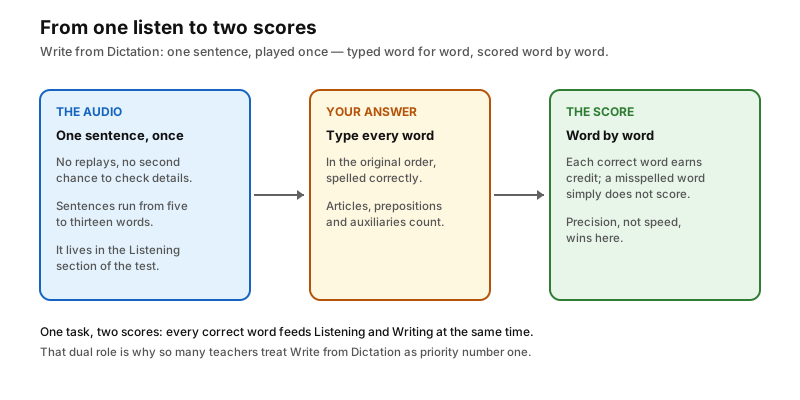
The audio finishes. One sentence, spoken once, already fading from your ears — and an empty answer box waiting for every word of it, spelled correctly, in the right order. If that thought makes you tense, you are in good company: Write from Dictation unsettles learners at every level. Yet it also repays preparation more generously than almost any other PTE Academic task, because it contributes to your Listening and your Writing scores at the same time. Every word you capture correctly strengthens two sections of your score in a single stroke.
In this guide we will work through 100 practice dictation sentences, arranged in three difficulty levels, together with a method for studying them and a plan that fits around a full life. Spend regular time with these sentences and the real exam starts to feel familiar rather than frightening.
How Write from Dictation Works
This task sits in the Listening section and does exactly what its name promises. You hear a single sentence once — there are no replays — and then you type what you heard into the answer box. Sentences vary in length: some are short and friendly, others long enough to test your concentration to the limit.
According to Pearson's official scoring information, this task contributes points to both your Listening and your Writing performance. That dual role is unusual on the exam, and it explains why so many teachers treat Write from Dictation as priority number one.
Scoring works word by word: each correctly spelled word earns credit, while a missing word or wrong word order costs you. A misspelled word simply does not score. Precision, not speed alone, wins here.
Why Familiar Patterns Are Your Friend
Think about how you learned your first language. Nobody handed you a dictionary on day one — you met common phrases over and over until they ran themselves. Dictation practice draws on the same principle.
Academic English leans on recurring structures: passive reports like "the research was conducted", recommendation patterns like "the committee recommended", cause-and-effect chains built around "due to" and "as a result". When you train on sentences built from those shapes, you stop decoding every word from scratch during the exam — the grammar starts predicting itself. Sentences like these come up again and again, and learners who know their patterns hear whole phrases rather than loose words.
Here is how the three levels in this guide build on each other:
| Level | Sentence Length | Focus Areas | What It Trains |
|---|---|---|---|
| Foundation | 5–8 words | Simple vocabulary, basic grammar | Spelling, word order, memory |
| Confidence | 8–11 words | Academic vocabulary, compound structures | Listening for detail, note-taking speed |
| Exam-Ready | 9–13 words | Complex grammar, abstract concepts | Sustained concentration, accuracy under pressure |
A Practice Loop That Works
Before you open the lists, set up this four-step routine:
- Listen and write. Have someone read a sentence aloud, or turn it into audio with a text-to-speech tool. Write exactly what you hear — do not peek at the sentence beforehand.
- Check and correct. Compare your version against the original. Mark every slip, including tiny ones such as a dropped article or an extra letter.
- Rewrite from memory. Cover the correct version and write the sentence again. Repeat until it comes out perfect without looking.
- Track your trouble spots. Keep a running list of the words and structures you miss most often, and review that personal list daily.
Consistency beats intensity. Fifteen focused minutes each day will carry you further than three hours crammed into a weekend.
Level 1: Foundation Sentences
These thirty sentences are short and use everyday academic vocabulary. They exist to make accuracy automatic before length becomes a factor. Master them properly rather than skimming them, however easy they look.
- The lecture starts at nine o'clock.
- Students must submit their assignments on time.
- The library is closed on weekends.
- She studied hard for the examination.
- The research was conducted in the laboratory.
- All students are required to attend the seminar.
- The professor gave a very interesting lecture.
- Please submit your work by Friday.
- The course begins in the first semester.
- There are many books in the library.
- The exam will be held next week.
- The teacher asked the students to sit down.
- She completed her degree in three years.
- The university offers a wide range of courses.
- He received a scholarship for his research.
- The conference will take place in London.
- Please read the instructions carefully.
- The results were published in a journal.
- Every student must attend the orientation.
- The deadline for the assignment is tomorrow.
- She works in the chemistry department.
- The lecture was about climate change.
- He passed the examination with high marks.
- The students had to write an essay.
- Research shows that exercise improves memory.
- The seminar was very informative.
- She is studying for a master's degree.
- The assignment requires a lot of research.
- The experiment was a great success.
- Students are encouraged to ask questions.
What to Watch For at This Level
Short sentences still hide plenty of traps:
- Articles (a, an, the) vanish easily when you listen quickly. Notice how sentence 7 runs "gave a very interesting lecture" — drop the "a" and you lose a point on a sentence you understood perfectly.
- Prepositions deserve their own attention. Watch which one each phrase demands: sentence 8 marks a deadline with "by Friday", while sentence 3 places the library closed "on weekends". These pairings rarely translate directly from your first language, so learn them as fixed chunks.
- Spelling of common academic words — "examination" in sentences 4 and 23, "laboratory" in sentence 5, "assignment(s)" in sentences 2, 20, and 28 — trips up many capable test-takers. Build the checking habit now, on easy sentences, so it holds under pressure later.
Level 2: Building Confidence
These sentences run longer and bring in proper academic vocabulary alongside more complex grammar. This middle band is where most test-takers discover their weakest links, so give it generous time.
- The government announced a new policy on education.
- The majority of students preferred the morning lectures.
- She presented her research findings at the conference.
- The new library will be open to the public.
- Academic writing requires a formal style and tone.
- The student submitted a well-organised essay.
- The population of the city has increased significantly.
- The research project was funded by the government.
- Environmental issues have become a major concern.
- The university provides support services for international students.
- The professor emphasised the importance of critical thinking.
- The report highlighted several key findings.
- She was awarded a prize for her academic achievements.
- The data was collected over a period of two years.
- The committee will review all the applications next month.
- The lecture covered a wide range of topics.
- His research focuses on the effects of pollution.
- The students were required to complete a group project.
- The experiment demonstrated the effectiveness of the treatment.
- She decided to pursue a career in medicine.
- The workshop will be held in the main auditorium.
- The course provides an introduction to modern philosophy.
- The study examined the relationship between diet and health.
- He has published several papers in academic journals.
- The department is planning to introduce new courses.
- The library has an extensive collection of reference materials.
- The final examination will consist of multiple-choice questions.
- She argued that the policy was unfair to students.
- The project required a significant amount of teamwork.
- The students presented their projects to the class.
- The university has strong links with industry.
- The research suggests a connection between sleep and learning.
- She was invited to speak at an international conference.
- The programme is designed to develop leadership skills.
- The study was based on a sample of five hundred participants.
- The new regulations will come into effect next year.
- The analysis revealed some interesting patterns in the data.
- He was unable to attend the meeting due to illness.
- The course covers both theoretical and practical aspects.
- The student received feedback on her first draft.
What to Watch For at This Level
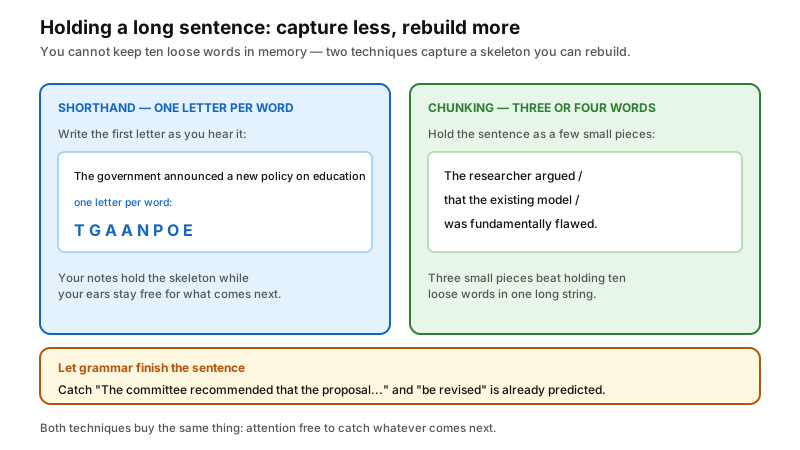
Sentences of this length no longer fit in memory whole, so you need a shorthand strategy:
- Write the first letter of each word as you hear it. Sentence 31 — "The government announced a new policy on education" — becomes "T-G-A-A-N-P-O-E." Your notes hold the skeleton while your ears stay free for whatever comes next.
- Listen hard for verb forms: "has increased" in sentence 37, "was collected" in sentence 44, "is planning" in sentence 55. Those small auxiliary verbs decide the tense of the entire sentence, and they are exactly where rushed writers slip.
- Hyphenated compounds appear regularly: "well-organised" in sentence 36 and "multiple-choice" in sentence 57. Learn them as single units rather than two words joined at the last moment.
Level 3: Exam-Ready Sentences
These are the longest and most demanding sentences in the collection, written in the style of the hardest dictations you may meet on test day. If you can write these accurately from a single hearing, you have trained precisely the skill this exam measures.
- The researcher argued that the existing model was fundamentally flawed.
- The government has allocated additional funding for scientific research.
- The findings of the study were consistent with previous research.
- She demonstrated a thorough understanding of the subject matter.
- The committee recommended that the proposal be revised and resubmitted.
- The implications of this research extend beyond the field of psychology.
- The participants were asked to complete a questionnaire before the experiment.
- The university encourages interdisciplinary collaboration among its research departments.
- The results of the survey were analysed using statistical methods.
- He emphasised the need for further investigation into this phenomenon.
- The conference brought together leading experts from around the world.
- The policy has been criticised for failing to address the root causes.
- The experiment was designed to test the hypothesis under controlled conditions.
- The students are expected to demonstrate critical analysis in their essays.
- The research was carried out in collaboration with several international institutions.
- The development of new technologies has transformed the way we communicate.
- The professor pointed out several limitations of the current research methodology.
- The report concluded that the intervention had a positive effect on outcomes.
- She contributed significantly to the advancement of knowledge in this area.
- The study highlights the importance of early childhood education.
- The assessment criteria include both content and language proficiency.
- The proposal outlines a comprehensive plan for environmental sustainability.
- The researcher identified a number of potential variables that could affect the outcome.
- The effectiveness of the programme was evaluated through a series of interviews.
- The new approach has been shown to improve student engagement significantly.
- The findings suggest that further research is needed to confirm these results.
- The lecture explored the relationship between economic growth and social inequality.
- The university is committed to promoting diversity and inclusion on campus.
- The data collected from the survey was carefully verified and validated.
- The professor recommended a number of strategies for improving academic performance.
What to Watch For at This Level
The enemy here is not any single difficult word — it is attention drift across a long sentence. Two techniques protect you:
- Chunk the sentence into groups of three or four words. Take sentence 71: "The researcher argued / that the existing model / was fundamentally flawed." Holding three small pieces beats holding ten loose words, and it mirrors how fluent speakers package language naturally.
- Let grammar finish the sentence for you. Suppose you catch only the opening of sentence 75: "The committee recommended that the proposal..." English itself tells you what follows. After verbs of recommendation, the clause normally takes a base-form verb — so "be revised" should spring to mind almost automatically. Train yourself to expect such patterns, and even a half-heard sentence can be rebuilt accurately.
The Mistakes I See Most Often
After years of marking students' dictation practice, I can predict most errors before reading them. Here are the five worth guarding against:
1. Dropping the small words. Articles, prepositions, and auxiliaries (has, was, be) carry as much scoring weight as any content word, and they are precisely the ones nervous writers leave behind. Remember: every word counts equally.
2. Misspelling high-value academic vocabulary. Words like "questionnaire" (sentence 77), "interdisciplinary" (sentence 78), and "methodology" (sentence 87) punish guesswork. Keep a personal spelling list and rehearse it until these words cost you nothing.
3. Writing words out of order. Under pressure, people scribble down whatever they remember in whatever order it surfaces — and the result is ungrammatical nonsense. Always rebuild the sentence in its original sequence.
4. Second-guessing yourself. A quiet pattern appears again and again: students write a sentence correctly, stare at it, change a right word into a wrong one, and lose the point. Unless you can see a definite error, trust your first instinct and move on.
5. Neglecting capitalisation and punctuation habits. Scoring focuses on word accuracy, but opening every answer with a capital letter and closing it with a full stop keeps you thinking in complete sentences — and complete sentences are exactly what this task rewards.
Short Sessions Still Count
A packed schedule does not disqualify you from preparing well; it only changes the shape of your practice:
- The five-minute morning drill. Choose five sentences, cover them, write each from memory after one careful listen, check your work, move on. Faster than brewing coffee.
- Audio on the go. Convert these sentences into recordings with a text-to-speech app and play them during commutes, cooking, or winding down. Your ear trains even when your desk is nowhere near.
- The one-sentence rule. On impossible days, write one sentence perfectly and call it done. One sentence a day becomes thirty mastered sentences in a month — genuine, compounding progress.
- Be your own reader. Record yourself speaking the sentences aloud, then play the recording back and transcribe what you hear. That loop needs no partner, no textbook, and no internet connection.
Short, frequent sessions stick in memory far better than rare marathons — one of the most dependable patterns in language learning, and one you can put to work tonight.
A Four-Week Route Through the List
Here is a simple month-long plan you can bend to fit your own schedule:
| Week | Focus | Sentences | Daily Time |
|---|---|---|---|
| Week 1 | Foundation | Sentences 1–30 | 15 minutes |
| Week 2 | Foundation + Confidence | Sentences 1–30 (review) + 31–50 | 20 minutes |
| Week 3 | Confidence | Sentences 31–70 | 20 minutes |
| Week 4 | Exam-Ready | Sentences 71–100 + mixed review | 25 minutes |
By the end of week four, aim to write most of these sentences accurately from a single listen. If particular patterns still resist you — long passives, perhaps, or hyphenated compounds — camp on those specific sentences instead of pushing forward. Depth beats coverage every time.
Where Steady Practice Leads
Write from Dictation rewards preparation more directly than any open-ended task ever could. There is a right answer here — a recoverable sentence — and every sentence you master moves real points within reach. Few parts of the exam offer that kind of honest exchange: effort in, accuracy out.
So start small and start today. Pick five sentences from the Foundation list, give yourself five quiet minutes, and write them from memory after a single listen. Check honestly, correct carefully, and repeat tomorrow. You do not need to be flawless on day one — you only need to show up again tomorrow. Do that, and your ear will grow sharper, your spelling steadier, and the empty answer box far less intimidating than it looks today.
Related Articles
🔁 PTE Repeat Sentence: 50 High-Frequency Sentences for Practice
Boost your PTE Repeat Sentence score with 50 high-frequency sentences. Practice with audio scripts, memory techniques, and scoring strategies.
🎧 PTE Listening: Fill in the Blanks — How to Predict Words
Master the PTE Listening Fill in the Blanks task with prediction techniques. Learn to guess parts of speech and likely meanings before the audio plays.
📝 PTE Reading & Writing: How to Master 'Fill in the Blanks' (The Most Important Task for a High Score)
Master the PTE Reading & Writing Fill in the Blanks task — the highest-impact section for boosting your overall score. Learn strategies, timing, and vocabulary tips.