📝 PTE Reading & Writing: How to Master 'Fill in the Blanks' (The Most Important Task for a High Score)
8 min read
2026-06-16
Master the PTE Reading & Writing Fill in the Blanks task — the highest-impact section for boosting your overall score. Learn strategies, timing, and vocabulary tips.
EngSandbox Editorial Team
Written with AI assistance and reviewed by our editors — experienced PTE/IELTS tutors. Every article is fact-checked against official band descriptors, the Academic Word List and Cambridge assessment research, then field-tested with learners before publishing. Human reviewed + field tested. Questions? Contact us — see our Editorial Process.

A paragraph appears on your screen. Scattered through it are gaps, and sitting above each gap is a drop-down box hiding four candidate words. Behind the scenes, the Reading section clock is already running. This is Reading & Writing: Fill in the Blanks, and in my experience it is the task you can improve fastest through focused practice.
Why do I single this task out? Because it does something unusual: every answer you select feeds both your Reading score and your Writing score. Few other question types pay you twice for the same effort. That dual contribution is precisely why an hour spent practising here tends to lift an overall result more noticeably than an hour spent on many single-scored items — and why I encourage every learner I coach to treat this task as a priority rather than an afterthought.
In this guide we will work through four things: how to stay calm in front of those drop-down boxes, which clues reveal the right word, which word partnerships are worth memorising, and how to pace yourself inside one shared section timer.
Why Capable Readers Still Slip Up Here
When the clock is ticking, a friendly-looking paragraph can suddenly resemble a wall of text. Under that pressure, many test-takers make the same opening mistake: they click open the first drop-down menu straight away and begin weighing individual word choices before they have any idea what the paragraph is about.
I have watched this pattern countless times in learners' practice sessions, and it always unfolds the same way. Under time pressure, reading quietly turns into hunting. The eyes jump from gap to gap, snagging on isolated words while the main idea slips away. Once that thread is lost, every option looks equally plausible, because your best piece of evidence — the surrounding context — has vanished from view. Anxiety then feeds on itself: the more rattled you feel, the narrower your attention becomes, and the less of the text you actually take in.
The Fix: slow your first move down. Before touching the mouse at all, take one breath and remind yourself, "I am just reading a short story." Skim the whole paragraph from its first capital letter to its final full stop, ignoring the blanks completely — this takes perhaps twenty or thirty seconds, and it is never wasted time. Ask yourself two questions as you read: What is this text about? Is the tone positive, negative, or neutral? Finding that main idea anchors you, so that when you finally meet the tricky vocabulary options, they are floating in a context you understand.
Your Three-Part Toolkit for Choosing the Right Word
When you are ready to tackle a blank, three reliable tools will help you select the correct answer. You do not need to be a walking dictionary; you need to be a good detective.
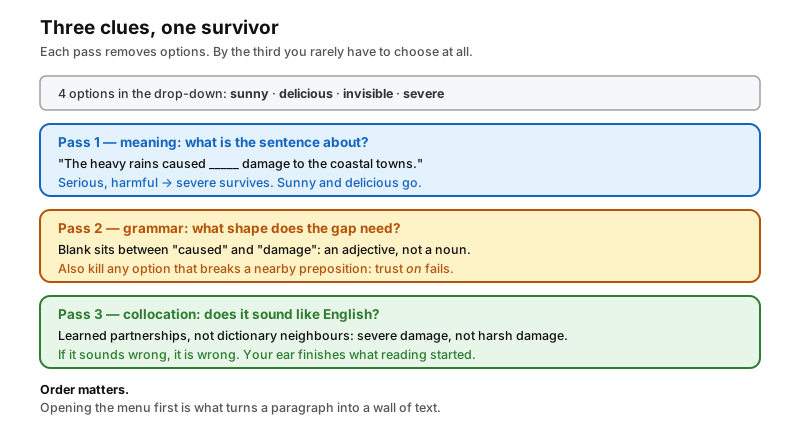
1. Context Clues (The Meaning)
Words never exist alone; they live in neighbourhoods. The sentences before and after a gap will almost always tell you what sort of word belongs there.
- Example: Suppose the sentence says, "The heavy rains caused _____ damage to the coastal towns," and your options are sunny, delicious, invisible, and severe. The context clue "heavy rains" tells you the missing word must describe serious, harmful effects — so severe is the only option that truly fits.
2. Grammar Clues (The Rules)
Sometimes you will not know the exact meaning of an option, but the grammar around the gap can rescue you anyway. Pay close attention to the small words beside it, especially prepositions (in, on, at, of, to, with).
- Example: If the blank is followed by "on," the word rely becomes attractive, because natural English pairs rely with on. Meanwhile you can eliminate trust immediately, because we do not say trust on.
- A second grammar trick: look at the part of speech the gap demands. If the blank sits directly before a noun, you almost certainly need an adjective; if it follows "to," you probably need a base verb. Suppose you see "a _____ increase in prices" and the options include sudden and suddenly. The gap sits between the article "a" and the noun "increase," so it needs an adjective: a sudden increase is correct English, while "a suddenly increase" is impossible.
3. Collocations (Natural Word Partnerships)
This is the most powerful tool of the three. In English, certain words behave like close friends: they simply sound right together. We say "fast food," not "quick food," and we make a "big mistake," not a "large mistake." These natural pairings are called collocations, and recognising them allows you to eliminate wrong answers almost entirely by ear.
Where do test writers find these pairings? Not from thin air. Pearson publishes an official Academic Collocation List, drawn from a large collection of academic English, showing the combinations that recur again and again in academic writing. Working through that list is one of the fastest vocabulary investments you can make for this task.
Fifty Partnerships Worth Learning Before Test Day
You do not need to swallow the entire dictionary. To get you started, here are fifty common, useful collocations of exactly the kind that fills academic texts — including PTE-style passages.
Read the pairs aloud to yourself regularly. Better still, pick three or four each day and write one short sentence using each pair; words you have personally used are far harder to forget than words you have merely seen. The more your ear hears these partnerships, the faster the right answers will leap off the page on test day.
| Collocations 1–25 | Collocations 26–50 |
|---|---|
| 1. academic achievement | 26. gain insight |
| 2. accurate assessment | 27. global economy |
| 3. achieve a goal | 28. heavily influenced |
| 4. active participation | 29. historical context |
| 5. adverse effect | 30. human behaviour |
| 6. allocate resources | 31. immediate environment |
| 7. alternative approach | 32. increasingly important |
| 8. apply a method | 33. inextricably linked |
| 9. appropriate action | 34. initial stage |
| 10. artificial intelligence | 35. intellectual property |
| 11. assume responsibility | 36. largely ignored |
| 12. available data | 37. logical conclusion |
| 13. basic assumption | 38. major contribution |
| 14. become apparent | 39. mutually exclusive |
| 15. beneficial effect | 40. negative impact |
| 16. brief overview | 41. objective criteria |
| 17. broad spectrum | 42. obtain information |
| 18. capitalist economy | 43. overall performance |
| 19. carry out research | 44. poorly understood |
| 20. causal link | 45. potential benefits |
| 21. central issue | 46. practical application |
| 22. changing circumstances | 47. primary focus |
| 23. closely allied | 48. promote equality |
| 24. comprehensive review | 49. provide evidence |
| 25. considerable impact | 50. raise awareness |
Notice how many of these partnerships follow patterns you can reuse: verbs paired with nouns (allocate resources, raise awareness), adjectives paired with nouns (adverse effect, logical conclusion), and adverbs paired with adjectives (increasingly important, poorly understood). Learning the patterns multiplies the value of every individual pair.
A Working Order for Each Blank — Inside One Shared Clock
Knowing the strategy is one thing; running it while the section clock runs down is quite another. Remember that the reading tasks share a single timer: nothing grants you a private allowance per question, so pacing is entirely in your hands. Aim to settle each blank briskly and steadily, banking spare moments for the items that fight back later in the section.
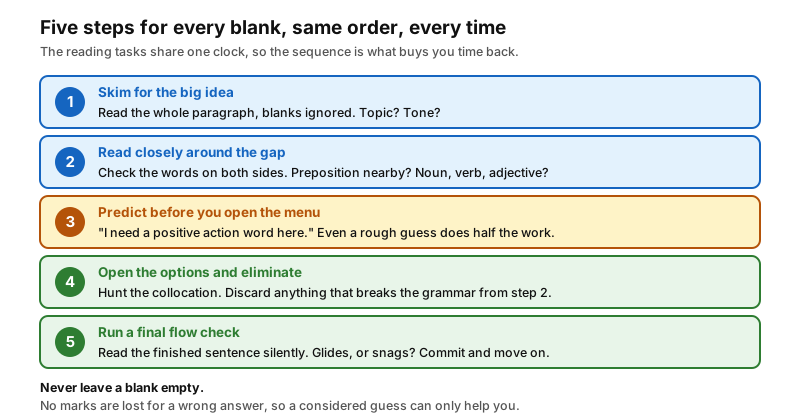
Follow this exact sequence every time you practise, so that it becomes second nature on exam day:
-
Skim for the big idea. Do not open the options yet. Read the whole paragraph from beginning to end, ignoring the blanks, and ask yourself: What is the main topic? Is the tone positive, negative, or neutral?
-
Read closely around the blank. Look at the words immediately before and after the gap. Is there a preposition nearby? Do you need a noun, a verb, or an adjective?
-
Predict before you peek. Guess what kind of word belongs there before opening the menu. Even a rough prediction — "I need a positive action word here" — has already done half the work.
-
Open the options and eliminate. Hunt for the collocation that matches the text, and discard anything that breaks the grammar you identified — an adjective, say, where a verb is clearly required.
-
Run a final flow check. Read the completed sentence silently. Does it glide, or does something snag? If it snags, re-check your grammar clues quickly, commit to your best choice, and move on without looking back.
One more rule worth engraving: never leave a blank empty. PTE Academic does not subtract marks for wrong answers, so a considered guess can only help you — while an untouched gap earns nothing at all.
Habits That Quietly Build This Skill Around a Busy Week
Progress in reading vocabulary rarely comes from dramatic study days; it comes from ordinary weeks repeated patiently. Here is the shape of practice I recommend to learners juggling jobs, families, or coursework.
Read material you genuinely enjoy. Motivation survives when the practice itself feels rewarding. Alongside your test materials, read articles about whatever absorbs you — technology, fashion, sport, psychology. Volume of comfortable reading is exactly what stocks your mental shelf of natural word partnerships, and Fill in the Blanks pays out from that very shelf.
Practise in short, regular bursts. If you are working full-time or raising a family, long study sessions may be impossible — and happily, they are unnecessary here. One short article a day, read during your commute or over morning coffee, is enough. Fifteen minutes daily builds more speed and intuition than occasional marathons, because regularity, not intensity, trains the reading mind.
Collect small wins as evidence. Did you get three out of five blanks right on a practice set today? That is measurable progress, and tomorrow the number may be four. Belief in your own ability is not summoned by pep talks; it grows from accumulated proof, and every correct blank is one more proof.
Nowhere in your preparation does consistency beat cramming more decisively than it does here. The collocations you meet this week will still be sitting quietly in your memory next month, provided you keep visiting them briefly and often.
Finishing the Story
Reading & Writing: Fill in the Blanks rewards a particular kind of attention: read for meaning first, choose words second. Train the five-step order until it runs automatically, learn the word partnerships a few at a time, and let your daily reading stock the shelves in the background. Do that consistently, and test-day paragraphs will stop resembling walls of text. They will feel like stories missing a few words — stories whose endings you know exactly how to write.
Related Articles
🎧 PTE Listening: Fill in the Blanks — How to Predict Words
Master the PTE Listening Fill in the Blanks task with prediction techniques. Learn to guess parts of speech and likely meanings before the audio plays.
📝 PTE Write from Dictation: 100 Most Common Sentences
Boost your PTE Write from Dictation score with 100 high-frequency sentences. Practice with grouped difficulty levels and memory techniques.
📝 PTE Summarize Written Text: How to Write a One-Sentence Summary
Master the PTE Summarize Written Text task with a step-by-step strategy. Learn to identify main ideas, use clause connectors, and write a perfect one-sentence summary.