🏆 10 High-Scoring Words and Phrases to Boost Your IELTS Lexical Resource Score
13 min read
2026-08-30
Discover 10 powerful words and phrases to boost your IELTS Lexical Resource score. Master less common vocabulary with correct collocation to achieve Band 7 or higher.
EngSandbox Editorial Team
Written with AI assistance and reviewed by our editors — experienced PTE/IELTS tutors. Every article is fact-checked against official band descriptors, the Academic Word List and Cambridge assessment research, then field-tested with learners before publishing. Human reviewed + field tested. Questions? Contact us — see our Editorial Process.

Here are two body paragraphs written in response to the same Task 2 question: "Some people think governments should invest in public transport rather than new roads. To what extent do you agree?"
Writer A:
"I agree with this proposal to a large extent. Trains and buses carry far more passengers than private cars, and they produce far less pollution. If governments invested in affordable public transport, many drivers would happily leave their cars at home. In my view, this would make city centres cleaner and quieter for everyone."
Writer B:
"I firmly assert the paramountcy of public transportation. Governments, as catalysts of societal progress, must advocate the prevailing view regarding vehicular infrastructure. Conversely, roads illustrate a deleterious paradigm for modern cities."
Which writer sounds more advanced? Most learners pick Writer B, because B uses longer and rarer words. Yet an examiner would reward Writer A, and understanding why is the fastest way to raise your vocabulary score.
Last spring, a learner I coached for IELTS 7.0 sent me an essay full of Writer B sentences. She had memorised a list of "high-scoring words" from a video and forced them all into one paragraph. Her mock Writing score came back as 5.5 for Lexical Resource with the comment "frequent errors in word choice and collocation." We replaced the list approach with the system in this guide: one precise phrase per idea, stored with its real sentence, rehearsed three times in speaking. Six weeks later her Writing moved to 6.5, with no new rare words added. The method below is that replacement.
What Examiners Mean by "Lexical Resource"
Lexical Resource is the official name for vocabulary in your marks. It accounts for a quarter of your Writing band score and shapes your Speaking band the same way.
Writer A has no rare words, yet every combination is precise: carry passengers, produce pollution, invest in transport, leave their cars at home. The descriptors for the higher bands reward two things: using less common lexical items and showing awareness of style and collocation. Rare words deployed awkwardly score lower than familiar words arranged expertly.
Writer B fails on this point. Assert normally takes a that-clause — assert that public transport deserves investment — so bolting it to abstract nouns sounds hollow; a catalyst causes change rather than describing a government's job; roads cannot illustrate anything. Each impressive word sits slightly wrong, and those slips drag the score down faster than plain words ever would.
| Band | What the descriptor says | What that sounds like |
|---|---|---|
| Band 6 | Adequate vocabulary; some inaccuracy in word choice and collocation | advocate about, prevailing view for one person's opinion, catalyst of with wrong preposition |
| Band 7 | Some less common items with some awareness of style and collocation; occasional inaccuracy | advocate for stricter laws, the prevailing view is that..., a catalyst for globalisation — precise chunk, right preposition |
| Band 8 | Wide vocabulary used naturally and precisely; rare minor errors | Same chunks as Band 7, varied across the essay without repetition |
The gap between Band 6 and 7 is not word length but collocation accuracy. That is the design of this guide.
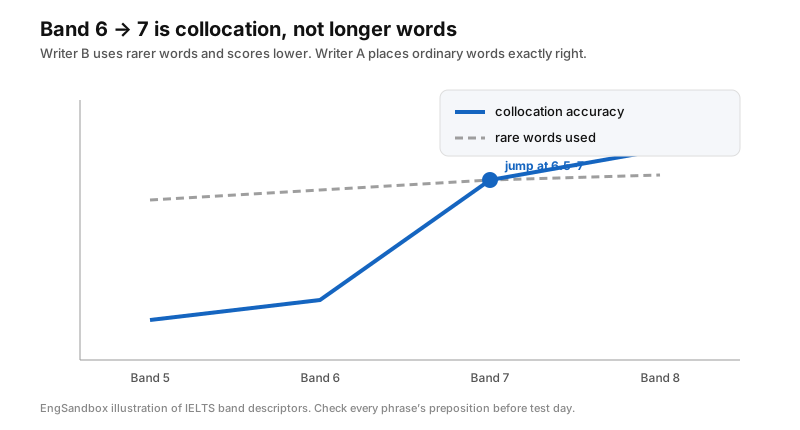
The Band 6 to 7 jump is collocation accuracy, not longer words — Writer A beats Writer B on placement, not rarity.
The same collocation awareness helps reading — see Benefits of Daily Reading for Language Acquisition and 75 Most Common English Collocations Every Learner Should Know.
Words Travel in Groups
Words love company. English speakers store language in ready-made chunks: make a mistake (never do a mistake), heavy rain (never strong rain). These partnerships are called collocations, and using them is what makes your English sound effortless.
Learners who memorise isolated words forget most within weeks, while those who record whole phrases keep both the words and the grammar that connects them. Every entry below therefore comes with a full sentence: steal the pattern, not just the word.
Collocation table: correct partner and the mistake that loses marks
Check every phrase against this before putting it into an essay. The "Why it fails" column is what examiners penalise.
| Phrase | Correct collocation | Common mistake | Why it fails |
|---|---|---|---|
| firmly assert | I firmly assert that public transport should be free. | assert about public transport | assert takes a that-clause, not about |
| advocate for | advocate for stricter laws | advocate to stricter laws | Wrong preposition; advocate for + noun |
| the prevailing view | The prevailing view is that technology isolates us | my prevailing view is that... | Phrase reports what most people think, not one person |
| conversely | Conversely, rural residents struggle. | Conversely to the city, rural... | Sentence adverb needs comma; use in contrast to if you need to |
| nevertheless | It is expensive. Nevertheless, it is valuable. | Nevertheless it is expensive but valuable | Do not pair with but |
| in stark contrast to | stands in stark contrast to rural life | contrast with rural life | Fixed to, not with |
| a prime example of | A prime example of this is the electric car | example for this | Preposition is always of |
| stem from | problems stem from lack of exercise | stem of lack of exercise | Cause follows from |
| a catalyst for | a catalyst for globalisation | catalyst of globalisation | Fixed for + noun |
| play a pivotal role in | plays a pivotal role in reducing emissions | role to reduce | in + -ing or noun, not to + verb |
| to a large extent | I agree to a large extent | to large extent | Article a required |
| give rise to | can give rise to stress | give rise of stress | Fixed to |
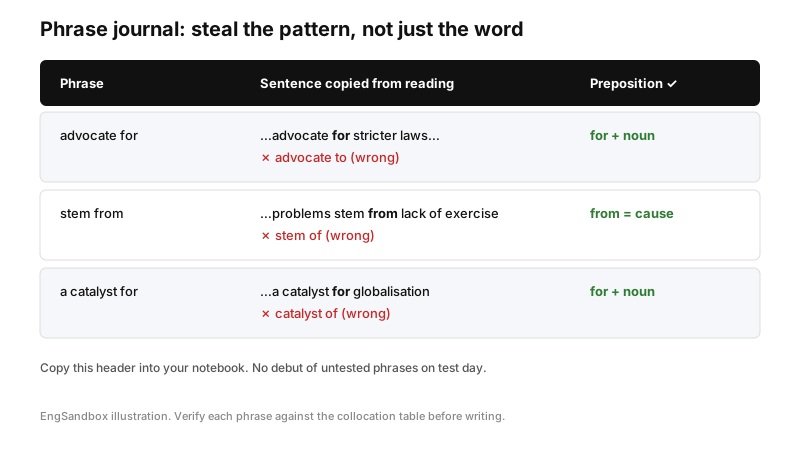
Journal format that examiners reward: phrase plus the real sentence plus the preposition checked — advocate for, stem from, a catalyst for.
Copy this header into your notebook and verify each phrase before writing — the same check an examiner will do after.
Twelve Phrases Worth Mastering
Grouped by the four jobs a Task 2 essay actually asks you to do. The first ten are the core set; the last two complete the hedging toolkit.
Category 1: Giving Your Opinion
1. Firmly assert
- Meaning: to state an opinion confidently.
- Example: "I firmly assert that public transport should be free for students."
- Watch out: assert takes a that-clause. Never "assert about".
2. Advocate for
- Meaning: to publicly support a policy.
- Example: "Many environmentalists advocate for stricter laws on plastic pollution."
- Bonus: noun too: "a strong advocate for cycling infrastructure."
3. The prevailing view
- Meaning: the opinion most people hold now.
- Example: "While the prevailing view is that technology isolates us, I believe it connects people globally."
- Why it earns marks: presents others' opinions neutrally before you answer.
Category 2: Showing Contrast
High-scoring essays weigh two sides before concluding — the same balance taught in IELTS Writing Task 2: The Foolproof 4-Paragraph Essay Structure for Band 7+ and 20 Linking Words That Boost Your IELTS Writing Score.
4. Conversely
- Meaning: in an opposite way.
- Example: "City dwellers enjoy hospital access. Conversely, rural residents often struggle to find care."
- Watch out: comma after it when it opens a sentence.
5. Nevertheless
- Meaning: despite what was just said.
- Example: "Studying abroad is expensive. Nevertheless, it offers life-changing opportunities."
- Speaking tip: pause briefly after it; the pause sounds calm.
6. In stark contrast to
- Meaning: strikingly different from.
- Example: "The pace of life in Tokyo stands in stark contrast to rural villages."
- Watch out: needs a genuine opposite, not merely a different size.
Category 3: Explaining and Giving Examples
7. A prime example of
- Meaning: a particularly clear case of something.
- Example: "The shift to electric cars is a prime example of industry adapting to climate concerns."
- Watch out: keep of at the end.
8. To illustrate this point
- Meaning: to make my meaning clearer with a concrete case.
- Example: "Children acquire language quickly. To illustrate this point, watch a toddler singing a cartoon song — she absorbs grammar before opening a textbook."
9. Stem from
- Meaning: to be caused by.
- Example: "Many health problems stem from a lack of daily exercise."
- Note: cause follows from: the problem stems from its cause.
10. A catalyst for
- Meaning: something that triggers major change.
- Example: "The internet acted as a catalyst for globalisation."
- Why it works: science term adopted into academic English; correct for shows control.
Category 4: Hedging and Precise Cause (the two additions that fix Band 6 overclaim)
Band 6 essays often claim 100 percent — I completely agree. Band 7 hedges and names cause precisely.
11. Play a pivotal role in
- Meaning: to be crucially important in causing or enabling something.
- Example: "Teachers play a pivotal role in shaping students' attitudes."
- Watch out: play a pivotal role in + noun or -ing: in reducing emissions, not to reduce.
12. To a large extent / Give rise to
Two sides of the same coin; learn them as a pair.
- To a large extent — Meaning: mostly, but not entirely. Safe replacement for completely when you partly agree.
- Example: "I agree to a large extent that governments should fund buses, although rural roads still matter."
- Give rise to — Meaning: to cause, especially an outcome that develops over time.
- Example: "Poor planning can give rise to traffic that stems from the same root cause."
- Watch out: give rise to needs a noun after to: give rise to inequality, not of.
With these four categories you can open, contrast, exemplify, and hedge — the four jobs Task 2 actually tests.
Before / After: Rewriting a Band 6 Paragraph to Band 7
Same ideas, same number of phrases; the difference is collocation accuracy. Annotations show why one stays at Band 6.
Band 6 attempt (5 phrases, 4 slips)
"I firmly assert about the paramountcy of public transport. Governments as catalysts of societal progress must advocate to stricter investments. Conversely to city life, rural areas need roads. Many health problems stem of pollution, which is in stark contrast with cleaner buses."
Why an examiner keeps this at Band 6:
- firmly assert about — wrong preposition (needs that)
- as catalysts of societal progress — catalyst for is the collocation; role forced into a definition
- advocate to stricter investments — needs advocate for
- Conversely to city life — Conversely, is a sentence adverb; use In contrast to
- stem of pollution — stem from
- in stark contrast with — fixed to
Five attempted phrases, four inaccurate. That reads as "some awareness with frequent error" — Band 6.
Band 7 rewrite (5 phrases, 0 slips)
"I agree to a large extent that governments should prioritise public transport. Buses play a pivotal role in reducing pollution and congestion. Nevertheless, rural communities still depend on roads for access to hospitals. Poor planning can give rise to problems that stem from the same cause: car-dependent design stands in stark contrast to a system where affordable buses are a prime example of inclusive policy."
What changed:
- to a large extent hedges instead of overclaiming
- play a pivotal role in reducing keeps in + -ing
- Nevertheless, opens a new sentence with a comma
- give rise to problems that stem from chains two cause phrases with correct prepositions
- in stark contrast to + a prime example of close the paragraph with checked collocations
Same five phrases, zero slips. Examiners can now tick "uses less common vocabulary with some awareness of collocation" with only occasional slips elsewhere — Band 7.
Your turn: Take your last Task 2 body paragraph and rewrite it under the same constraint — same ideas, at most one phrase per sentence, every preposition checked against the table.
The Dos and Don'ts of Exam Vocabulary
DO: keep a phrase journal. Record the entire sentence where you found catalyst — a catalyst for change, not just catalyst. Whole sentences teach the grammar glue. The 15-minute capture method in Benefits of Daily Reading gives you one real sentence per day.
DON'T: stack big words into one sentence. "I firmly assert that the prevailing view stems from a catalyst of urban development." Every phrase is from today's list, yet the sentence says almost nothing, because stems from demands a genuine cause. One precise phrase per idea is plenty.
DO: say every phrase out loud. Even for Writing, read the examples aloud. Phrases you have spoken feel familiar in Speaking instead of frightening.
DON'T: debut a new word on test day. If a phrase wobbles in memory, reach for a simpler word you trust. State used accurately beats assert used blindly. Save untested phrases for practice.
DO: test each phrase in Speaking Part 3. Prompts such as How has transport changed in your country? invite play a pivotal role in and give rise to naturally. See IELTS Speaking Part 3: How to Give Extended Answers.
From Journal to Instinct: A 7-Day Plan
A phrase becomes yours after roughly three honest uses: once in an essay, once in a conversation, once in an email. Start small.
| Day | Task (10 minutes) | Phrases to use |
|---|---|---|
| Mon | Copy 3 phrases with full sentences into your journal | firmly assert that / advocate for / the prevailing view |
| Tue | Write one body paragraph (120w) using max 2 of Mon's phrases | Reuse Mon's 2, check prepositions |
| Wed | Record a 60-second answer using Tue's paragraph aloud | Same 2, spoken |
| Thu | Add 2 new phrases; write a new paragraph using 1 old + 1 new | nevertheless / in stark contrast to |
| Fri | Cover the example column and reproduce the collocations | All 5, focus on for/to/in/from |
| Sat | Full Before/After rewrite: fix only collocations in a Band 6 paragraph | Any 5 from the 12 |
| Sun | Quiz yourself: produce each of the 12 with its preposition from memory | All 12, mark wobbles for Monday |
Review the following day, three days later, and once a week after. Those few minutes matter more than any rush of new phrases. For the academic layer behind these, see 100 Academic Words Every University Student Must Know and 75 Most Common English Collocations.
FAQ
Should I use these phrases in Speaking too? Yes, but soften them. I firmly assert is written register; in Speaking prefer I would argue that or To a large extent, I think.... Nevertheless works with a slight pause. Save a catalyst for for longer explanatory answers.
Is it safe to use advanced words from a random list? Only if you have seen the word in three real sentences and can reproduce its preposition without checking. Unchecked borrowing is why Writer B scores lower despite rarer vocabulary. Prefer 12 checked phrases to 50 unchecked ones.
How many phrases should I use in one essay? Five to six across the whole Task 2 essay is plenty — roughly one per body paragraph plus one in introduction or conclusion. More than that suggests memorisation. The Before/After above uses five and keeps Band 7.
What if I blank on a phrase during the exam? Drop it and use a simpler accurate phrase. I think this causes is safer than a half-remembered give rise of. Accuracy under pressure is the Band 7 habit.
Final Thoughts
Writer A did not win by knowing rarer words. They won by knowing ordinary words extraordinarily well — placing carry, produce, invest in, leave at home exactly where a native speaker expects them. The 12 phrases here give you the same leverage at a higher register, but only if you give each phrase its correct company.
Choose two phrases today. Use one in tomorrow's paragraph and the other in a conversation. The next day, verify the prepositions against the table before adding anything new. That verification — not the number of words you collect — lifts Lexical Resource from Band 6 to 7.
Next up: Practise the contrast job with IELTS Writing Task 2: The Foolproof 4-Paragraph Essay Structure, or broaden the base that makes these phrases feel natural with Benefits of Daily Reading.
Related Articles
🎓 100 Academic Words Every University Student Must Know
Master 100 essential academic words every university student needs. Learn key vocabulary for lectures, essays, and exams with definitions and usage examples.
📚 50 Phrasal Verbs for Everyday English
Learn 50 essential phrasal verbs organized by everyday topics. Master work, travel, relationships, and communication vocabulary with definitions and examples.
🔗 20 Linking Words That Boost Your IELTS Writing Score
Master 20 essential linking words to improve your IELTS Writing coherence and cohesion. Learn how to connect ideas smoothly and boost your band score.