🎤 IELTS Speaking Part 2: How to Prepare Any Cue Card Topic in Under 1 Minute
8 min read
2026-06-09
Learn a proven strategy to prepare any IELTS Speaking Part 2 cue card topic in under one minute, with frameworks, keywords, and confidence-building techniques.
EngSandbox Editorial Team
Written with AI assistance and reviewed by our editors — experienced PTE/IELTS tutors. Every article is fact-checked against official band descriptors, the Academic Word List and Cambridge assessment research, then field-tested with learners before publishing. Human reviewed + field tested. Questions? Contact us — see our Editorial Process.

The examiner slides a cue card across the table, sets a pencil and a sheet of paper beside it, and announces that you have one minute to prepare a talk of up to two minutes. Then the clock starts, and sixty seconds suddenly feel like ten.
If that image quickens your heartbeat, you are in very normal company. Nearly every learner I have prepared for IELTS Speaking Part 2 describes the same moment: the mind empties, the pencil hovers, and a small voice insists there is nothing worth saying. Here is what I tell them, and what I invite you to hold on to: the long turn is not a talent contest. Handling a cue card is a skill, and like riding a bicycle or cooking a favourite meal, it improves with a clear method and honest practice.
This guide hands you that method. You will learn exactly how to spend your one minute of preparation, why the approach keeps nerves manageable, and how to sidestep the traps that catch so many candidates. Towards the end, we will prepare five complete cue cards together so you can watch the strategy working.
The One-Minute Blueprint: Spending Your Sixty Seconds Well
When the examiner starts the clock, you have sixty seconds. Here is how to divide them so that you begin your talk feeling organised rather than rattled.
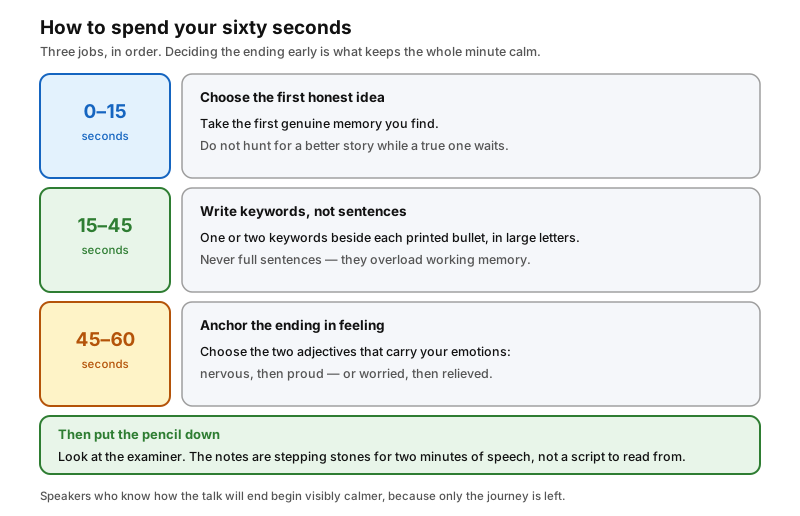
Seconds 0 to 15: Choose the First Honest Idea
The moment you finish reading the topic, accept the first genuine idea that arrives. Do not search for the perfect story. The most common waste of preparation time is spending half the minute hunting for something impressive while a simple, true memory waits unnoticed. If the card asks you to describe a time you helped someone and you remember helping your younger brother with his homework, take it. Never feel obliged to invent a drama about rescuing a stranger from a fire. True memories are easier to speak about than invented ones, because the images, the order of events, and much of the vocabulary already live in your mind.
Seconds 15 to 45: Write Keywords, Not Sentences
You now have roughly thirty seconds at the paper. Never write full sentences. Look instead at the bullet points printed beneath the prompt. Cue cards follow a stable pattern: several points establish the basics — who or what, when and where, sometimes who shared the moment with you — and the final point always begins with the words and explain, usually asking how you felt. Write one or two keywords beside each point, in large clear letters. Those keywords become stepping stones that carry you across the whole two minutes of speaking.
Seconds 45 to 60: Anchor Your Ending in Feeling
Reserve the last fifteen seconds for that final bullet. Choose now the two adjectives that will carry your emotions — nervous and then proud, or worried followed by relieved — and write them down. In my experience, the speakers who know precisely how their talk will end begin visibly calmer, because the destination is settled and only the journey remains. A sincere emotional close also gives a talk a natural landing, and listeners remember landings.
Why the Mind Goes Blank, and How This Plan Protects It
Once you understand what happens inside your head during that minute, the blueprint stops looking arbitrary and starts looking obvious.
Anxiety behaves like an invisible wall between your ideas and your mouth. Feel reasonably calm and the wall stays down, letting phrases you barely knew you owned come out smoothly. Let stress spike and the wall rises, hiding vocabulary you have used happily for years. Every experienced tutor watches this happen; it is the most common reason a well-prepared candidate performs below their level on the day.
Working memory raises the second problem. At any instant, you can hold only a few items of information in your mind. Spend the preparation minute composing elegant full sentences and you overload it, arriving at the first second of your long turn already exhausted.
Purpose matters too. The long turn exists to measure how naturally you communicate — how smoothly you travel from one idea to the next — not how faithfully you recite a script. Memorised speeches rarely survive contact with nerves in any case: one forgotten line and the whole performance trembles. Keyword notes protect your working memory, keep the wall low, and leave room for genuine speech. That is the entire logic of the plan.
Three Traps in the Exam Room, and How to Step Past Them
Trap 1: Changing your mind halfway. Around second thirty, doubt whispers that your idea is too dull and something better must exist.
The fix: Trust your first choice. The examiner is assessing your English, not the excitement of your biography. A clearly told story about sharing a cup of tea with a neighbour serves you far better than a confusing scramble through imagined skydiving.
Trap 2: Talking to the paper. Notes written as sentences drag your eyes downwards, and candidates end up addressing their handwriting instead of the person in front of them.
The fix: Keep keywords large and few. Put the pencil down the moment the minute ends. Look at the examiner, smile, and glance at your notes only when you need the next stepping stone.
Trap 3: Dreading the empty seconds. Many learners fear falling silent before the two minutes finish.
The fix: Slow down and decorate with detail. Mention a café and describe the smell of the coffee and the colour of the chairs; mention an evening walk and name the streets you take. Detail fills time generously, displays useful vocabulary, and — if a gap opens anyway — you can simply return to an earlier keyword and widen it with one example. Nobody expects relentless momentum; steady is enough.
Five Cue Cards, Prepared Together
Now let us set the strategy to work on five classic topics: a person, a place, an object, an event, and an activity. Notice how brief the notes remain. Afterwards, try the same process tonight with any practice cue card: set a timer for sixty seconds, jot your keywords, then record yourself speaking for two minutes. Hearing a playback once a week is one of the quickest ways to recognise your own habits.
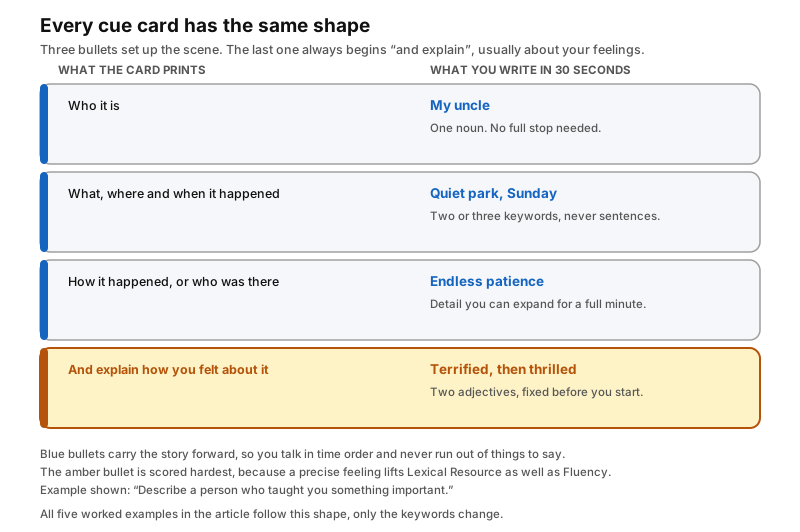
Example 1: Describe a Person
The Prompt: Describe a person who taught you something important.
- Who the person is
- What they taught you
- How they taught you
- And explain how you felt about this person
Your 1-Minute Notes:
- Who: My uncle
- What: Riding a bicycle
- How: Quiet park, endless patience, no training wheels
- Feelings: Terrified at first, then thrilled, grateful afterwards
Why this works: You have chosen a simple, real memory, so nothing needs translating as you speak. Your energy flows into the sunny park, the patient voice beside you, and the honest feeling words at the end — which give the whole talk its landing.
Example 2: Describe a Place
The Prompt: Describe a quiet place you like to spend time in.
- Where it is
- How often you go there
- What you do there
- And explain why you like it
Your 1-Minute Notes:
- Where: City library, third floor
- When: Sunday mornings, rainy afternoons
- What: Read novels, sip coffee from a thermos
- Why: Peaceful, smell of old paper, escape from noise
Why this works: "Peaceful" and "the smell of old paper" are natural pairings, not textbook lists. Concrete touches such as "the third floor" and "a thermos" add texture to your answer without demanding advanced grammar.
Example 3: Describe an Object
The Prompt: Describe something special you lost and later found again.
- What it was
- How you lost it
- How you found it
- And explain how you felt about it
Your 1-Minute Notes:
- What: Silver watch (grandfather's)
- Lost: Chaotic week, moving flat
- Found: Months later, in a winter coat pocket
- Feelings: Devastated, then relieved, deeply moved
Why this works: "Devastated" and "relieved" are precise emotion words that lift Lexical Resource at once, and the story owns a natural shape — the upheaval of moving, the loss, the unexpected discovery — so your two minutes almost organise themselves.
Example 4: Describe an Event
The Prompt: Describe a memorable celebration you attended.
- What the celebration was
- Who was there
- What happened
- And explain why it was memorable
Your 1-Minute Notes:
- What: Sister's university graduation
- Who: The whole family, grandparents travelling a long way
- Happened: Long ceremony, sunshine, big family dinner
- Why: Proud, end of a long journey, joyful
Why this works: Celebrations overflow with material, which is exactly why candidates wander. Keeping your notes to just "long ceremony" and "big family dinner" holds the talk on course and lets the pride surface in your own words.
Example 5: Describe an Activity
The Prompt: Describe a healthy habit you have.
- What it is
- When you do it
- How you started it
- And explain why it is good for you
Your 1-Minute Notes:
- What: Twenty-minute evening walk
- When: After dinner, before bed
- Started: Doctor's advice during a spell of poor sleep
- Why: Clears the mind, settles digestion, refreshes
Why this works: Nobody needs an elaborate gym routine to impress anyone. A short nightly walk lets you discuss health, rest, and peace of mind comfortably — and comfort, as we saw earlier, is what keeps the invisible wall down.
Feeling Words That Travel Between Topics
Strong performance in the long turn rests partly on Lexical Resource, one of the four official speaking criteria, alongside Fluency and Coherence, Grammatical Range and Accuracy, and Pronunciation. Range does not demand swallowing a dictionary. It asks for a compact set of flexible, precise expressions that suit many topics, plus the composure to use them naturally.
| Basic Word | Better IELTS Upgrade | Example Sentence to Use |
|---|---|---|
| Happy | Thrilled / Over the moon | "When I finally passed the test, I was absolutely thrilled." |
| Sad | Devastated / Heartbroken | "I was heartbroken when I realised I had lost the watch." |
| Good | Incredible / Memorable | "It was an incredibly memorable occasion for my whole family." |
| Bad | Frustrating / Disappointing | "Waiting in the rain for a bus that never arrived was utterly frustrating." |
| Tired | Exhausted / Drained | "After the long journey, I felt drained but quietly happy." |
| Beautiful | Breathtaking / Stunning | "The view from the top of the mountain was simply breathtaking." |
And when a precise word abandons you mid-sentence, do not freeze — paraphrase. Describing around a missing word ("the metal thing you use to open a bottle") is not a confession of weakness; handling it smoothly is itself a marker of a fluent speaker.
Choose three favourites from the middle column and practise easing them into real conversation this week. Fifty new words crammed at once will jam under pressure; three comfortable ones will arrive on their own.
Fitting Cue-Card Practice into a Crowded Week
Most learners balance preparation against a job, university classes, or family life, and long free stretches are scarce. The answer is habit stacking in its plainest form: attach a tiny new habit to one you already have, and let the old routine remind you to perform the new one. Five-minute windows are genuinely enough:
- In the shower: pick a random topic, such as describing a favourite food, and mentally sketch your four bullet points.
- On the commute: choose a building outside the window and build a one-minute spoken outline about it.
- While cooking: talk aloud about the ingredients in your hands and how the dish makes you feel.
Brief, frequent sessions suit the brain far better than one heroic Sunday marathon followed by six silent days, because recall strengthens through returning.
Walking In with a Plan
Remember, too, that the examiner is not setting traps. Their role is to hear your voice, your ideas, and something of your character; the two-minute cut-off exists because the format requires it, not because anything has gone wrong. Knowing the shape of the task removes half of its fright.
So keep faith with the blueprint: accept the first honest idea, write a handful of keywords, anchor the ending in feeling, and let detail stretch your minutes. Practise in small pockets through the week, forgive yourself the wobbly days, and treat every practice card as one more stone laid under your feet. Learners who prepare in this steady way tend to walk into the speaking room noticeably calmer — and calm, in the long turn, is very close to what fluent sounds like.
Related Articles
🏆 10 High-Scoring Words and Phrases to Boost Your IELTS Lexical Resource Score
Discover 10 powerful words and phrases to boost your IELTS Lexical Resource score. Master less common vocabulary with correct collocation to achieve Band 7 or higher.
🎧 IELTS Listening: How to Avoid Distractors and Identify the Correct Answer in Multiple-Choice Questions
Learn how to spot and avoid common distractors in IELTS Listening multiple-choice questions. Master strategies to identify the correct answer and boost your band score.
✍️ IELTS Writing Task 2: The Foolproof 4-Paragraph Essay Structure for a Band 7+
Master the IELTS Writing Task 2 with a simple, foolproof 4-paragraph essay structure. Learn how to plan, write, and polish your essay for a Band 7 or higher.