🎧 IELTS Listening: How to Avoid Distractors and Identify the Correct Answer in Multiple-Choice Questions
8 min read
2026-06-16
Learn how to spot and avoid common distractors in IELTS Listening multiple-choice questions. Master strategies to identify the correct answer and boost your band score.
EngSandbox Editorial Team
Written with AI assistance and reviewed by our editors — experienced PTE/IELTS tutors. Every article is fact-checked against official band descriptors, the Academic Word List and Cambridge assessment research, then field-tested with learners before publishing. Human reviewed + field tested. Questions? Contact us — see our Editorial Process.

You are sitting in a quiet room. The recording starts. You are listening carefully — and then, just like that, you circle option B with confidence. But when the results come back, the correct answer was C. What happened?
If this sounds familiar, you are not alone. Many IELTS candidates find the listening section surprisingly tricky, especially the multiple-choice questions. The reason? Distractors. These are carefully designed "traps" built into the test to see whether you truly understand what you hear — or whether you are just reacting to words you recognise.
The good news is this: once you understand how distractors work, you can beat them. This guide will walk you through the five most common trap types, show you exactly what to listen for, and give you a proven strategy for catching signposting words that point you straight to the correct answer. Let's get started!
What Is a Distractor — and Why Does IELTS Use Them?
A distractor is a wrong answer that is designed to sound correct. According to the official IELTS test format published on IELTS.org, the listening section contains 40 questions spread across four recordings, and multiple-choice questions can appear in any part of the test. The recordings include a mix of monologues and conversations, featuring a range of accents including British, Australian, American, and other varieties of English.
The test designers — Cambridge Assessment English, in partnership with the British Council and IDP — deliberately include distractors to measure your ability to understand meaning and context, not just individual words. As the British Council's IELTS preparation guidance makes clear, the listening test is not a simple word-matching exercise. It requires you to process language at a deeper level.
Researcher John Field, in his influential book Listening in the Language Classroom (Cambridge University Press, 2008), explains that second-language listeners often struggle because they rely too heavily on "bottom-up" processing — that is, catching individual words — rather than using the wider context of a conversation to guide their understanding. This is exactly the gap that IELTS distractors are designed to expose.
Understanding this shifts your mindset. You are not just listening for words. You are listening for meaning. That is a big and empowering difference.
The 5 Most Common Distractor Traps — and How to Spot Them
Here is your essential reference table. Study it carefully, because these five trap types appear again and again across IELTS practice materials and real exam recordings.
| Trap Type | What the Speaker Says (Distractor) | What the Correct Answer Is | Key Signal to Listen For |
|---|---|---|---|
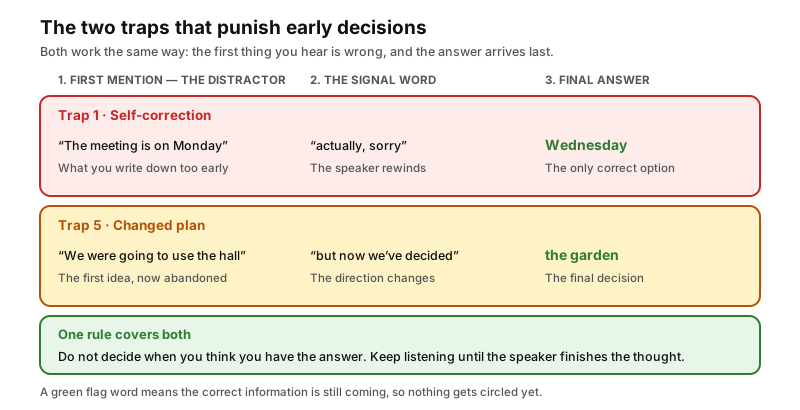
| 1. Self-Correction Trap | "The meeting is on Monday — oh, actually, sorry, it's on Wednesday." | Wednesday (the corrected information) | Words like actually, sorry, I mean, no wait, I should say |
| 2. Synonym / Paraphrase Trap | Speaker says "the price was reduced" but the options say "the cost went down" | The option that paraphrases what was said, not the exact words | The meaning matches, not the vocabulary |
| 3. All-Options-Mentioned Trap | Speaker discusses A, B, and C, but only C actually answers the question | The option that directly responds to the question asked | Re-read the question before the recording; focus on what is being asked |
| 4. Negation Trap | "The centre does not open on Sundays" but option D says "open on Sundays" | The option that reflects the negation (e.g., "closed on Sundays") | Words like not, never, no longer, except, unless, apart from |
| 5. First-Mentioned / Changed-Plan Trap | "We were going to use the hall, but now we've decided on the garden." | The final plan or decision (the garden) | Words like but, however, in the end, we've decided, actually, instead |
Let's look at each of these in a little more detail, because knowing the name of a trap and truly feeling it in a real listening situation are two different things.
Trap 1: The Self-Correction Trap
This is one of the most common and most frustrating traps for learners. The speaker says something, then corrects themselves. If you are not listening carefully, you write down the first piece of information — which is wrong.
Common mistake: Many learners underline or circle information as soon as they hear it, without waiting to see if the speaker changes it. Train yourself to keep listening after you think you have found the answer.
Tip: When you hear a self-correction word such as "actually," "sorry," "I mean," or "no, wait," treat it as a green flag. The correct information is coming.
Trap 2: The Synonym / Paraphrase Trap
IELTS questions rarely use the exact words from the recording. This is intentional. Cambridge Assessment English has consistently confirmed that paraphrasing is a core feature of the IELTS listening test design. The question or the correct answer option will use different vocabulary to express the same idea.
Common mistake: Learners often eliminate the correct option because the wording "doesn't match" what they heard. They are listening for identical words, not for meaning.
Tip: Before the recording begins, look at each answer option and think of synonyms or alternative ways to say the same thing. For example, if option A says "affordable," be ready to hear "cheap," "low-cost," "budget-friendly," or "inexpensive" in the recording.
Trap 3: The All-Options-Mentioned Trap
This one is particularly clever. All three options are mentioned in the recording — but only one of them actually answers the question. The others are red herrings, included simply to confuse you.
Common mistake: Learners hear a word from option A and circle it immediately, without checking whether it genuinely answers what was asked.
Tip: Before the recording starts, read the question very carefully. Ask yourself: what exactly am I being asked? Is it asking for a reason, a problem, a time, a location, or an opinion? Keep that question sharp in your mind as you listen.
Trap 4: The Negation Trap
A speaker says "the café does not accept credit cards." An answer option reads "the café accepts credit cards." If you miss that small word "not," you will choose the wrong answer.
Research on second-language listening comprehension supports how challenging negation is. Larry Vandergrift and Christine Goh, in their book Teaching and Learning Second Language Listening (Routledge, 2012), note that learners often process the content words in a sentence while missing grammatical elements — including negation markers — especially under time pressure and anxiety.
Tip: Make a mental habit of treating negative words as alarm bells. When you hear "not," "never," "no longer," "except," or "unless," sit up a little straighter. That word is going to change the meaning of everything around it.
Trap 5: The First-Mentioned / Changed-Plan Trap
This trap appears most often in Part 2 (a monologue about a local topic) and Part 3 (a discussion between two or more students). Someone proposes an idea, then a new plan emerges. The original idea becomes the distractor. The final decision is the correct answer.
Common mistake: Learners record the first plan they hear and stop listening, assuming no change will come.
Tip: Listen all the way to the end of each exchange. Plans, ideas, and decisions can change. The final information is usually the correct answer when a change-of-plan trap is used.
The Signposting Words Strategy: Your Listening Compass
Now that you know the five trap types, let's talk about one of the most practical and effective listening strategies you can use: listening for signposting words.
Signposting words are the "road signs" of spoken language. They tell you where the speaker is going — whether they are about to add information, contradict something, give a reason, or change direction. When you learn to hear signposting words, you start to feel the shape of a conversation. You know when a trap is coming before it arrives.
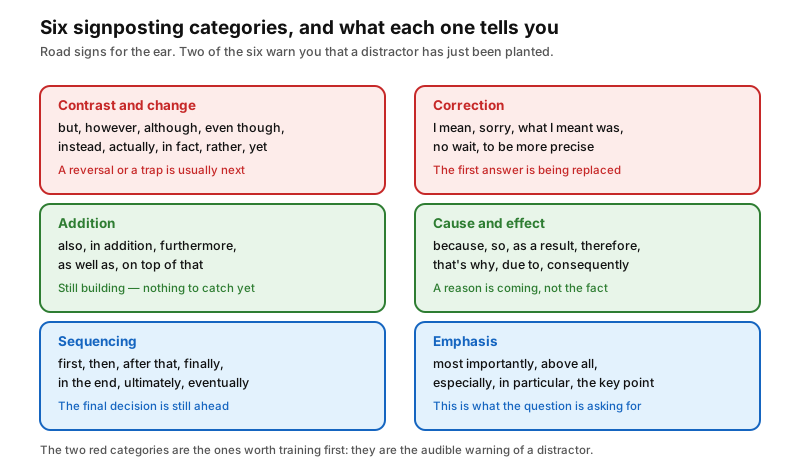
Here are the main categories of signposting words and what they signal:
Contrast / Change of Direction (these often signal a trap or a correction): but, however, although, even though, on the other hand, instead, actually, in fact, rather, yet
Correction or Clarification (self-correction trap warning): I mean, sorry, actually, what I meant was, let me correct that, no wait, to be more precise
Addition (the speaker is building on information — keep listening): also, in addition, furthermore, as well as, not only that, on top of that
Cause and Effect (often found in negation or changed-plan traps): because, so, as a result, therefore, that's why, due to, consequently
Sequencing (helpful for tracking final decisions): first, then, after that, finally, in the end, ultimately, eventually
Emphasis (the speaker is highlighting the most important point): most importantly, above all, especially, in particular, the key point is, what matters most is
How to Practise Signposting Words
Here is a simple and effective exercise: when you listen to English podcasts, TED Talks, or news broadcasts, write down every signposting word you hear. After a week, you will start to hear them naturally, without trying. The British Council's LearnEnglish platform offers free audio materials at different levels, which are excellent for this kind of focused listening practice.
Common Mistakes and How to Avoid Them
Beyond the five trap types, learners make a few other predictable mistakes in IELTS multiple-choice questions. Here are the most important ones to watch for:
Panicking and losing your place. If you miss one question, it is easy to spend so much time worrying about it that you miss the next two. Accept the miss, move on, and come back to it during transfer time. One question is never worth three.
Not using the preparation time. IELTS gives you time to read the questions before each recording. Use every second of it. Read carefully, think about synonyms, and predict what kind of information you need (a number? a name? a reason?).
Trusting the first answer you think of. As you have seen from the trap types above, the first-mentioned option is often a deliberate distractor. Listen until the speaker finishes the relevant part before deciding.
Staying Motivated: A Kind Word About the Process
Learning to hear distractors takes practice, and it can feel frustrating at first. You might study hard, understand the traps logically, and still circle the wrong answer in a timed practice test. That is completely normal — and it does not mean you are failing.
Psychologist Carol Dweck's research on growth mindset, widely discussed in educational contexts, reminds us that the experience of making a mistake is actually where learning happens most powerfully. Every wrong answer you analyse is a step forward. Be curious about your mistakes, not ashamed of them.
A practical mindset tip: after each practice test, do not just check which answers were right and wrong. Sit with the recording for each question you missed, listen again, and identify which trap caught you. Was it a self-correction? A negation? Name it. By naming the trap, you take back control.
Adjusting When Life Gets Busy
Not everyone can study for two hours every day, and that is perfectly okay. If your schedule is full, even 15 focused minutes can make a difference. Here is a simple, flexible mini-plan:
- 10 minutes: Listen to one short audio clip (a podcast, a news segment, a YouTube video) and note every signposting word you hear.
- 5 minutes: Review one distractor type from this article and think of one real example from something you recently listened to.
Consistency matters far more than marathon study sessions. Small, regular practice keeps your listening skills sharp and your confidence steady.
A Final Encouraging Word
The IELTS listening test is genuinely designed to challenge you — but it is also completely learnable. Every distractor type follows a pattern. Every pattern can be recognised. Every signposting word is a clue waiting to be used.
You already have something powerful: awareness. Now that you understand how the traps work, you will start to notice them in practice materials, in podcasts, in everyday English conversations. That awareness is the beginning of mastery.
Keep going. You are more prepared than you realise.
Sources and Further Reading:
- Field, J. (2008). Listening in the Language Classroom. Cambridge University Press.
- Vandergrift, L., & Goh, C. C. M. (2012). Teaching and Learning Second Language Listening: Metacognition in Action. Routledge.
- Dweck, C. S. (2006). Mindset: The New Psychology of Success. Random House.
Related Articles
📝 IELTS Reading: How to Solve 'Matching Headings' Questions in Under 2 Minutes
Master the IELTS Matching Headings task with a proven under-2-minutes-per-paragraph strategy. Learn to skim topic sentences, avoid keyword traps, and boost your Reading band score.
✍️ IELTS Writing Task 2: The Foolproof 4-Paragraph Essay Structure for a Band 7+
Master the IELTS Writing Task 2 with a simple, foolproof 4-paragraph essay structure. Learn how to plan, write, and polish your essay for a Band 7 or higher.
🎤 IELTS Speaking Part 2: How to Prepare Any Cue Card Topic in Under 1 Minute
Learn a proven strategy to prepare any IELTS Speaking Part 2 cue card topic in under one minute, with frameworks, keywords, and confidence-building techniques.