🎤 IELTS Speaking Part 3: How to Give Extended, High-Scoring Answers
9 min read
2026-07-26
Master the IELTS Speaking Part 3 with strategies for giving extended, high-scoring answers. Learn how to structure opinions, use examples, and demonstrate fluency for Band 7+.
EngSandbox Editorial Team
Written with AI assistance and reviewed by our editors — experienced PTE/IELTS tutors. Every article is fact-checked against official band descriptors, the Academic Word List and Cambridge assessment research, then field-tested with learners before publishing. Human reviewed + field tested. Questions? Contact us — see our Editorial Process.

The examiner puts down the booklet, looks at you directly, and asks, "Some people say children today grow up too quickly. Why do you think that might be?" Your mind goes completely blank. You manage two short sentences about smartphones, trail off, and watch the examiner glance at the timer. If that moment feels familiar, take heart: Part 3 is where I watch even capable candidates stall in mock tests, and it is almost never because their English is weak.
Here is the reassuring truth: Part 3 does not test your knowledge of the world. It tests whether you can develop an idea out loud — at length, in clear, connected English. The gap between a Band 5 answer and a Band 7 answer is rarely intelligence or vocabulary size. It is structure: whether you extend your first thought with a reason, an example, and a consequence, or let it die after one sentence.
In this guide, we will unpack what the examiner actually hears during those four to five minutes, build a repeatable answer shape called OREC, work through strategies for the four most common Part 3 question types, and rehearse graceful ways to buy thinking time when your mind hesitates. Everything here can go straight into your next practice session.
What Part 3 Really Is — and What the Examiner Hears
First, a quick map of the territory. Part 3 begins the moment your Part 2 long turn ends, and it stays on the same topic — only broader. Describe a teacher you admired in Part 2, and the examiner will follow it with a four-to-five-minute discussion about education, childhood, or role models. It sounds like a conversation, but it is scored with the same care as everything else, against the four official criteria: Fluency and Coherence, Lexical Resource, Grammatical Range and Accuracy, and Pronunciation.
Many candidates believe Part 3 rewards expert knowledge. It does not. Nobody can grade whether your theory about childhood is correct. The Fluency and Coherence descriptors state plainly what earns credit: at Band 7, a candidate "speaks at length without noticeable effort or loss of coherence" and "uses a range of connectives and discourse markers with some flexibility." In plain language, that means:
- You keep going beyond two or three sentences without falling apart.
- Each idea leads logically to the next.
- Linking language — however, for instance, as a result — guides the listener through your thinking.
Lexical Resource works similarly. The higher-band criteria talk about discussing topics with flexible vocabulary and paraphrasing effectively — in other words, talking your way around a concept when the precise word escapes you. Notice what is missing from that description: any requirement for rare or academic words. A candidate who says "house prices have gone through the roof, so young couples struggle to get a foot on the ladder" sounds far stronger than one who forces in "the escalation of residential tariffs."
The contrast shows up in behaviour long before it shows up in scores:
| What tired candidates do | What Band 7+ candidates do |
|---|---|
| Give one sentence and stop | Develop the answer over four to six sentences |
| State an opinion flatly | Support it with a reason, an example, or both |
| Restate the same point in new words | Move on to a genuinely new angle |
| Freeze into long silences | Fill pauses with natural phrases |
| Ramble without signposts | Connect ideas with discourse markers |
None of the right-hand column requires specialist knowledge. Every item is trainable. One learner I coached answered nearly every opinion question with "I agree" and a shrug; we spent two lessons doing nothing except adding one reason and one example after each agreement, and her answers doubled in length without a single memorised sentence. That extension habit, more than anything else, is what we build below.
OREC: A Four-Step Shape for Almost Any Question
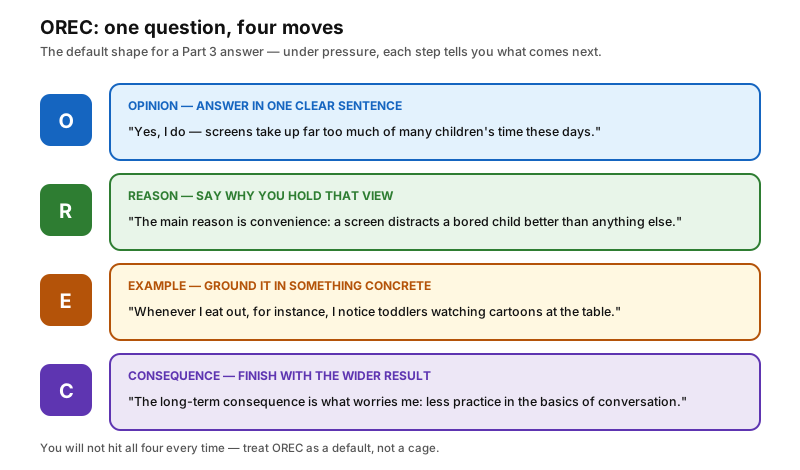
Under pressure, your brain wants a template. Without one, you default to short answers; with one, each step tells you what kind of sentence comes next, so you are never stranded mid-answer wondering what to say. We use OREC in lessons because it takes minutes to learn and fits nearly every abstract question:
O — Opinion: Answer the question directly, in one clear sentence. R — Reason: Explain why you hold that view. E — Example: Ground the idea in something concrete and specific. C — Consequence: Finish with the wider result or implication.
Let us see it in action. Imagine the examiner asks:
"Do you think children spend too much time on electronic devices these days?"
A typical underdeveloped reply:
"Yes, I think so. Children use phones and tablets a lot. It is not good for them."
Now the same opinion, built with OREC:
"Yes, I do — I think screens take up far too much of many children's time these days. The main reason is convenience: a tablet distracts a bored child more effectively than almost anything else, so screens become the default during meals, car journeys, and rainy afternoons. Whenever I eat out, for instance, I notice toddlers watching cartoons at the table while the adults chat above their heads. The long-term consequence is what worries me: some children seem to start school with very little practice in the basics of conversation — taking turns, asking questions, coping with boredom."
Follow that second answer from the examiner's chair: opinion, reason, example, consequence, each signposted (the main reason is, for instance, the long-term consequence). Nothing in it required research — only the habit of extending, which is exactly what moves a Fluency and Coherence score upwards.
Here is another one. The examiner asks:
"Why do you think some people prefer to work from home rather than in an office?"
"For me, the biggest factor is flexibility. Working from home lets people shape the day around their own energy levels and their family's needs, instead of around a fixed office timetable. A parent might start at seven in the morning, for example, so that they can finish in time to collect their children from school — something that would be practically impossible in a traditional office job. As a result, plenty of people find their work-life balance improves sharply the moment the commute disappears."
You will not hit all four steps every time; some questions invite a comparison rather than an example, and that is fine. Treat OREC as a default, not a cage. When a question does fit, though, it reliably produces the length and shape that the higher bands demand.
Four Question Types, Four Ways In
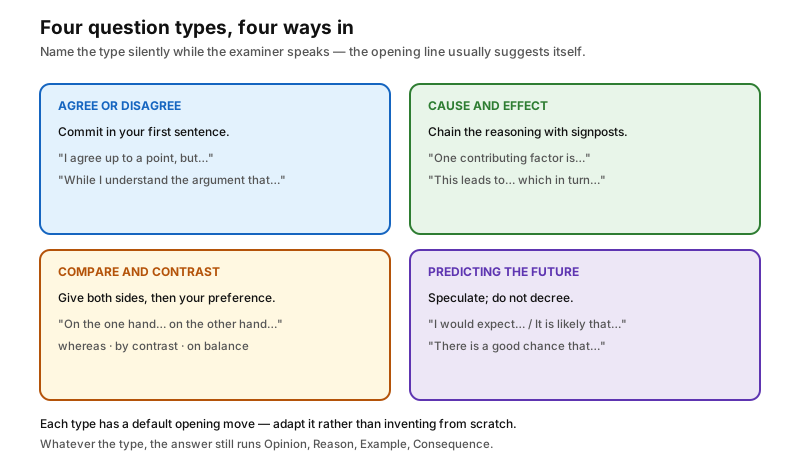
Part 3 questions cluster into recognisable families. If you can name the type silently while the examiner is still speaking, the right opening line usually suggests itself. These are the four we drill most often in lessons, with a model answer for each.
1. Agree or Disagree
- "Some people say public transport should be free. Do you agree?"
- "Do you think money can buy happiness?"
Strategy: Commit in your first sentence. Sitting on the fence for forty seconds reads as evasion. If your honest position is partial, say so immediately — "I agree up to a point, but..." — and then defend the part you have chosen. The word while balances two sides elegantly within a single sentence:
"While I understand the argument that free buses and trains would take cars off the road, I suspect they would create as many problems as they solve, because somebody still has to pay for the service — and that usually means higher taxes for everyone, including people who never set foot on a bus."
2. Cause and Effect
- "Why do you think obesity rates are rising in many countries?"
- "What effects does tourism have on small communities?"
Strategy: Chain your ideas with cause-and-effect signposts: one contributing factor is..., this leads to..., which in turn.... The examiner then hears a chain of reasoning rather than a shopping list — and reasoning earns credit:
"One major contributing factor is how cheap and convenient processed food has become. In many cities a burger costs less than a salad, and delivery apps bring it to your door in minutes, so eating badly takes almost no effort at all. This leads to a pattern in which busy families rely on takeaway food several nights a week, which in turn pushes obesity rates steadily upwards."
3. Compare and Contrast
- "How is education today different from when your parents were young?"
- "Is living in a city better than living in the countryside?"
Strategy: Give both sides airtime before revealing your preference, and make the comparison visible with whereas, by contrast, or on the one hand... on the other hand. Candidates who describe only one side leave the examiner waiting for a comparison that never arrives:
"On the one hand, cities concentrate opportunity: better-paid jobs, universities, and specialist hospitals are all close at hand. On the other hand, the countryside offers cleaner air, lower living costs, and a sense of neighbourliness that most cities lost decades ago. Personally, I would want a middle ground — a smaller town, perhaps, with fast rail links, where you could enjoy the best of both worlds."
4. Predicting the Future
- "How do you think technology will change education in the future?"
- "Will people still read printed books in fifty years?"
Strategy: Speculate; do not decree. Hedged language — I would expect..., it is likely that..., there is a good chance that... — displays grammatical range and protects you from sweeping claims an examiner could challenge. Absolute predictions such as "books will definitely disappear" invite trouble:
"I would expect artificial intelligence to play a much larger role in classrooms. Software already adjusts to a learner's pace in a way that a teacher facing thirty students never could, and that capability will only improve. Having said that, I doubt machines will replace human teachers entirely, because encouragement, patience, and sensing when a class has switched off remain deeply human skills."
Buying Thinking Time Gracefully
Silence feels dangerous in an exam room, yet every speaker — native speakers included — needs a beat to formulate ideas. The trick is to fill that beat with language that does communicative work, so the pause reads as thoughtfulness rather than struggle.
| The situation | Language that buys you a moment |
|---|---|
| You need a few seconds | "That is an interesting question — let me think for a second." |
| You want to confirm the question | "So you are asking whether... Is that right?" |
| The topic is unfamiliar | "I have not really thought about this before, but off the top of my head..." |
| You want to add a second perspective | "That is one way of looking at it, though another possibility is..." |
| You are moving between points | "Having said that, we should also consider..." |
Notice that none of these phrases is empty noise. Confirming the question demonstrates comprehension; admitting unfamiliarity is honest and buys three or four genuine seconds; "off the top of my head" signals that spontaneous reasoning is coming. What damages Fluency and Coherence is the opposite: long strings of "umm... yeah... like... you know..." that carry no meaning. One or two natural fillers sound human; a chain of them sounds stuck.
A second technique is reformulation. Take the question "Do you think governments should invest more in space exploration?" Instead of leaping straight in, begin like this:
"So, essentially, the question is whether public money belongs in space research when there are pressing needs here on Earth. It is a tricky balance..."
You have just earned several seconds of thinking time and demonstrated paraphrase, which the Lexical Resource criteria explicitly reward. When we rehearse this in lessons, it doubles as a comprehension check: if you have misunderstood the question, the examiner can correct you before you answer the wrong thing.
Five Habits That Quietly Cost Marks
Knowing the frameworks is not enough on its own; small habits undo them. These five are the ones I correct most often.
1. Answering the question you expected, not the one asked. Composing your answer while the examiner is still speaking practically guarantees mismatches. Let the question finish — those two seconds cost you nothing.
2. Listing instead of developing. Asked why people travel, a candidate recites "food, culture, weather, relaxation" and stops. Pick one motive and dig into it: whose food, what kind of culture, and what does the experience give the traveller? Depth beats breadth in Part 3.
3. Deploying memorised openers. "In today's modern world..." or "Since the dawn of time..." are instant red flags. Examiners hear them constantly, and recitation is easy to recognise. Start with your actual opinion instead — it always sounds fresher.
4. Freezing on unfamiliar topics. You are not expected to know anything specialised. Borrow the honest-guess formula: "I am not very familiar with this area, but if I had to guess, I would say..." — and then reason aloud. Handling an unfamiliar question coherently is precisely the skill Part 3 exists to test.
5. Confusing speed with fluency. Rushing produces errors, mumbled endings, and tangled logic; the official criteria reward a natural pace, not a fast one. Slow down, breathe between ideas, and let each sentence land before you start the next.
Part 3 Practice That Fits into Fifteen Minutes a Day
Full mock speaking tests matter, but the skills above develop perfectly well through short, frequent repetitions. When my learners' schedules collapse under work or study, we switch to micro-sessions like these:
- The five-minute OREC drill. Choose one Part 3 question from any practice book. Spend three minutes jotting an OREC skeleton — four bullet points, one per step — then speak the full answer aloud twice. You are training retrieval, not memorisation.
- Shadow an opinion. Play two minutes of any English-language interview or podcast. The moment the speaker states a view, pause and ask yourself: what was their opinion, reason, example, and consequence? You are teaching your ear to recognise extended answers — the same shapes you want your mouth to produce.
- Ninety seconds on record. Once a day, open your voice recorder, pick a question, and speak for ninety seconds without stopping. Resist replaying it immediately if listening back feels uncomfortable; the stamina itself is the win.
- Rehearse in the queue. Waiting for coffee or a bus, pick a theme — education, health, technology — and silently build one OREC answer. Mental rehearsal will not replace speaking aloud, but it keeps the structure active between proper sessions.
Whichever mix you choose, protect the frequency. Ten or fifteen focused minutes every day builds the reflex of thinking in extended answers far more effectively than a heroic three-hour session once a week — and that reflex, not talent, is what carries candidates through the real four to five minutes.
Where This Leaves You
Strip Part 3 down, and it asks for three things: a direct opening, ideas that lead somewhere, and language that connects them. None of that depends on luck on the day. OREC gives your thoughts somewhere to go; the question-type strategies tell you where to start; the thinking-time phrases keep your composure intact when your mind hesitates.
Be patient with the gap between knowing all this and doing it under pressure. Learners who drill these patterns consistently tend to walk into the test room noticeably calmer, because nothing the examiner asks is structurally new to them. So try one question tonight: opinion, reason, example, consequence — out loud, for ninety seconds. Then do it again tomorrow. Steady, unglamorous repetition is precisely how answers transform.
Related Articles
🎤 IELTS Speaking Part 2: How to Prepare Any Cue Card Topic in Under 1 Minute
Learn a proven strategy to prepare any IELTS Speaking Part 2 cue card topic in under one minute, with frameworks, keywords, and confidence-building techniques.
🏆 10 High-Scoring Words and Phrases to Boost Your IELTS Lexical Resource Score
Discover 10 powerful words and phrases to boost your IELTS Lexical Resource score. Master less common vocabulary with correct collocation to achieve Band 7 or higher.
✍️ IELTS Writing Task 2: The Foolproof 4-Paragraph Essay Structure for a Band 7+
Master the IELTS Writing Task 2 with a simple, foolproof 4-paragraph essay structure. Learn how to plan, write, and polish your essay for a Band 7 or higher.