📜 A Brief History of the English Language
15 min read
2026-08-28
Trace the fascinating journey of the English language from its Germanic roots to its status as a global lingua franca.
EngSandbox Editorial Team
Written with AI assistance and reviewed by our editors — experienced PTE/IELTS tutors. Every article is fact-checked against official band descriptors, the Academic Word List and Cambridge assessment research, then field-tested with learners before publishing. Human reviewed + field tested. Questions? Contact us — see our Editorial Process.

The English language has a rich and complex history that spans over fifteen centuries. What began as a collection of Germanic dialects spoken by a small number of tribes in what is now England has evolved into a global language spoken by over one and a half billion people worldwide. Understanding this history provides valuable insight into why English has so many irregularities and why it continues to change today.
Last autumn, a learner preparing for IELTS 7.5 asked me why though, through, tough and thought share -ough but sound nothing alike, and why government has a silent n. She had been memorising each spelling separately and losing marks for them. I showed her two facts on one page: the gh spellings were frozen by Caxton's press before the Great Vowel Shift finished, and government kept its French gouverner shape after 1066. Once she saw where the irregularity came from, she grouped similar words together and her spelling errors halved in three weeks. This article gives you that same map — a timeline you can refer to, two borrowing waves you can picture, and a practical filter for choosing the right word in academic writing.
Why This History Matters for You as a Learner
You do not need dates to pass IELTS or PTE, but you need a mental model for three frustrations.
1. Spelling feels inconsistent. It is. English fixed its spelling with the printing press around 1476-1500, then its pronunciation kept shifting for another 150 years. The spelling you see is often Middle English pronunciation frozen on paper. Knowing this turns knight (once pronounced with k and a hard gh) from a random trap into a predictable leftover.
2. Vocabulary feels twice as big as it should be. About 60 percent of English vocabulary comes from French and Latin, layered on a Germanic core. That is why English often has two words for one idea: ask (Germanic, everyday) versus question (French, formal). The 100 Academic Words Every University Student Must Know and 75 Most Common English Collocations both draw heavily from that French-Latin layer — recognising the layer helps you remember them.
3. Grammar feels simple but with odd leftovers. Old English had grammatical genders and case endings. Contact with Old Norse and later Norman French stripped most of them away, leaving the analytic word-order grammar you use today with fossils such as children (double plural) and pronoun they (borrowed from Norse). Knowing why the simplification happened helps you focus on the patterns that remain.
Keep these three lenses as you read: frozen spelling, doubled vocabulary, simplified grammar.
Timeline at a Glance: 450 to Today
Use this as a reference sheet. The sample sentence is the same idea — "The king loves fair words" — rendered as it would have looked in each period.
| Period | Years | Key event | Sample sentence (as written then) | Modern gloss |
|---|---|---|---|---|
| Old English | c. 450-1150 | Angles, Saxons, Jutes settle Britain; Viking contact from 8th c. | Se cyning lufaþ fægeru word | The king loves fair words |
| Early Middle English | 1150-1300 | Norman French dominates court after 1066; inflections erode | The king loveth faire wordes | The king loves fair words |
| Late Middle English | 1300-1500 | English re-emerges; Chaucer 1387-1400; printing press 1476 | The kyng loveth fayre wordes | The king loves fair words |
| Early Modern English | 1500-1700 | Great Vowel Shift; Renaissance Latin borrowing; Shakespeare | The king loves faire words | The king loves fair words |
| Late Modern English | 1700-1900 | Johnson's Dictionary 1755; Empire spreads English | The king loves fair words | — |
| Present-Day Global English | 1900-present | US media, internet, World Englishes | The government loves transparent communication | — |
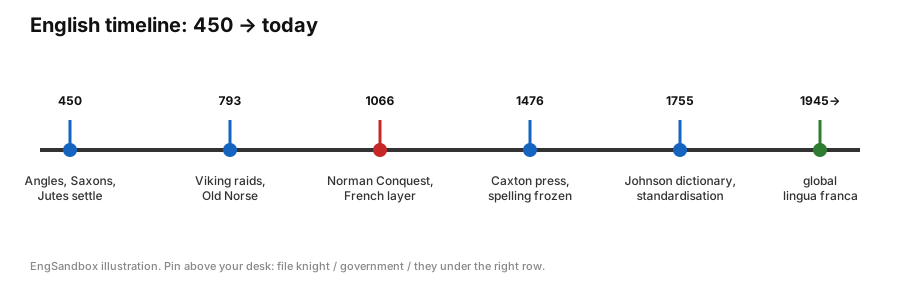
Six anchors for the timeline above: 450 settlement, 793 Viking contact, 1066 Conquest, 1476 press, 1755 dictionary, post-1945 lingua franca.
If you pin this table above your desk, you will know which row to file knight, government, or they under.
Old English: The Germanic Roots
The story of English begins in the fifth century CE, when Germanic tribes known as the Angles, Saxons, and Jutes migrated from what is now northern Germany and southern Denmark to Britain. They brought West Germanic dialects that became Old English. This early form was a highly inflected language with grammatical genders, cases, and verb conjugations — closer to modern Icelandic or German than to the English you use today.
Old English was not uniform. Four main dialects existed: Northumbrian north of the Humber, Mercian in the Midlands, West Saxon in the south and west, and Kentish in the southeast. Most surviving texts, including Beowulf, are in West Saxon, so our view is filtered through that prestige dialect. Regional words such as bairn (child) in Scotland and northern England go back to Northumbrian forms.
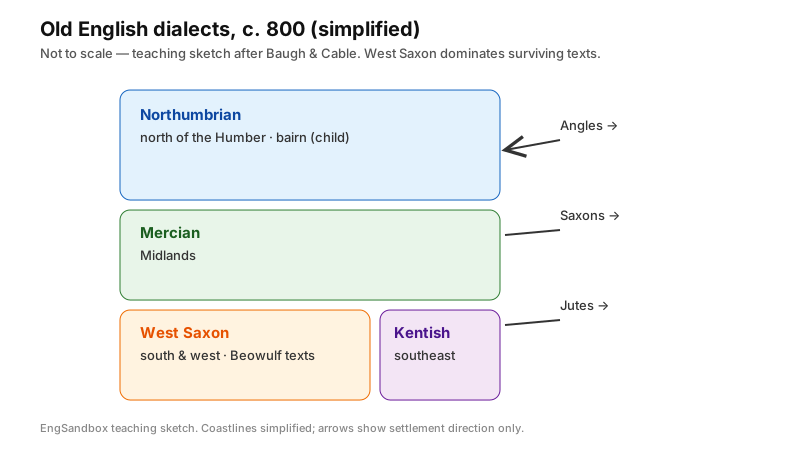
Teaching sketch after Baugh and Cable: Northumbrian, Mercian, West Saxon and Kentish. Most surviving texts are West Saxon.
Core vocabulary you still use daily comes from this layer: house, water, earth, eat, drink, sleep, father, mother, friend, fight, love. Grammar did the heavy lifting: nouns had three genders and four cases, and word order was flexible because endings marked who did what to whom.
Two contacts began to dismantle that system. Christian missionaries from 597 introduced Latin words such as angel, school, bishop, and from the eighth century the Vikings brought Old Norse, which would reshape the grammar more deeply than any earlier influence.
Two Borrowings That Shaped Modern English: Old Norse vs Norman French
Learners often lump borrowings together, but the Norse and French waves were opposite in character. One simplified grammar; the other doubled vocabulary.
Old Norse (8th-11th c.) — everyday and structural
The Vikings who settled the Danelaw (northeast England) spoke Old Norse, closely related to Old English. Because the languages were partly mutually intelligible, ordinary people intermarried and traded using a contact language that favoured dropping the endings they did not share.
Norse gave English:
- Grammar words: they, them, their (replacing Old English hīe, him, hira), are, though, till
- Everyday nouns and verbs: sky, egg, knife, window (from vindauga "wind-eye"), die, take, call, want
- Simplification: loss of gender and case endings accelerated, pushing English towards fixed Subject-Verb-Object order
You feel the Norse effect in a sentence such as They take the eggs to the window — three content words, a pronoun, and the word order itself are Norse gifts.
Norman French (1066-1400) — formal and register-building
The Norman Conquest was a top-down replacement. French became the language of crown, courts, and high cuisine for nearly three centuries while English continued among commoners. When English re-emerged as the language of record, it had absorbed roughly ten thousand French words.
French gave English:
- Government and law: government, parliament, justice, court, jury, prison, authority
- Art and culture: beauty, art, colour, music, poet, story
- Food: beef (French) vs cow (English), pork vs pig, mutton vs sheep — the animal stayed English with the farmer, the meat became French on the lord's table
The lasting consequence is register doubling, which examiners reward you for handling well:
| Register | Germanic (everyday) | French (formal) | Latin/Greek (technical) |
|---|---|---|---|
| Verb | ask | question | interrogate |
| Adjective | friendly | amicable | cordial |
| Noun | help | aid | assistance |
| IELTS impact | Band 6 safe but plain | Band 7 natural if collocated well | Band 7+ if precise |
A learner who knows this table can revise We need to ask why governments help poor people to We need to question how governments allocate aid without memorising a thesaurus — just shifting layers. Explore those pairings in 100 Academic Words and 75 Common Collocations.
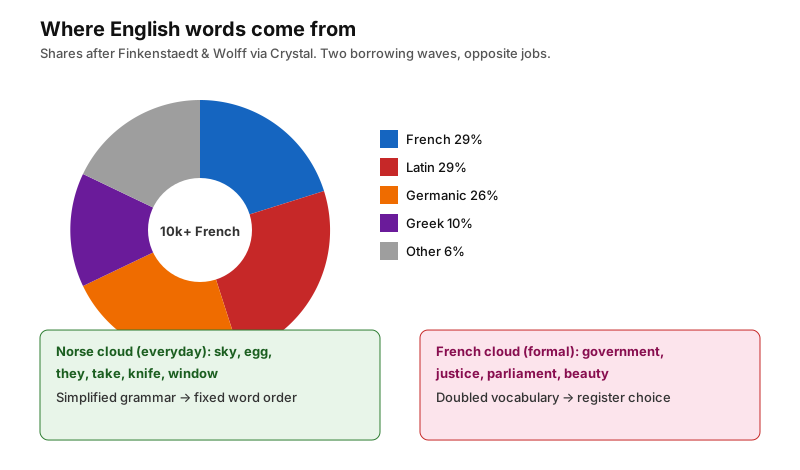
About 60 percent French plus Latin layered on a Germanic core — hence ask versus question, help versus aid. Norse simplified grammar; French doubled vocabulary.
Middle English and the Norman Conquest
The most transformative event in the history of English was the Norman Conquest of 1066. When William the Conqueror became king, Norman French became the language of the ruling classes, the court, and the legal system. For the next three centuries, English was primarily spoken by common people, while French was used for administration and literature.
During this period, English changed profoundly:
- It absorbed thousands of French words in law, government, art, and cuisine
- Grammar simplified decisively: gender was lost, case endings reduced to modern -'s and -s, verb conjugations thinned to I/you/we/they take vs he takes
- Spelling became variable, with French-trained scribes writing qu for older cw (queen for cwēn) and ou for u (house for hūs)
By the late fourteenth century, English had re-emerged as the dominant language. The loss of Normandy in 1204 cut aristocratic ties to France, the Hundred Years' War fostered English patriotism, and the Black Death raised the status of English-speaking workers.
Geoffrey Chaucer's Canterbury Tales (1380s) is one of the earliest major works in Middle English. While still quite different from modern English — Whan that Aprill with his shoures soote — it is broadly comprehensible when sounded out, unlike Old English. For the first time, you can read a line and feel English becoming a written language again.
Try a facing-page Chaucer excerpt once, not for study but to feel that return. It trains the inference skill that helps in The Benefits of Daily Reading and in exam reading tasks.
Early Modern English: Print and the Great Vowel Shift
The period from 1500 was shaped by two developments that still cause almost every spelling headache: the Great Vowel Shift and the printing press.
Between roughly 1400 and 1700, the long vowels of Middle English systematically rose and, for the highest vowels, diphthongised. Spelling had already been fixed by printers, so the letters stayed while the sounds moved.
| Middle English vowel (c.1400) | Sound then | Modern sound | Example |
|---|---|---|---|
| a as in name | /aː/ as in father | /eɪ/ | name /neɪm/ |
| e as in see | /eː/ | /iː/ | see /siː/ |
| i as in bite | /iː/ | /aɪ/ | bite /baɪt/ |
| o as in go | /oː/ | /oʊ/ | go /ɡoʊ/ |
| u as in house | /uː/ | /aʊ/ | house /haʊs/ |
This table explains why vowel letters map to so many sounds, and why food (long o), good (short o that did not shift), and blood (same short o with a different outcome) diverged — they had different input vowels when the shift applied. Remember: the letters moved house after the pronunciation left.
William Caxton introduced the printing press to England in 1476. Printers needed consistent forms and chose the London-East Midlands dialect they saw most often. They employed Flemish typesetters whose habits introduced quirks such as h in ghost (gheest) and gh for older h sounds. Once printed, a spelling tended to stay. That is why knight (pronounced kneehht) kept its k and gh long after both fell silent, and why through, though, tough share ough but have four pronunciations — they had different vowels before the shift, and the printer froze them mid-change.
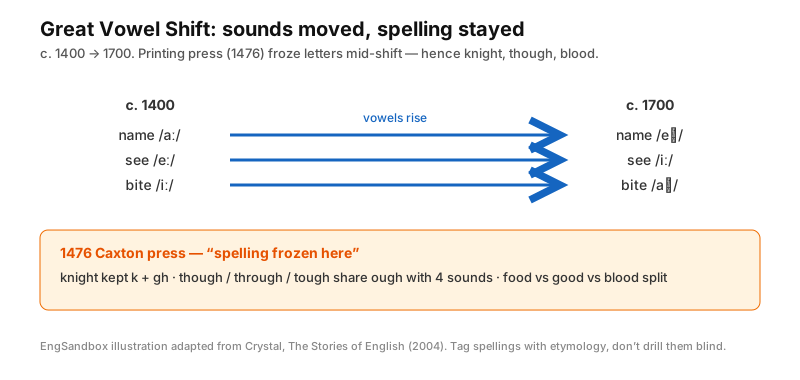
Long vowels rose while letters stayed put after 1476 — why knight kept its k and gh, and though, through and tough diverged. Adapted from Crystal.
For your notebook, add a two-word etymology tag to a spelling you keep getting wrong — knight [ME knicht, k silent after print] or government [Fr gouverner, n kept] — instead of copying the word ten times. The tag creates a retrieval cue.
The Renaissance and Standardisation
The Renaissance brought a deliberate explosion of vocabulary. Scholars borrowed extensively from Latin and Greek to express new concepts in science and philosophy — words such as atmosphere, catastrophe, species, data, nucleus, enthusiasm. Shakespeare, writing 1590-1613, contributed over 400 earliest attestations recorded by the Oxford English Dictionary: birthplace, bedroom, lonely, excellent, outbreak, fashionable, plus idioms like break the ice.
What this means for you is that synonym choice is really register choice. Native speakers do not choose randomly between begin, commence, and initiate — they choose begin work, commence proceedings, initiate a process as fixed collocations. Practise those pairings rather than memorising lists.
The eighteenth century then tried to fix the richness. Samuel Johnson's A Dictionary of the English Language (1755) recorded 42,773 words with quotations and helped cement spellings such as music over musick. Grammar books modelled on Latin, notably Bishop Lowth's Short Introduction (1762), introduced prestige rules such as avoiding split infinitives or sentences ending with a preposition. Modern linguists note these describe formal written style, not spoken grammar — and examiners test subject-verb agreement and article use, not Lowth's preferences. See The 5 Most Common Grammar Mistakes in IELTS Writing and How to Use Articles Correctly for what is actually tested.
English Becomes a Global Language
As the British Empire expanded during the eighteenth and nineteenth centuries, English spread to North America, Australia, New Zealand, South Africa, India, and many other territories. Each region developed its own varieties with distinctive vocabulary and pronunciation, now recognised as legitimate standards.
American English has had particular influence through Webster's spelling reforms (color for colour), Hollywood, and technology. But it is one standard among many. Linguist Braj Kachru's three-circle model remains a useful map:
- Inner Circle (native-majority): UK, US, Canada, Australia, New Zealand
- Outer Circle (institutional second-language): India (~125 million English speakers), Nigeria, Singapore, Philippines — English used in government and education
- Expanding Circle (foreign-language): China, Japan, Brazil, Germany — English learned as a lingua franca
You will encounter prepone (to move earlier, standard in Indian English) and can or not? (Singapore English tag) as systematic local norms, not errors. IELTS and PTE accept any consistent standard if the writing is coherent — mixing spellings within one essay signals inattention more than choosing American over British.
In the twentieth century, US media, the internet, and international business cemented English as the leading lingua franca — the language of aviation, maritime communication, science, and diplomacy. New words such as selfie, podcast, chatbot are added yearly, and World Englishes such as Indian and Nigerian English are developing codified standards taught in universities. Your goal is not to sound like a 1755 Londoner but to be intelligible, precise, and appropriately formal — a skill that listening to mixed accents (British news plus an American podcast plus a Singapore interview) trains directly.
What the 60 Percent Means for Your Study This Week
This history gives you a study filter for the next seven days.
1. Sort vocabulary by layer. When you meet a new word in reading, ask: Germanic everyday (get, make), French formal (obtain, produce), or Latin technical (acquire, manufacture)? Write the layer in brackets: obtain [Fr, formal for get]. The Germanic word becomes your anchor; the French-Latin partner becomes its formal counterpart. You will recall the pair together.
2. Expect French-Latin spelling habits. If a word looks French (government, parliament) or Latin (psychology, debt with its inserted b), expect silent letters. Note the etymology once instead of drilling the silence as a random exception.
3. Upgrade only with a collocation you have seen. We need to do something about pollution is clear. An unsafe upgrade — We need to execute something about pollution — is worse. The safe upgrade is the collocation from real reading: We need to take action on pollution or We need to address pollution. That discipline connects directly to the IELTS Writing Task 2 Structure and 20 Linking Words.
4. Read one short academic paragraph daily for two weeks. Choose The Economist or Nature News summaries at B2-C1 level. Highlight French-Latin words and check how many appear in 100 Academic Words — often 70 percent. Academic vocabulary is not a separate list to memorise but the natural register of the French-Latin half of English. Pair the reading with the 15-minute system in Benefits of Daily Reading.
FAQ
Will learning this history help my IELTS or PTE score directly? Not as a test topic — you will not be asked to date the Norman Conquest. The benefit is efficiency. Learners who sort vocabulary by layer retain collocations faster and choose register more accurately in Writing. The time you save by not re-drilling government as a random spelling pays for an extra essay.
Why does English have so many French words if the French left in 1204? The elite's continental holdings ended then, but French remained the language of law, parliament, and high culture for another 150 years. Words such as court, judge, jury, verdict, parliament, sovereign entered during that extended use — the vocabulary stayed because the institutions stayed.
Is American English more "original" than British English? Neither is more original; both changed in different directions. American English preserved some older features such as rhotic r in car and older words like fall for autumn, while British English preserved other older meanings. Examiners accept either — consistency within one essay matters more than which standard you choose.
How should I handle spelling in an exam? Pick one standard for the whole response and keep it. If you use organisation, colour, realise, stay with that system; if you use organization, color, realize, stay with that one. Mixing within a single essay signals inattention.
Final Thoughts
The history of English is a story of continuous adaptation. From Germanic dialects on a North Sea island, through Viking contact that simplified grammar, Norman occupation that doubled vocabulary, a printing press that froze spelling mid-shift, a Renaissance that loaded it with Latin and Greek, an eighteenth-century standardisation that gave it a shared written form, to a global expansion that created a family of World Englishes — English has borrowed, shed, and reinvented itself at every stage.
Its willingness to borrow and its relatively analytic grammar have contributed to its global success. For you as a learner, the history offers a practical sorting tool: Germanic for everyday clarity, French for formal precision, Latin-Greek for technical specificity — always with the collocation that makes the choice natural. Keep the timeline and the Norse-vs-French contrast on one page in your notebook, and let the next two weeks of reading supply the examples your hand writes.
Next up: Apply the layer filter to your next session in Benefits of Daily Reading for Language Acquisition, mine the academic layer in 100 Academic Words Every University Student Must Know, or polish register shifts in 20 Linking Words That Boost Your IELTS Writing Score.
Related Articles
📖 The Benefits of Daily Reading for Language Acquisition
Discover how a simple daily reading habit can dramatically improve your vocabulary, comprehension, and overall English proficiency.
📝 IELTS/PTE Writing: How to Use Articles (a, an, the) Correctly
Master the correct use of articles (a, an, the) in your IELTS and PTE writing. Learn the rules, common mistakes, and practical strategies to boost your grammar score.
📚 50 Phrasal Verbs for Everyday English
Learn 50 essential phrasal verbs organized by everyday topics. Master work, travel, relationships, and communication vocabulary with definitions and examples.