✏️ The 5 Most Common Grammar Mistakes in IELTS Writing (That Are Ruining Your Band Score)
9 min read
2026-06-09
Identify and fix the most frequent grammar errors that hold back your IELTS Writing band score, from subject-verb agreement to article misuse.
EngSandbox Editorial Team
Written with AI assistance and reviewed by our editors — experienced PTE/IELTS tutors. Every article is fact-checked against official band descriptors, the Academic Word List and Cambridge assessment research, then field-tested with learners before publishing. Human reviewed + field tested. Questions? Contact us — see our Editorial Process.

Whenever I sit down with a fresh stack of IELTS practice essays, the same patterns surface within the first few pages. Certain grammar points catch learners of every language background and every level, and they catch them in remarkably similar places. That predictability is good news for you: if the most frequent errors are known, they can be named, understood, and gradually retired.
First, some perspective. Writing a formal essay under a strict clock is demanding in your first language; doing it in a second language is a genuine accomplishment, and the fact that you are reading about grammar at all shows real commitment. It is equally normal to feel daunted sometimes — English bristles with irregular verbs and stubborn exceptions that exhaust even dedicated learners.
But here is the encouraging part: you do not need flawless English to write a strong IELTS essay. You need controlled English, and control is trainable. Below we will walk through the five mistakes I find myself correcting most often, look closely at how each sentence changes when it is repaired, and — just as importantly — ask why each mistake happens in the first place. When you understand the cause, the cure tends to stick.
Understanding Your Score: What Is Grammatical Range and Accuracy?
In IELTS Writing, your grammar is assessed under the criterion called Grammatical Range and Accuracy (GRA). Because writing is marked on four equally weighted criteria, GRA accounts for 25% of your total writing score — a quarter of it resting on how you build sentences.
According to the official band descriptors published on IELTS.org, examiners are looking for two things:
- Range: Can you use a mix of simple and complex sentence structures?
- Accuracy: How often do errors occur, and do they obscure your meaning?
Here is how the descriptors distinguish a Band 6 from a Band 7 in this criterion:
| Score | Grammatical Range and Accuracy (GRA) Requirements |
|---|---|
| Band 6 | Uses a mix of simple and complex sentences. Makes some errors in grammar and punctuation, but they rarely reduce communication. |
| Band 7 | Uses a variety of complex structures. Produces frequent error-free sentences. Has good control of grammar and punctuation. |
Read those lines slowly and notice what they reward: not decoration, but control. The distance between Band 6 and Band 7 is largely a matter of how many of your sentences arrive completely clean. The five mistakes below are where that cleanliness is most often lost.
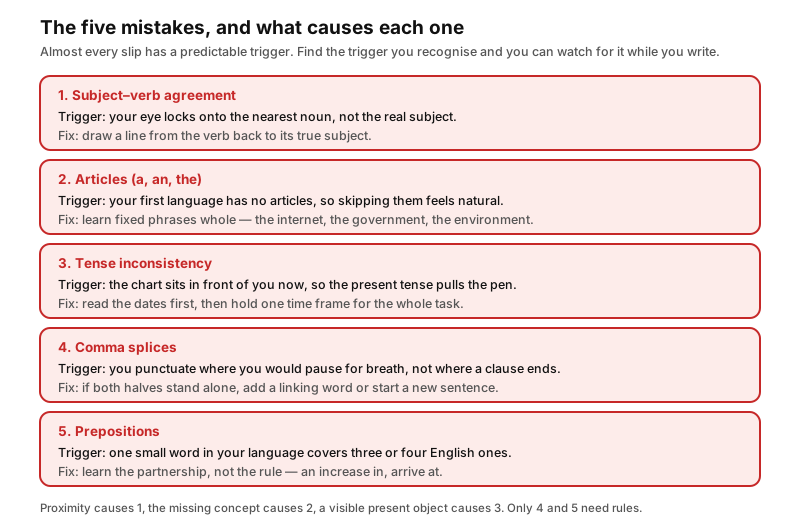
Mistake 1: Subject–Verb Agreement (The Sneaky Plurals)
The rule in brief: if your subject is singular, your verb must be singular; if your subject is plural, your verb must be plural. Simple in theory — until sentences grow long and the subject drifts away from the verb.
The Before and After:
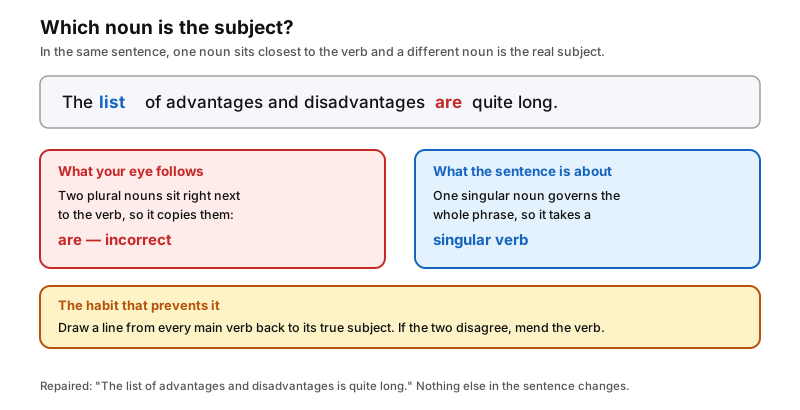
Before (Incorrect): The list of advantages and disadvantages are quite long.
After (Correct): The list of advantages and disadvantages is quite long.
How it affects your band score: Frequent agreement slips suggest to an examiner that basic structures are not yet secure, and insecurity at the foundation holds your Grammatical Range and Accuracy back, however ambitious your longer sentences may be.
Why it happens: This is the mistake I correct most often, at every level. The cause is nearly always proximity: the writer's eyes lock onto the nearest noun instead of the true subject. Above, the plural word disadvantages sits directly beside the verb, so the hand writes are. But the sentence is really about the list, and a list is singular.
A quick tip: When you proofread, physically draw a line from each main verb back to its true subject. If the two disagree, mend the verb.
Mistake 2: The Tricky World of Articles (A, An, The)
The rule in brief: a and an introduce singular, general things; the points to something specific; and occasionally no article belongs at all.
The Before and After:
Before (Incorrect): Internet has changed way we communicate with the society.
After (Correct): The internet has changed the way we communicate with society.
How it affects your band score: A missing article seldom destroys meaning, but it makes prose feel unmistakably unnatural, and Band 7 asks for frequent error-free sentences — tiny words included.
Why it happens: Article trouble follows your first language. If your mother tongue manages without articles — Mandarin, Russian, and Japanese are familiar examples — skipping them feels natural, because the concept simply has no home in your thinking. There is nothing wrong with your logic; the habit simply needs retraining, one phrase at a time.
A quick tip: Do not be too hard on yourself; this error fades slowly even for diligent learners. Meanwhile, memorise fixed phrases wholesale: the government, the environment, the internet, the average citizen. Chunks learned whole survive exam pressure better than rules recalled piece by piece.
Mistake 3: Tense Inconsistency (Jumping Through Time)
The rule in brief: keep your verbs inside one time frame unless there is a genuine reason to move, because random switching scrambles the timeline your reader is trying to follow.
The Before and After:
Before (Incorrect): In 2015, the company opens a new branch and hired fifty staff members.
After (Correct): In 2015, the company opened a new branch and hired fifty staff members.
How it affects your band score: Tense drifting costs you twice. It dents Grammatical Range and Accuracy directly, and it muddles Coherence and Cohesion, because the examiner loses track of when each event occurred.
Why it happens: Again and again in Task 1 scripts I watch the same slide: the chart covers, say, 1990 to 2010, the writer opens confidently in the past tense, and halfway down the paragraph present-tense verbs creep in. The pull is understandable — the graph sits in front of the writer right now, so the present tense tugs at the pen — but the dates printed on the chart, not the moment of writing, govern your tense.
A quick tip: Before writing a single word of Task 1, read the dates. If they lie in the past, write PAST TENSE in capitals across your planning page and let it guard every sentence that follows.
Mistake 4: Run-on Sentences and Comma Splices
The rule in brief: a comma cannot weld two complete sentences together. Doing so produces a comma splice — technically a run-on — and readers feel the joint wobbling.
The Before and After:
Before (Incorrect): The government should ban plastic bags, they are terrible for the environment.
After (Correct): The government should ban plastic bags because they are terrible for the environment. (Or simply use a full stop: ...plastic bags. They are...)
How it affects your band score: Band 7 requires good control of grammar and punctuation, and a splice signals the opposite: joining two independent clauses without a linking word such as because, and, but, or so tells the examiner that clause structure is not yet fully under your command.
Why it happens: In the scripts I mark, commas tend to appear wherever the writer would pause for breath. Speech gets away with this because pauses and intonation carry the boundaries; a silent page cannot. On paper, only punctuation and linking words can show where one idea ends and the next begins.
A quick tip: Read your sentence silently and ask whether each half could stand alone with a capital letter and a full stop. If both halves survive separately, they cannot be joined by a comma alone — add a linking word, or be brave and start a fresh sentence.
Mistake 5: Incorrect Prepositions (Lost in Translation)
The rule in brief: prepositions — in, on, at, of, for, to, and with, among others — express direction, time, place, and relationships between ideas. Unfortunately, they refuse to translate logically between languages.
The Before and After:
Before (Incorrect): The chart shows a dramatic decrease of pollution levels.
After (Correct): The chart shows a dramatic decrease in pollution levels.
How it affects your band score: Prepositions sit astride two criteria. Wrong ones weaken Grammatical Range and Accuracy, and they also break the natural collocations — word partnerships — on which Lexical Resource depends. Accurate pairings feed both marks at once.
Why it happens: Preposition errors are among the most stubborn I encounter when marking, and direct translation explains their staying power. In Spanish, for instance, one small word, en, covers situations where English insists on in, on, or at. Mapping one miniature word onto another almost never works, because each language divides space and time along its own lines.
A quick tip: Abandon the hope of learning preposition rules in isolation; the exceptions outnumber the rules. Learn partnerships instead: not increase alone, but an increase in; not arrive alone, but arrive at a station or arrive in a city, depending on the destination.
When Old Mistakes Resurface: Protecting Your Confidence
Knowing your weak points is half the work; the other half is keeping your spirits intact while you repair them. Preparation rarely moves in a straight line. You might handle a structure cleanly for a fortnight, then spot the very error you believed you had buried creeping back into a timed mock essay.
Please believe that this is the process working, not failing. Errors resurface under time pressure for everyone, and each one you catch during practice is one you have taught yourself to notice — which means it is already losing its grip on you.
Anxiety matters here more than most learners expect. When you feel calm and encouraged, the grammar you have studied rises readily to the surface; worry pushes it back down exactly when you need it most. Kindness towards yourself is therefore not merely a nicety — it is a practical study tool.
Three habits protect that calm:
- Celebrate small wins. Did today's draft contain one flawless complex sentence? Say so out loud; that sentence is evidence of progress.
- Collect your errors proudly. A mistake caught in homework is a mistake disarmed before test day. Keep a list and watch it stop growing.
- Rehearse the process, not the prize. Rather than picturing results, imagine yourself in the exam room writing steadily, then reserving your final minutes to check subjects, verbs, and articles. Calm procedure is what produces clean papers.
Fifteen Minutes of Grammar Work on a Crowded Day
Study plans meet real life eventually: late meetings, tired children, sheer exhaustion. When that happens, do not abandon practice; shrink it. One principle has held true across every learner I have taught: steady frequency beats occasional intensity. Twenty focused minutes a day achieves more than a single four-hour weekend marathon, because recall grows through return visits.
If a full hour is impossible, try these fifteen-minute forms:
- The targeted proofread: open an essay you wrote last week and spend ten minutes hunting for one mistake type only — agreement, say, or articles. Narrow focus trains sharper radar than general rereading.
- Hand-copying model sentences: choose two complex sentences from a high-quality model answer and copy them slowly by hand. Your fingers learn the architecture of correct English along with your eyes.
- Spoken past-tense practice: narrate yesterday aloud while commuting or washing up, deliberately checking the time frame of every verb.
Keep this up quietly for a month, then reread an early essay. The improvement you find there will encourage you far more than any promise could — because you will have earned it, sentence by sentence, and the same patience will carry you steadily through test week and beyond.
Related Articles
🔄 The Passive Voice: What It Is and When Native Speakers Actually Use It
Your parcel has been delivered — the four-step switch, the four jobs the passive really does, the double-object trap, and ten sentences to rewrite.
🔁 Gerund or Infinitive: Verbs That Change Meaning — Stop, Remember, Forget, Try
Stop smoking vs stop to smoke: why remember, forget and try change meaning with -ing or to — plus the preposition rule, go + -ing, and a 15-sentence workout.
🔀 30 Confusing Word Pairs in English (and How to Never Mix Them Again)
Affect vs effect, borrow vs lend, its vs it's: 30 pairs grouped into 6 error families, each with a two-second test and a pocket reference table.