📚 How to Build a 3-Month Study Plan for PTE or IELTS (From Beginner to Exam-Ready)
10 min read
2026-06-08
A complete, step-by-step guide to creating a 3-month study plan for PTE or IELTS, from diagnostic test to exam day. Includes backward planning, skill-building, mock exams, and mindset strategies.
EngSandbox Editorial Team
Written with AI assistance and reviewed by our editors — experienced PTE/IELTS tutors. Every article is fact-checked against official band descriptors, the Academic Word List and Cambridge assessment research, then field-tested with learners before publishing. Human reviewed + field tested. Questions? Contact us — see our Editorial Process.

Preparing for an English proficiency test like the IELTS or PTE can feel a little like standing at the bottom of a very tall mountain. You look up, and the top seems so far away. If you are feeling a mix of excitement and nervousness right now, please know that what you are feeling is completely normal! Almost every successful test-taker has stood exactly where you are today.
The wonderful news is that you do not need to leap to the top of the mountain in one day. You just need a map and the willingness to take one step at a time. This guide is your map.
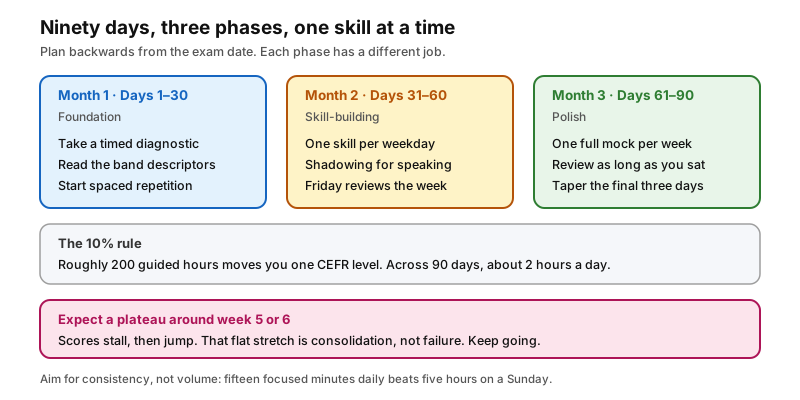
According to research from Cambridge Assessment English, it takes approximately 200 hours of guided learning to move up one full level on the Common European Framework of Reference for Languages (CEFR). Spread over three months, that is about two hours of practice a day. It is completely doable.
By using a method called "backward planning" — where we start with your test date and work backward to today — we can build a realistic, stress-free roadmap. Let's break down your next 90 days into three clear, manageable steps. You have got this!
The Core Strategy: Backward Planning
Backward planning is a highly effective goal-setting strategy. Instead of starting today and blindly studying, you write your exact exam date on your calendar. From there, you work backward, assigning specific goals to Month 3, Month 2, and Month 1.
Educational psychologists have found that backward planning reduces feelings of being overwhelmed because it connects your daily tasks directly to your final goal. When you know exactly why you are doing a reading exercise on a Tuesday morning, your motivation stays high.
Phase 1: Month 1 – Assessment & Foundation (Days 1–30)
Your first month is not about being perfect. It is about exploring the test, understanding your current skills, and building a strong daily habit.
1. Take a Diagnostic Test First
Before you buy a dozen textbooks, you must know your starting point. Take a full, timed official practice test. You can find free familiarization tests on the official IELTS.org website, or use the Scored Practice Tests provided by Pearson for the PTE.
- Why this matters: The British Council states that simply understanding the format of the test — knowing how many questions there are and how much time you have — significantly reduces test-day anxiety and naturally improves your score.
- A Common Mistake: Many learners skip the diagnostic test because they are afraid of getting a low score. Remember, this score is not a judgment of your intelligence! It is just a friendly GPS telling you where you are so you can map the route to your destination.
2. Learn the Rules of the Game
Spend your first two weeks deeply understanding the scoring criteria. For IELTS, read the "Band Score Descriptors" for Writing and Speaking. For PTE, read Pearson's "Score Guide." Knowing exactly what the examiners (or the computer) are looking for saves you hundreds of hours of wasted effort.
3. Build a Foundation of Vocabulary
Start building a vocabulary journal. However, do not just read lists of words. Use spaced repetition apps like Anki or Quizlet.
- The Science: In the late 19th century, psychologist Hermann Ebbinghaus discovered the "Forgetting Curve," showing that we rapidly forget new information unless we review it at specific intervals. Spaced repetition apps use this exact science, automatically showing you words just before you are about to forget them — a method proven to boost long-term retention dramatically.
Phase 2: Month 2 – Targeted Skill-Building (Days 31–60)
Now that you are comfortable with the test format, it is time to build your muscles in the four core skills: Reading, Writing, Listening, and Speaking.
During Month 2, aim to study for about 1.5 to 2 hours a day. The secret is to focus on just one skill per day so your brain does not get tired.
Your Weekly Schedule Template
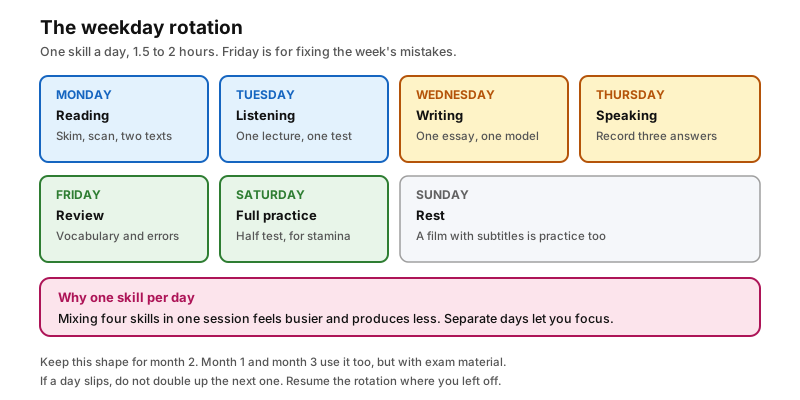
| Day | Focus Skill | Suggested Activity (1.5–2 Hours) |
|---|---|---|
| Monday | Reading | Learn skimming and scanning. Practice two passage types. |
| Tuesday | Listening | Listen to a TED Talk. Take one practice test section. |
| Wednesday | Writing | Write one essay. Compare it to official model answers. |
| Thursday | Speaking | Record yourself answering three prompt questions. |
| Friday | Review | Review vocabulary and mistakes from the week. |
| Saturday | Full Practice | Take a half-length practice test to build stamina. |
| Sunday | Rest | Relax! Watch an English movie with subtitles. |
Deep Dive into the Four Skills
1. Reading: Read for Purpose, Not Perfection When reading in a foreign language, it is natural to want to understand every single word. In the exam, you do not have time for this. Practice the skills of skimming (reading quickly for the main idea) and scanning (looking for specific details like dates or names).
2. Writing: The Power of Feedback Writing can feel lonely, but it follows very strict patterns. Focus heavily on linking words (therefore, however, in addition). Research published by Cambridge Assessment English highlights that students who focus on "cohesion and coherence" (how smoothly ideas connect) see the fastest improvements in their writing scores.
- Recommended Resource: Use the official British Council IELTS Prep App or Pearson's official coursebooks.
3. Listening: Active Immersion Listening requires focus. When practicing, do not just listen passively while washing the dishes. Sit down with a pen and take notes.
- Common Mistake: Trying to translate English into your native language in your head while listening. This slows you down, and you will miss the next sentence! Practice listening and understanding directly in English.
4. Speaking: The Shadowing Technique For the speaking test, fluency and confidence are key. For PTE, you are speaking to a computer, so a clear, steady pace is vital. For IELTS, you are speaking to a friendly human.
- The Science: A popular method in Second Language Acquisition (SLA) is "Shadowing." Listen to a native speaker (like a news anchor or podcast host) and immediately repeat what they say, matching their rhythm and tone. Peer-reviewed studies in SLA show that shadowing drastically improves pronunciation and sentence flow in just a few weeks.
Phase 3: Month 3 – Mock Exams & Polish (Days 61–90)
Welcome to the final stretch! You have built your foundation, expanded your vocabulary, and mastered the test strategies. Month 3 is your dress rehearsal.
1. Practice Under Real Conditions
Once a week, take a full, uninterrupted mock exam.
- The Science: Psychologists call this "state-dependent learning." Research indicates that you recall information much better if the environment where you take the test matches the environment where you studied. Sit at a quiet desk. Put your phone in another room. Time yourself strictly. Drink water just like you would on exam day. By the time the real test arrives, your brain will feel completely at home.
2. The Magic is in the Review
Taking a practice test only does half the job. The real magic happens when you review your answers. Spend just as much time reviewing your mistakes as you did taking the test. Ask yourself, with genuine curiosity: "Why did I get this wrong? Was it a vocabulary issue, a timing issue, or did I misunderstand the question?" Every mistake you find during practice is a mistake you will not make on test day. Celebrate each one!
3. Tapering Off
In the final three days before your exam, greatly reduce your study hours. Just review your vocabulary notes lightly. Professional athletes do not run a marathon the day before the Olympics; they rest their muscles. You need to rest your brain.
Adjusting the Plan: What If Life Gets Busy?
We all have real lives. You might be working full-time, taking care of a family, or managing university studies. If you miss a day, do not panic, and please do not be hard on yourself! Guilt is the enemy of learning.
If you cannot find a solid two-hour block to study, use the power of microlearning.
A study published in the Journal of Applied Psychology found that learning in short, focused bursts can be considerably more efficient for memory retention than long, exhausting study sessions.
- Got 10 minutes on the bus? Open your Anki or Quizlet app and review 20 vocabulary words.
- Got 15 minutes on your lunch break? Read one IELTS reading passage or listen to one PTE audio clip.
- Got 5 minutes before bed? Write down three new sentences using the grammar structure you learned that day.
Consistency is much more powerful than intensity. Fifteen minutes a day every single day is better than studying for five hours on Sunday and doing nothing the rest of the week.
The Psychology of Success: Keep Your Motivation High
Learning a language is an incredibly brave thing to do. It takes courage to make mistakes, try new sounds, and express yourself in a new way. Along this three-month journey, you must actively protect your mental health and motivation.
Beware the "Plateau Effect"
Around Week 5 or 6, you might feel like you have stopped improving. Your practice scores might stay the same for two weeks. This is completely normal! In cognitive science, this is known as a "learning plateau." Your brain is secretly organizing all the new information you have fed it. Keep going. Suddenly, in Week 7 or 8, you will see a jump in your scores. Trust the process.
Lower Your "Affective Filter"
Dr. Stephen Krashen, one of the world's leading experts in linguistics, introduced the "Affective Filter Hypothesis". He found that when learners are stressed, anxious, or lacking self-confidence, an invisible "filter" goes up in their brain, effectively blocking them from acquiring new language.
Conversely, when you feel relaxed, cheerful, and supported, the filter lowers, and your brain absorbs English like a sponge.
How do you apply this?
- Smile when you practice. It sounds silly, but the physical act of smiling tells your nervous system you are safe.
- Speak kindly to yourself. If you stumble over a word, do not say, "I am so bad at this." Say, "English is tricky, but I am getting better every day."
- Adopt a growth mindset. Dr. Carol Dweck's famous research from Stanford University shows that people who believe their intelligence can grow through effort consistently outperform those who think their abilities are fixed. You are not "bad at English" — you are simply learning English.
Your Journey Starts Now
Building a three-month study plan for the PTE or IELTS is not just about memorizing grammar rules or passing a test. It is a journey of personal growth. You are proving to yourself that you can set a big goal, break it down into small pieces, and show up for yourself day after day.
Remember your plan:
- Month 1: Take a baseline test, understand the scoring, and start your vocabulary habit.
- Month 2: Dedicate each day of the week to one specific skill. Use spaced repetition and shadowing techniques.
- Month 3: Take full, timed mock tests. Review your mistakes with curiosity, not frustration.
You are highly capable, and you have exactly what it takes to succeed. Gather your resources, write your exam date on the calendar, take a deep breath, and take that very first step up the mountain. You are going to do wonderfully!
Related Articles
🎯 IELTS vs. PTE: Which English Test is Right for You?
A comprehensive comparison of IELTS and PTE Academic to help test takers choose the right English proficiency exam for their study abroad or visa goals.
✏️ The 5 Most Common Grammar Mistakes in IELTS Writing (That Are Ruining Your Band Score)
Identify and fix the most frequent grammar errors that hold back your IELTS Writing band score, from subject-verb agreement to article misuse.
✍️ PTE Essay Writing: How to Score 70+ with a Simple Template
Master the PTE essay with a simple, repeatable template. Learn how the automated scoring works, manage your 20 minutes effectively, and use a proven structure to score 70+.