🎯 IELTS vs. PTE: Which English Test is Right for You?
8 min read
2026-06-08
A comprehensive comparison of IELTS and PTE Academic to help test takers choose the right English proficiency exam for their study abroad or visa goals.
EngSandbox Editorial Team
Written with AI assistance and reviewed by our editors — experienced PTE/IELTS tutors. Every article is fact-checked against official band descriptors, the Academic Word List and Cambridge assessment research, then field-tested with learners before publishing. Human reviewed + field tested. Questions? Contact us — see our Editorial Process.

The Big Decision
Imagine sitting at your desk with your laptop open. On one side of your screen, you see the IELTS website. On the other side, you see the PTE website. Both exams promise to help you achieve your big dreams of moving, studying, or working in a new country. But which one should you choose?
If you are staring at the screen and feeling completely confused, please take a deep breath. You are not alone!
Many students feel stressed when they start looking for an English proficiency test for visa or study abroad applications. It feels like a very big decision. You might worry that choosing the wrong test will be a costly mistake. But let me tell you a secret: there is no "wrong" test. Both of these exams are highly respected, and both are very achievable. We just need to find the one that fits your personal style, your skills, and your comfort zone.
In this guide, we are going to walk through this choice together. We will look at IELTS vs PTE like two different paths to the exact same beautiful destination. We will also talk about the newest IELTS 2025 updates and what is happening with PTE Academic 2025. Grab a cup of tea or coffee, relax your shoulders, and let's figure out which English test is better for you!
A Quick Overview: Meet the Tests
Before we dive into the deep details, let's briefly introduce our two friendly competitors. What exactly are these tests?
First, we have IELTS. This stands for the International English Language Testing System. It is the oldest and most famous English test in the world. When people think about proving their English skills, they usually think of IELTS. It tests your English in four areas: Listening, Reading, Writing, and Speaking. You can choose to take it on a computer or with a traditional pencil and paper.
Second, we have PTE Academic. PTE stands for Pearson Test of English. It is the modern, fast, and fully computer-based alternative. It also tests the exact same four skills: Listening, Reading, Speaking, and Writing. For a long time, PTE was famous because a computer algorithm — artificial intelligence (AI) — graded everything, even your speaking and writing. While that is still mostly true, PTE is making a few exciting changes right now.
Thousands of universities, colleges, and governments all over the world accept both tests. Whether you want to study in Canada, work in the UK, or get a permanent visa for Australia, both certificates will help you open those doors.
Key Differences at a Glance
It is much easier to compare things when we can see them side by side. Let's look at the basic differences between the two exams. This simple comparison table will give you a clear picture of how they work.
| Feature | IELTS | PTE Academic |
|---|---|---|
| Test Format | Paper-based or Computer-based | 100% Computer-based |
| Speaking Test | Face-to-face with a real human examiner | Speaking into a computer microphone |
| Total Test Time | About 2 hours and 45 minutes | About 2 hours and 15 minutes |
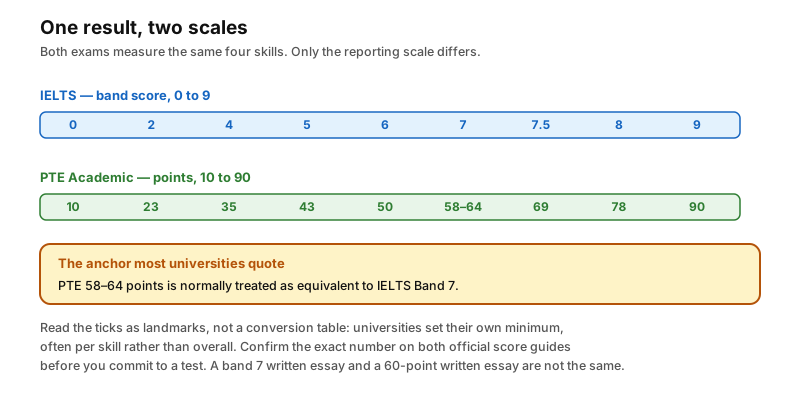
| Score System | "Band score" from 0 to 9 | Points from 10 to 90 |
| Results Time | 3 to 5 days (computer), 13 days (paper) | Usually 2 to 5 days |
| Cost | Around USD 200–300 (depends on country) | Around USD 200–300 (depends on country) |
| Acceptance | Widely accepted (over 12,500 places) | Widely accepted (thousands of places) |
You might be looking at the table and wondering, "What is a band score?" A band score is simply the number system IELTS uses. In IELTS, a 9 means you are an absolute expert, and a 5 or 6 means you are intermediate. PTE uses a wider point scale. In PTE, scoring 58 to 64 points is usually the same as an IELTS Band 7.
Now that we have seen the basic facts, let's explore who each test is perfectly designed for.
IELTS: Who Is It Best For?
IELTS is wonderful for people who like traditional learning and human connection. Let's talk about why you might love this test.
The biggest highlight of IELTS is the Speaking test. Instead of talking to a blank screen, you will sit in a quiet room with a friendly human examiner. It feels just like a normal conversation! If you stumble over a word, you can smile, correct yourself, and keep going. The human examiner understands body language, eye contact, and natural pauses. If you are someone who feels more relaxed when talking to a real person, IELTS is a wonderful choice for you.
IELTS is also great if you prefer to take things one step at a time. The test sections are very clearly separated. You do Listening, then Reading, then Writing. Your Speaking test might even be on a completely different day! This separation gives your brain a nice break.
There are also some fantastic IELTS 2025 updates you should know about. Have you ever taken a test, done well on three sections, but struggled on just one? In the past, you had to retake the whole exam. Not anymore! IELTS recently introduced something called One Skill Retake. This means if you have a bad day and do poorly on just the Writing section, you only have to retake that one section. This saves you so much time, money, and stress.
Also, looking ahead to 2026, IELTS is introducing a new "Writing on Paper" option for computer test-takers. This means you can take your Reading and Listening sections on the computer, but write your essay with a real pen on paper! If you think better when writing by hand, this update is a dream come true.
The Ideal IELTS Candidate: You should choose IELTS if you feel comfortable having a real-life conversation, if you prefer clear and separate test sections, and if you want the security of knowing almost every university and government in the world accepts this certificate.
PTE: Who Is It Best For?
If IELTS is the classic choice, PTE Academic is the high-tech, fast-paced option. PTE is a great fit for people who love computers, type quickly, and want their results as soon as possible.
With PTE, everything happens in one single session on a computer. You put on a headset, listen to audio, type your answers, and speak directly into the microphone. There is no human examiner sitting across from you. For some students, talking to a teacher or an examiner is terrifying. If you feel shy or get nervous when someone is watching you, you will love speaking to a computer. You can just look at the screen, focus on your voice, and do your best without worrying about eye contact.
PTE tasks are also integrated rather than separate. In real life, we listen, read, and write at the same time — and PTE tests you this way. For example, a task might ask you to listen to a short lecture and then type a summary. This tests your listening and your writing together in one question.
There are some very important PTE Academic 2025 updates you need to know. Starting in August 2025, PTE added two brand-new tasks to the Speaking section. One is called "Summarize Group Discussion" (you listen to three people talking, then summarize what they said). The other is "Respond to a Situation" (you hear a real-life problem and suggest a polite solution). Because of these extra questions, the total test time increased slightly to about 2 hours and 15 minutes.
Another big 2025 update is how PTE grades your test. In the past, a computer AI graded 100% of the test. Now, PTE is combining the speed of computers with the fairness of humans. For certain speaking and writing tasks, real human experts review your content (the actual meaning and ideas of your words). They do this to make sure test-takers are not just memorizing robotic templates. But do not worry — the computer still scores your pronunciation and fluency, so no human will ever judge your accent!
The Ideal PTE Candidate: You should choose PTE if you are comfortable with technology, if you type quickly on a keyboard, if you get nervous talking to real people, and if you need your results very quickly for a tight deadline.
How to Decide: Ask Yourself These Questions
We have covered a lot of information! If you are still asking yourself which English test is better for you, let's simplify things. Grab a piece of paper and ask yourself these four practical questions. Be honest with yourself — there are no wrong answers here!
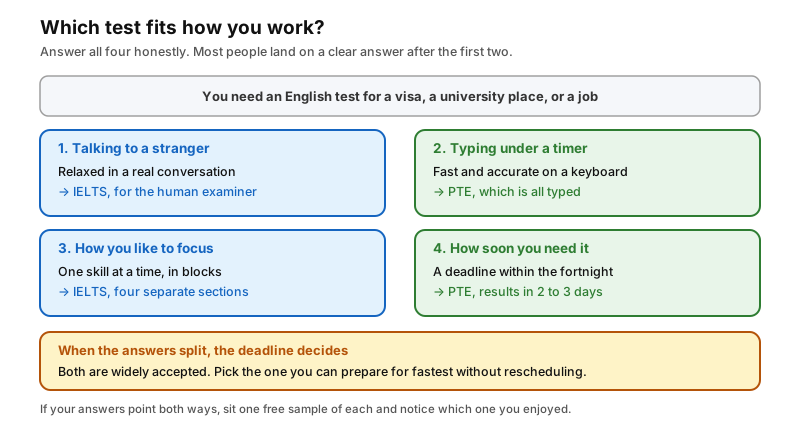
- How do you feel about speaking English to a stranger? Imagine sitting across from a friendly examiner. Does a normal conversation make you feel relaxed? If yes, lean towards IELTS. If the thought of a real person makes your heart beat fast and you would rather talk to a computer screen, lean towards PTE.
- How are your typing skills? PTE requires a lot of typing. You need to type quickly and accurately to finish your essays before the timer stops. If you are a fast typist, PTE is a great fit. If you type slowly with one finger, or if you make a lot of spelling mistakes on a keyboard, IELTS might be safer because you can write by hand.
- Do you prefer focused tasks or multi-tasking? In IELTS, you focus on one skill at a time: you listen first, then read, then write. It is very structured. In PTE, you are constantly mixing skills — reading a text to speak about it, or listening to audio to write about it. If you like clear boundaries, choose IELTS. If your brain enjoys jumping between different skills, choose PTE.
- How soon do you need your results? If your visa or university application is due next week, PTE is famous for its speed. Most students get their PTE scores in just 2 days. IELTS computer results are also very fast now (usually 3 to 5 days), but PTE still holds the crown for ultimate speed.
You Can Do This
Choosing an English test can feel like standing at a crossroads. It is completely normal to feel a little bit anxious about making the choice. But please remember this: both IELTS and PTE are simply tools to help you show the world what you already know. They are not trying to trick you or make you fail. They just want to hear your unique voice and read your thoughts.
Don't worry — you've got this! You have already done the hardest part, which is learning a beautiful, complex new language. Taking the test is just the final step on your wonderful journey. Whether you decide to sit in a room and chat with an IELTS examiner, or put on a headset and conquer the PTE computer, you are going to do amazing things.
Take a moment today to look at the free practice materials on both official websites. Try one IELTS speaking practice question, and try one PTE speaking practice question. Notice how your body and mind feel. Trust your instincts, pick the path that makes you smile a little more, and start preparing with confidence. We are cheering for you!
Related Articles
📚 How to Build a 3-Month Study Plan for PTE or IELTS (From Beginner to Exam-Ready)
A complete, step-by-step guide to creating a 3-month study plan for PTE or IELTS, from diagnostic test to exam day. Includes backward planning, skill-building, mock exams, and mindset strategies.
✍️ IELTS Writing Task 2: The Foolproof 4-Paragraph Essay Structure for a Band 7+
Master the IELTS Writing Task 2 with a simple, foolproof 4-paragraph essay structure. Learn how to plan, write, and polish your essay for a Band 7 or higher.
🗣️ PTE Speaking: How to Ace 'Describe Image' with a 3-Step Template (2026 Strategies)
Master the PTE Describe Image task with a simple, modern 3-step template. Learn how to structure your response, use adaptable frameworks, and speak confidently for a high score.