🔁 Gerund or Infinitive: Verbs That Change Meaning — Stop, Remember, Forget, Try
11 min read
2026-09-16
Stop smoking vs stop to smoke: why remember, forget and try change meaning with -ing or to — plus the preposition rule, go + -ing, and a 15-sentence workout.
EngSandbox Editorial Team
Written with AI assistance and reviewed by our editors — experienced PTE/IELTS tutors. Every article is fact-checked against official band descriptors, the Academic Word List and Cambridge assessment research, then field-tested with learners before publishing. Human reviewed + field tested. Questions? Contact us — see our Editorial Process.

I stopped smoking. I stopped to smoke. These two sentences share every word except one tiny to, yet they describe two different people. The first speaker gave up cigarettes months ago; the second interrupts whatever she is doing whenever the urge strikes. If that gap surprised you even slightly, this article will repay your attention — because stop is not alone. Remember, forget, and try pull the same trick, and intermediate learners run into them constantly: in emails, in meetings, in exam listening recordings.
Here is how we sort this out in lessons. Most verbs behave themselves: they accept one pattern and reject the other, so you simply learn their preference. Then there is a small, famous group of double agents that plays both sides and shifts its meaning each time. Get comfortable with the two well-behaved camps first, and the double agents become far less alarming.
The Two Well-Behaved Camps
The Noun-Costume Camp: Verbs That Take -ing
An -ing form used like a noun is called a gerund, and some verbs demand one as their object: enjoy, avoid, finish, mind, keep, suggest, consider, imagine, miss. Think of the activity dressed in a noun costume — the verb treats it as a thing, the way it would treat music or lunch.
- I enjoy cooking for friends.
- Would you mind closing the window?
- He avoided answering my question directly.
- Have you finished decorating the spare room?
The costume idea is testable. In Swimming keeps me fit, the -ing form sits where a plain noun would: Exercise keeps me fit. When a noun could replace the -ing chunk and the sentence still makes sense, -ing belongs there. It is the same packaging instinct that decides whether a word like advice or information can take a plural in the first place — if noun packaging still puzzles you, work through countable and uncountable nouns alongside this guide, because the two systems overlap constantly.
The Forward-Pointing Camp: Verbs That Take to
Other verbs attach an infinitive with to: want, need, decide, hope, plan, promise, offer, refuse, learn, afford. Their shared instinct is direction: the main verb happens now, while the action it points to stays ahead.
- We decided to move closer to the station.
- She promised to call every Sunday.
- They can't afford to eat out twice a week.
- He refused to sign the contract until he had read it.
Notice how the timeline works in each one: the promising happens today; the calling comes later. Keep that forward-pointing image — it returns shortly, wearing a disguise, inside the double agents themselves.
One small footnote before we move on. Like, love, hate, and prefer accept both patterns with little difference in everyday speech, but after would, only the infinitive survives: I'd love to join you, never I'd love joining you.
Why Prepositions Never Tolerate to
This rule explains half of all -ing mistakes I see in student writing: after a true preposition, a following verb must wear -ing. Prepositions — in, at, of, about, for, from, without, before, after, instead of — need noun-shaped objects, and the gerund supplies exactly that shape.
- She's good at defusing awkward moments.
- I'm tired of repeating myself.
- He left without paying.
- Wash your hands before touching the dough.
- Instead of arguing, propose a solution.
So interested in learning works and interested in to learn never will, no matter how logical it feels. Whenever you spot a preposition, treat the next verb as a noun-in-disguise and reach for -ing automatically.
Go Swimming, Go Shopping: The Out-of-the-House Pattern
English has a fixed formula for free-time outings: go + -ing. The activity becomes the trip itself — you are not merely swimming, you are going for the purpose of swimming.
- We went skiing in February.
- Let's go swimming before the pool gets crowded.
- Tourists go sightseeing; locals go shopping.
The pattern has boundaries worth respecting. Ball games refuse it — we play football, we do not go footballing — and ordinary obligations stay outside too: nobody goes working or goes studying. Picture leisure, movement, and fresh air, and the formula will rarely mislead you.
Meet the Four Double Agents
And now the verbs that change costumes and personalities. Each one accepts both patterns legally, so the surrounding sentence decides the meaning:
| Verb | + -ing | + to |
|---|---|---|
| stop | quit the activity itself | pause in order to do something |
| remember | recall a past action | hold on to a duty ahead |
| forget | lose the memory of a past action | fail to do a planned action |
| try | test one possible solution | struggle to achieve something difficult |
Learner's dictionaries such as Cambridge Dictionary and Oxford Learner's Dictionaries list these pairs as separate senses — official confirmation that you are dealing with two meanings, not one slippery rule.
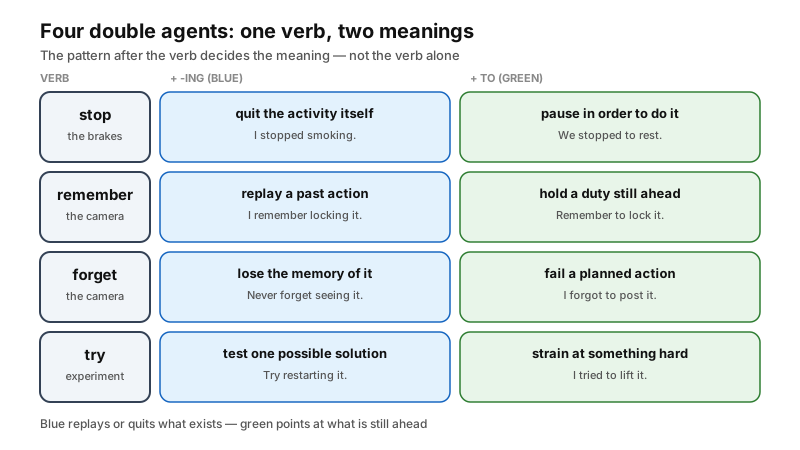
Stop: The Brake Test
With -ing, the brakes shut the activity down for good or for the day. With to, the brakes come on for a reason — the same purpose machinery as We left early to beat the traffic.
- I stopped drinking coffee in March. (quitting)
- We stopped to admire the view. (paused the journey — why? to admire)
The test I teach is a question: why did you stop? If the next words answer it, you need to. Notice too that English leaves the interrupted activity out — We stopped to take photos quietly assumes you were driving or walking, and context fills the gap.
Remember and Forget: The Camera and the Calendar
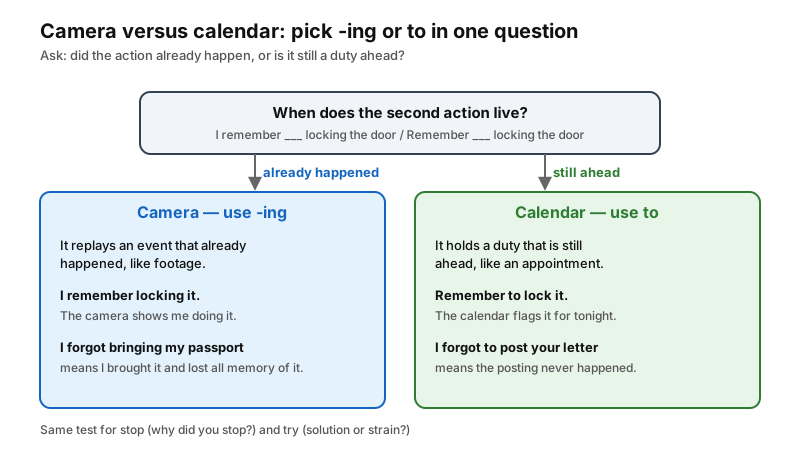
Give each pattern a mental device. The -ing form is a camera: it replays an event that already happened. The to form is a calendar: it holds a duty that is still ahead.
- I remember locking the door. (the camera shows me doing it)
- Please remember to lock the door. (the calendar flags it for tonight)
- I'll never forget seeing the northern lights. (a stored memory)
- I forgot to post your letter. (the duty slipped — it never happened)
The mix-up produces genuinely confusing messages. One learner wrote I forgot bringing my passport, intending to apologise for leaving it at home; his sentence actually confessed to something stranger — bringing it and losing all memory of the deed. When the action never happened, the calendar form forgot to is the only honest choice.
Try: Experiment Versus Effort
With -ing, you test one candidate solution among several — the register of troubleshooting and friendly advice. With to, you strain at something demanding, and success is uncertain.
- The page won't load? Try refreshing it. (solution number one)
- I tried to open the jar, but the lid wouldn't move. (effort defeated)
Quick paraphrase checks: if as a possible solution slots in naturally, choose -ing; if made an effort, but... captures the feeling, choose to. The lines can blur when pure effort is the message, but in advice-giving English leans firmly toward -ing — which is exactly how you will hear it from native speakers. Direct advice with would lives in the same territory — the classic If I were you, I'd... pattern runs on the same friendly-advisor instinct.
Your Turn: Fifteen Sentences Against the Double Agents
Fill each gap with the correct form of the verb in brackets. Read the whole sentence first — the surrounding words, not the verb, announce the answer.
- It started raining, so we stopped ____ (play) and looked for shelter.
- On the way home, we stopped ____ (buy) a coffee.
- I remember ____ (visit) the aquarium as a child — the sharks seemed enormous.
- Remember ____ (lock) the door when you leave.
- I forgot ____ (post) your letter — it's still in my bag.
- I'll never forget ____ (see) the northern lights for the first time.
- My laptop froze, so I tried ____ (restart) it, and that solved the problem.
- I tried ____ (reach) the top shelf, but I'm too short.
- He stopped ____ (drink) coffee last year, and he says he sleeps better now.
- We were lost, so we stopped ____ (ask) a local for directions.
- Did you remember ____ (feed) the cat this morning?
- The Wi-Fi isn't working — try ____ (turn) the router off and on again.
- I remembered ____ (take) my medicine because I had set an alarm.
- She tried ____ (carry) all the bags at once, but they were too heavy.
- Do you remember ____ (meet) my brother at the wedding?
Answer Key
- playing — the game itself ended when the rain arrived.
- to buy — we paused in order to buy; purpose takes the infinitive.
- visiting — the camera replays a childhood event.
- to lock — a duty flagged on tonight's calendar.
- to post — the posting never happened.
- seeing — a stored memory of a real moment.
- restarting — one tested solution, and it worked.
- to reach — genuine effort against a physical limit.
- drinking — coffee has left his life.
- to ask — we paused the walk for a purpose.
- to feed — a morning duty under inspection.
- turning — classic troubleshooting advice.
- to take — the remembering came first, the taking followed.
- to carry — the attempt failed under the weight.
- meeting — asking whether the camera holds that recording.
Score yourself on meaning as well as form: every item here rewards you for reading the situation, not just hearing the verb.
The Pocket Card
Screenshot or copy this card; it compresses the whole system into eight rows.
| Situation | Form | Example |
|---|---|---|
| Activity as object: enjoy, avoid, finish, mind, keep, suggest, consider | -ing | I enjoy cooking. |
| Action pointed at the future: want, need, decide, hope, plan, promise, refuse, afford | to + base verb | We decided to move. |
| Any preposition before a verb | -ing | He left without paying. |
| Free-time outing | go + -ing | We went skiing. |
| stop: quit | -ing | She stopped smoking. |
| stop: pause in order to | to | We stopped to rest. |
| remember / forget: past event | -ing | I remember locking it. |
| remember / forget: duty ahead | to | Remember to lock it. |
| try: experiment | -ing | Try restarting it. |
| try: struggle | to | I tried to lift it. |
A Ten-Minute Daily Routine That Locks It In
Double agents fade without contact, so give them ninety seconds a day rather than a marathon once a month. The same logic runs through how to build a 3-month study plan — short daily reps inside a longer plan beat last-minute grammar marathons every time. Each evening, write two lines about your real day: one camera sentence replaying something you did (I remember locking the office at six) and one calendar sentence flagging tomorrow's duty (Remember to charge my headset). Naming real events in perfect grammar is strangely satisfying, and it retires the confusion along with the sentence.
Once a week, hunt for double agents in the wild: work emails, app notifications, podcast transcripts. Every stopped to take a break or forgot to attach the file you spot is the system working in public. Collect three sightings a week and the patterns stop feeling like rules at all.
This pays off directly in exams, where these verbs cluster in listening traps and writing accuracy marks. IELTS Listening loves the calendar form in instructions and reminders (remember to bring your...), while Writing Task 2 examiners dock grammatical range and accuracy for exactly the slips in the practice set above. It is the same one-pattern-at-a-time habit behind fixing the most common grammar mistakes in IELTS writing: one slow pass hunting a single error type beats ten rushed re-reads.
Quick Answers to Questions Learners Always Ask
I left my passport at home and wrote "I forgot bringing it" — what did I actually say? You confessed to something stranger than your intention: that you brought the passport and lost all memory of the deed. The camera form -ing insists the action really happened. Since yours never did, the calendar form is the only honest choice: I forgot to bring my passport. When the action never happened, forgot to is never wrong.
Can "stop to do" ever mean quitting? No — and that stability is the good news. Run the brake test: why did you stop? If the next words answer the question (to buy a coffee, to admire the view), you paused for a purpose and to is mandatory. If nothing answers it, you quit and -ing is mandatory: I stopped drinking coffee in March. Purpose always takes the infinitive; quitting always takes -ing.
Does "try doing" versus "try to do" matter in IELTS Writing? Yes, because examiners read the difference as meaning, not style. The council should try recycling the waste proposes one candidate solution among several; The council tried to recycle the waste reports strained effort, probably defeated. In Task 2 proposals and recommendations, the experiment reading (try + -ing) is almost always the one you want — advice-giving English leans firmly toward it.
Why is "interested to learn" wrong when "happy to help" is fine? Because in is a true preposition and happy takes no preposition at all. After a genuine preposition — in, of, about, for, from, without, before, after, instead of — the next verb must wear -ing: interested in learning, tired of repeating, instead of arguing. Adjectives like happy, willing, or ready attach a to-infinitive directly (happy to help), with no preposition involved. Spot the preposition first and the choice makes itself.
Related Articles
⏱️ Present Simple vs Present Continuous: The Complete Guide
Stop guessing between present simple and present continuous — the window-and-dots model, stative verbs, signal words, and a 20-sentence check-up.
✏️ The 5 Most Common Grammar Mistakes in IELTS Writing (That Are Ruining Your Band Score)
Identify and fix the most frequent grammar errors that hold back your IELTS Writing band score, from subject-verb agreement to article misuse.
🧮 Countable and Uncountable Nouns: Much, Many, Some and Any — Without Guessing
Why advice and information refuse an -s, when much beats many, and how a piece of advice rescues an uncountable noun — plus a four-step card you can pin up.