🧮 Countable and Uncountable Nouns: Much, Many, Some and Any — Without Guessing
12 min read
2026-09-13
Why advice and information refuse an -s, when much beats many, and how a piece of advice rescues an uncountable noun — plus a four-step card you can pin up.
EngSandbox Editorial Team
Written with AI assistance and reviewed by our editors — experienced PTE/IELTS tutors. Every article is fact-checked against official band descriptors, the Academic Word List and Cambridge assessment research, then field-tested with learners before publishing. Human reviewed + field tested. Questions? Contact us — see our Editorial Process.

Before we touch a single rule, try this three-sentence check. Two sentences are correct and one is broken — which one?
- My uncle gave me two useful advices before my interview.
- There were long grey hairs all over the back of the sofa.
- We didn't have much time to talk.
Most learners flag sentence 2 immediately, because hairs looks like a textbook slip. It is actually perfect English — individual strands count, so they take -s. The only broken sentence is number 1, because advice refuses to be counted directly, however useful it was. If that result surprised you, good: countability in English follows strict rules, but the rules track grammar rather than common sense. Once you see the system, you stop guessing.
Countability Belongs to Words, Not to the World
Start with the two categories themselves. Countable nouns name things English treats as separate units: you can put a number straight in front of them and add -s (one email, two emails). Uncountable nouns — often called mass nouns — name things English treats as one undivided substance: no bare number, no plural (water, money, advice).
The trap is assuming these categories describe objects in the world. They describe packaging decisions that English froze into its vocabulary centuries ago. Watch the same reality split down opposite lines:
- money (uncountable) versus coins and dollars (countable)
- spaghetti (uncountable) versus noodles (countable)
- furniture (uncountable) versus tables and chairs (countable)
Nothing about the physical world changed across those arrows — only the word did. So the reliable question is never "can I picture myself counting this?" but "does English treat this word as countable?"
The two-second test
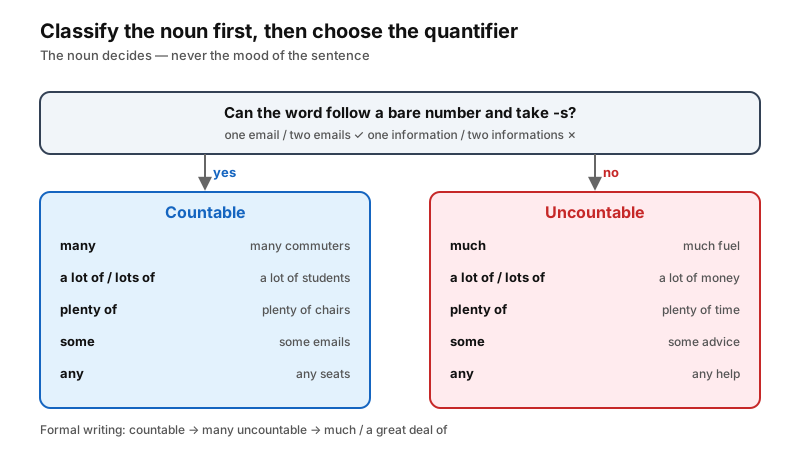
Ask one question: can the word follow a bare number and take a plural? One email, two emails passes; one information, two informations collapses. A second shortcut works in conversation: notice which question you would naturally ask — How many emails did you get? points to countable, How much time do we have? points to uncountable. When we practise this in lessons, learners quickly discover their ear already knows more than their grammar notes claim; the test just makes the ear audible.
Why "Informations" Feels So Right and Stays So Wrong
If you have ever typed informations or advices, nothing is wrong with your logic — it is simply logic borrowed from your first language, where the equivalent word really is countable. This is one of the most widespread transfer effects I see in adult learners' writing, and it clusters neatly by language family.
- Romance languages (French, Spanish, Italian, Portuguese): the everyday words behave like ordinary plural countables — des informations in French, consejos in Spanish, informazioni in Italian — so informations, advices, and researches slide naturally into English.
- German: the same story with Informationen, Ratschläge, Hausaufgaben, and Möbel, which is why homeworks and furnitures appear so often in drafts from German speakers.
- Arabic: the common words for information and advice (maʿlūmāt, naṣāʾiḥ) are already plural in shape, so the English singulars can genuinely look incomplete.
- Turkish: counting runs straight through the natural translation — üç tavsiye renders word-for-word as "three advice" — so the plural ending gets added to keep the sentence feeling finished.
- Article-free languages (Russian, Polish, Ukrainian, and other Slavic languages, plus Turkish, Japanese, Korean, and Mandarin): the bigger struggle is not the plural but the company these nouns keep — choosing between a, the, and nothing, and deciding where some belongs, since no exact equivalent exists. If articles are your weak spot generally, work through how to use articles a/an/the correctly alongside this guide — the two systems overlap constantly.
- Classifier languages (Mandarin, Japanese, Korean): nouns take no plural ending at all, which cuts both ways — learners sometimes write two book while confidently producing informations.
The cure is not lifelong memorisation. Meet the repeat offenders once, slowly, and the pattern holds. In my students' writing, the same short list keeps turning up: advice, information, news, furniture, equipment, luggage, homework, research, evidence, progress, feedback. All uncountable, always:
- She offered me some excellent advice.
- I found all the information on the university website.
- The evening news starts at nine. (Yes — it ends in -s yet behaves as uncountable: the news is, never the news are.)
- We bought most of our furniture second-hand.
- The gym finally replaced its old equipment.
- How much luggage can I take on board?
- How much homework did your teacher give you?
- Their research focuses on sleep and memory.
- The police collected very little evidence.
- You've made fantastic progress this term.
- Thanks for the detailed feedback.
Read that list aloud twice and you have done more for your writing than an hour of vague worrying would achieve.
Three Nouns That Live on Both Sides of the Line
Some nouns hold dual citizenship, and their meaning shifts with their side. These three cause the most confusion because both versions are common.
Hair. As a collective covering, it is uncountable: She has thick black hair. As individual strands, it counts: There's a hair in my soup. or I keep finding cat hairs on my winter coat. The meaning moves from "all of it together" to "separable pieces."
Time. As the resource you never have enough of, it is uncountable: I never have time to read. As instances or occasions, it counts: How many times have you visited Rome? or We meet three times a week. Duration flows; occasions tick.
Work. As effort, tasks, or employment, it is uncountable: I have too much work this week. As creations or products, it counts: the works of Shakespeare, This mural is a remarkable work of art. Effort spreads like a substance; artworks stand apart like objects.
A quick supporting cast: coffee is the drink in general (This region grows a lot of coffee) but becomes cups on order (Two coffees and a tea, please). Paper is the material (He wrapped the gift in brown paper) but a paper is a newspaper or an academic article. Room as space is uncountable (There's plenty of room in the car) while rooms are places (The house has four rooms). One warning before you experiment: the uncountable reading is always the default, and switching a noun to countable must mean units, kinds, or instances — otherwise the switch itself is the error.
Lending Countability: The Piece-Of Trick
Uncountable nouns cannot be counted directly, but English lets you lend them a temporary unit. These loan-units are called partitives, built on one formula: a/an + unit word + of + noun.
| Partitive | Pairs with | Example |
|---|---|---|
| a piece of | advice, information, news, evidence | Let me offer you a piece of advice. |
| a bit of | luck, help, gossip | With a bit of luck, we'll arrive early. |
| an item of | clothing, news | She packed every item of clothing she owned. |
| a slice of | bread, cake, pizza | Would you like another slice of cake? |
| a sheet of | paper | Grab a blank sheet of paper. |
| a bar of | chocolate, soap | He bought a bar of chocolate on the way home. |
| a grain of | rice, sand, salt | A few grains of rice stuck to the bowl. |
| a cup / bottle / glass of | tea, water, milk | We need two more bottles of water. |
Notice that containers happily wrap around countable nouns too — a box of matches beside a box of cereal — because the unit counts the package, not the contents.
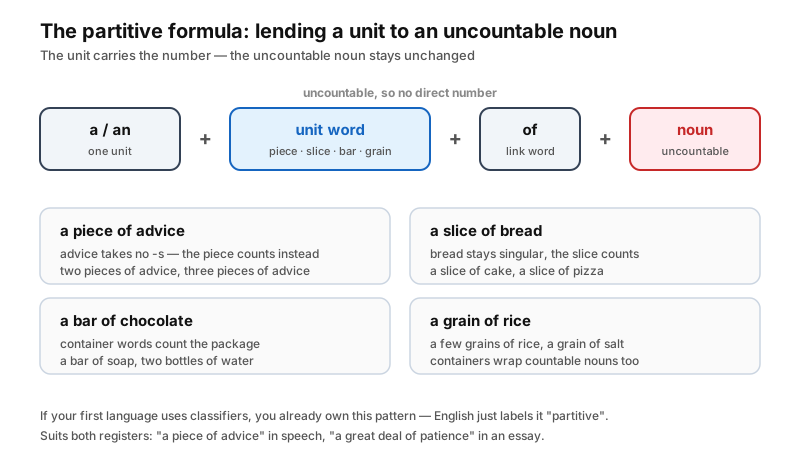
And here is the encouraging part for speakers of Mandarin, Japanese, or Korean: you already master this structure. Your first language measures nouns with classifiers — yī tiáo jiànyì in Mandarin is literally "one strip of advice." A partitive is your native system wearing English clothes: a piece of advice simply chooses piece as the classifier. Nothing new to learn; only new labels for the same instinct.
Much, Many, A Lot Of, Plenty Of: One Table, No Coin Flips
With the nouns sorted, the quantifiers almost decide themselves. Four workhorses cover most situations:
| Quantifier | Pairs with | Where it feels at home | Example |
|---|---|---|---|
| much | uncountable | questions and negatives | We don't have much fuel left. |
| many | plural countable | questions, negatives, and confident affirmative subjects | Many commuters now cycle to work. |
| a lot of / lots of | both | the all-purpose default, speech and writing alike | A lot of my students record themselves speaking. |
| plenty of | both | affirmative, with a "more than enough" glow | No hurry — we've got plenty of time. |
Three refinements make the table complete. First, much in an affirmative statement sounds formal or written — Much of the evidence points the same way belongs in an essay, while conversation prefers A lot of the evidence…. Second, many is comfortable in affirmative sentences when it leads the clause, as in the commuting example above. Third, for formal writing about uncountable nouns, a great deal of is a polished upgrade: The project required a great deal of patience.
The negative sentences deserve special attention, because the choice is mechanical once you trust the noun, not the mood of the sentence: I don't have many friends here versus I don't have much free time. Friends count; time flows.
The some/any split, including its polite exceptions
Some lives in affirmative sentences and in questions where you expect — or hope for — yes: Would you like some tea? (an offer) and Could you lend me some money? (a request). Any covers negatives (We don't have any bread), genuine questions with no assumed answer (Do you have any siblings?), clauses after if (If you need any help, text me), and one affirmative job: free choice with zero restriction — Choose any seat you like.
The subtle case is the question itself, and a kitchen scene shows the difference. Opening the fridge unsure, you ask: Do we have any eggs? But recipe in hand, fairly sure the eggs are there and asking someone to confirm: Are there some eggs in the fridge? Same shelf, same eggs — any checks, some presumes. Learners who grasp that difference stop treating some/any as random and start hearing the speaker's expectation inside the word.
Make the Dictionary Your Tiebreaker
Even fluent writers meet unfamiliar nouns, and guessing is unnecessary because the answer is printed. Oxford Learner's Dictionaries and Cambridge Dictionary label every noun entry [C] (countable), [U] (uncountable), or [C, U] (both, with the meanings separated). Check advice and you will see [U]; check hair and you will find [C, U] with the two senses explained exactly as above. Thirty seconds with a dictionary replaces minutes of anxious hesitation, and the habit compounds: after a few weeks of checking, your instincts store the answers automatically.
This matters doubly in timed exams, where quantity language fills data-description tasks. Writing about charts means constant choices — many households, much of the energy produced, a significant proportion of respondents — and the published assessment criteria for exams like IELTS award marks specifically for grammatical range and accuracy. Quantifier slips there are cheap points lost, and entirely preventable points.
So adopt a simple self-editing ritual for anything you write in English: reread it once hunting only for your suspect nouns and the words around them. Is there a stray -s after information? A many sitting beside an uncountable? Fixing those two patterns catches the overwhelming majority of countability errors in adult learners' texts — and unlike tense or word order, these fixes are instant. It is the same one-pattern-at-a-time habit behind fixing the most common grammar mistakes in IELTS writing: one slow pass hunting a single error type beats ten rushed re-reads.
Quick Answers to Questions Learners Always Ask
Is "fruits" ever correct? Yes — when you mean kinds, not pieces. This region grows many fruits means many types of fruit, just as two coffees means two cups and his latest papers means his academic articles. Default to the uncountable form; switch to the plural only when you mean units, kinds, or instances.
Should I write "much" or "many" in a formal essay? Many for plural countables everywhere, including formal writing. For uncountables, conversation prefers a lot of while formal writing accepts much and the polished upgrade a great deal of — The project required a great deal of patience.
Can I use "some" in a question? Yes, when you expect — or hope for — yes. Would you like some tea? is an offer, not a real question. Genuine open questions with no assumed answer take any: Do you have any siblings?
Why is it "the news is", not "the news are"? News ends in -s but behaves as uncountable singular, like mathematics or physics. The spelling is a historical accident; the grammar follows the [U] dictionary label, not the final letter.
The Whole System, Small Enough to Pin Up
Everything above compresses onto one card. Screenshot it, copy it onto paper, stick it beside your desk.
Step 1 — Classify the noun. Bare number plus -s possible? → countable. Not possible? → uncountable. Genuinely unsure? → look up the [C] / [U] label in Oxford Learner's Dictionaries or Cambridge Dictionary.
Step 2 — Pick the quantifier.
| Context | Countable (plural) | Uncountable |
|---|---|---|
| Question | many | much |
| Negative | many (e.g., not many friends) | much (not much time) |
| Neutral affirmative | many / a lot of | a lot of |
| Formal writing | many | much / a great deal of |
| "More than enough" | plenty of | plenty of |
| Unstated amount | some | some |
| Negative, open question, if-clause, free choice | any | any |
Step 3 — Rescue an uncountable that truly needs counting. Attach a partitive: a piece of advice, an item of news, a slice of bread, a bar of chocolate.
Step 4 — Run the watchlist before you submit. advice · information · news · furniture · equipment · luggage · homework · research · evidence · progress · feedback — uncountable every time, whatever your first language insists.
Four steps, one glance, no coin flips. Work the card into your next few messages and essays, and one day soon you will write some helpful advice without pausing — and smile at the memory of when informations ever felt right.
Related Articles
⏱️ Present Simple vs Present Continuous: The Complete Guide
Stop guessing between present simple and present continuous — the window-and-dots model, stative verbs, signal words, and a 20-sentence check-up.
✏️ The 5 Most Common Grammar Mistakes in IELTS Writing (That Are Ruining Your Band Score)
Identify and fix the most frequent grammar errors that hold back your IELTS Writing band score, from subject-verb agreement to article misuse.
📝 IELTS/PTE Writing: How to Use Articles (a, an, the) Correctly
Master the correct use of articles (a, an, the) in your IELTS and PTE writing. Learn the rules, common mistakes, and practical strategies to boost your grammar score.