📝 IELTS/PTE Writing: How to Use Articles (a, an, the) Correctly
8 min read
2026-07-01
Master the correct use of articles (a, an, the) in your IELTS and PTE writing. Learn the rules, common mistakes, and practical strategies to boost your grammar score.
EngSandbox Editorial Team
Written with AI assistance and reviewed by our editors — experienced PTE/IELTS tutors. Every article is fact-checked against official band descriptors, the Academic Word List and Cambridge assessment research, then field-tested with learners before publishing. Human reviewed + field tested. Questions? Contact us — see our Editorial Process.

If articles have ever made you want to close your laptop and walk away from IELTS or PTE preparation, you are not alone. The tiny words "a," "an," and "the" look simple, but they cause confusion for almost every English learner — especially when writing essays under time pressure. Even advanced speakers second-guess themselves on these little words.
The good news is that article usage follows clear, learnable patterns. Once you understand the rules and start noticing them in your own writing, your accuracy will improve faster than you might expect. According to the official IELTS Writing assessment criteria published by the British Council, IELTS Partners, and IDP, grammatical range and accuracy is one of the four pillars of your writing band score. Article errors are one of the most frequent types of grammar mistakes examiners see, which means fixing them gives you a real scoring advantage.
In this guide, we will walk through every major article rule you need for IELTS and PTE writing. You will learn when to use each article, how to avoid the most common traps, and how to practise effectively — even if you only have a few minutes a day.
Why Articles Matter More Than You Think
You might wonder: can a missing "the" or an extra "a" really affect my score? The answer is yes — and here is why.
In IELTS, your Writing score is based on four criteria: task response, coherence and cohesion, lexical resource, and grammatical range and accuracy. Article mistakes count under the grammar criterion. If an examiner notices repeated article errors throughout your essay, it signals that your control of English grammar is inconsistent, which can pull your score down by half a band or more.
In PTE Academic, Pearson's automated scoring system evaluates your grammar directly. The system is designed to detect patterns of error, and article mistakes are among the easiest patterns to detect because they appear in almost every sentence you write.
The encouraging part? Because articles show up so frequently, every correction you make is visible improvement. Fix your article habits, and your entire essay reads more fluently.
The Three Types of Articles: A Quick Overview
Before we dive into rules, let's make sure we share the same vocabulary. English has three article categories:
| Type | Words | Purpose | Example |
|---|---|---|---|
| Indefinite article | a, an | Introduces something non-specific or new | I saw a dog in the park. |
| Definite article | the | Refers to something specific or already known | I saw the dog again this morning. |
| Zero article | (none) | Used with general or uncountable nouns | Dogs are loyal animals. |
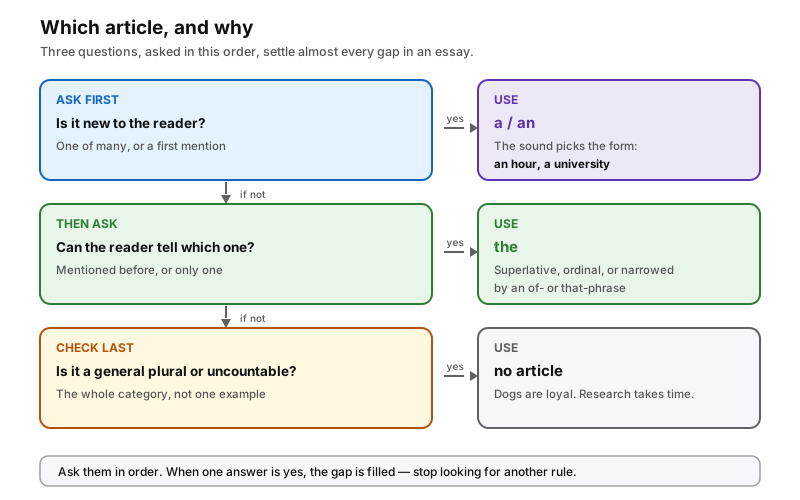
Think of it this way: "a" and "an" are like saying "one of many" — you are introducing something for the first time. "The" is like pointing at something — both you and your reader already know which one you mean. And sometimes, you need no article at all.
When to Use "A" and "An"
The indefinite article has two forms: "a" and "an". The rule is straightforward:
- Use "a" before words that begin with a consonant sound.
- Use "an" before words that begin with a vowel sound.
Notice the emphasis on sound, not spelling. This is where many learners get tripped up.
Sound-Based Examples
| Word | Article | Why |
|---|---|---|
| university | a university | Starts with /juː/ (consonant sound) |
| hour | an hour | "H" is silent; starts with /aʊ/ (vowel sound) |
| honest person | an honest person | "H" is silent |
| European country | a European country | Starts with /jʊ/ (consonant sound) |
| umbrella | an umbrella | Starts with /ʌ/ (vowel sound) |
Using the Indefinite Article in Your Essays
Use the indefinite article when you are:
-
Introducing something for the first time.
- The government recently built a new hospital in the area.
-
Referring to one member of a group (not a specific one).
- A university degree can open doors to many careers.
-
Describing someone's role or profession.
- She works as an engineer at a multinational company.
A quick tip: if you can replace "a" or "an" with "one" and the sentence still makes sense, you are using the indefinite article correctly. "She works as one engineer" sounds odd, but the underlying idea — one engineer among many — is correct.
When to Use "The"
The definite article is the most frequently used word in the English language. You need "the" when your reader can identify exactly which thing you are talking about. This usually happens in one of the following situations:
1. You Have Already Mentioned It
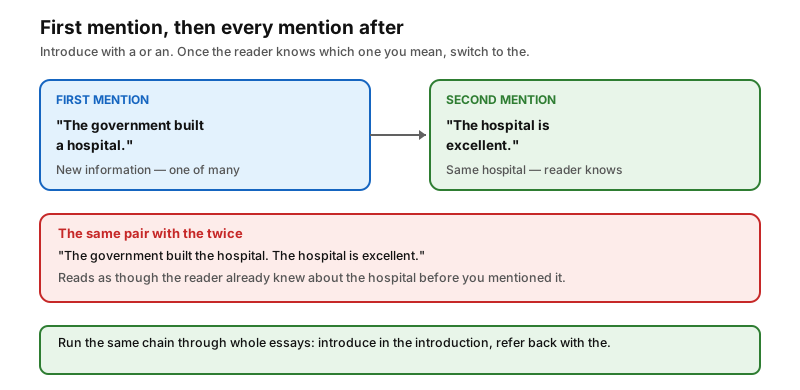
The first time you mention something, use "a" or "an." Every time after that, use "the."
- I visited a museum last weekend. The museum had a wonderful collection of modern art.
This pattern — introduce with "a," then refer back with "the" — is one of the most useful structures in IELTS Task 2 essays. It signals to the examiner that you are building a coherent argument.
2. There Is Only One
Use "the" when there is only one of something in the context you are discussing.
- The government should take action on climate change.
- She is the tallest person in her family.
3. The Noun Is Modified by a Specific Phrase
When a noun is followed by a phrase that makes it specific — such as "of," "that," "which," or "who" — you generally need "the."
- The rise of social media has changed how people communicate.
- The students who passed the exam were very relieved.
4. Superlatives and Ordinals
Always use "the" with superlative adjectives and ordinal numbers.
- This is the most important factor to consider.
- The first paragraph should introduce your main argument.
When to Use No Article (The Zero Article)
This is where many learners lose the most marks. Sometimes, the correct choice is no article at all. This is called the zero article, and it appears in several specific situations.
1. General Plural Nouns
When you talk about something in general — not one specific thing, but the whole category — use no article.
- ❌ The dogs are loyal animals.
- ✅ Dogs are loyal animals. (Dogs in general)
- ❌ The young people today face many challenges.
- ✅ Young people today face many challenges. (Young people in general)
2. Uncountable Nouns Used Generally
Words like "education," "information," "research," "pollution," and "traffic" are uncountable in English. When you refer to them in a general sense, do not use "the."
- ❌ The education is essential for a country's development.
- ✅ Education is essential for a country's development.
- ❌ The research shows that exercise improves mental health.
- ✅ Research shows that exercise improves mental health.
However, if you are being specific — pointing to particular research or particular information — then use "the."
- ✅ The research conducted by Oxford University supports this claim.
3. Most Proper Nouns
Do not use "the" with the names of most countries, cities, languages, meals, or subjects.
- ✅ She studied biology at Cambridge. (no "the")
- ✅ We had lunch at noon. (no "the")
But some proper nouns do take "the" — particularly country names that are plural or contain a common noun:
- ✅ The United Kingdom, The Netherlands, The United States
- ✅ The University of Oxford (because "university" is a common noun here)
4. Abstract Nouns in General Statements
When you speak about abstract concepts in general, use the zero article.
- Happiness cannot be bought with money.
- Freedom of speech is a fundamental right.
Tricky Situations That Confuse Everyone
Even students who know the rules well get stuck on certain patterns. Here are the situations that come up most often in IELTS and PTE writing.
"The" + Adjective to Describe a Group
When you use an adjective to represent a whole group of people, use "the."
- The elderly need better access to healthcare.
- The unemployed often struggle to find new jobs.
This structure is extremely useful in Task 2 essays when discussing social issues. Do not forget "the" here — saying "Elderly need better access" is incomplete.
First Mention vs. Second Mention
This deserves repeating because it is so important for essay writing. The pattern is:
- First mention → a / an (introducing it as new information)
- Second mention → the (referring to the same thing)
Compare:
- ❌ The government built the hospital. The hospital is excellent. (Sounds like the reader already knew about the hospital.)
- ✅ The government built a hospital. The hospital is excellent. (Clear and natural.)
Note: "The government" already uses "the" because we are typically referring to a specific government — the one governing the country we are discussing.
Countable vs. Uncountable Noun Confusion
Some words change their article behaviour depending on whether they are countable or uncountable in a given context.
| Sentence | Correct? | Explanation |
|---|---|---|
I need an advice. | ❌ | "Advice" is uncountable. |
I need some advice. | ✅ | Use "some" or "a piece of" with uncountable nouns. |
She gave me a useful piece of advice. | ✅ | "Piece of advice" is countable. |
The information was helpful. | ✅ | Specific information (previously mentioned or implied). |
I need an information about the course. | ❌ | Should be "some information" or "information." |
Practice Exercises
Let's put these rules into action. For each sentence below, fill in the blank with a, an, the, or (no article). Try answering before you look at the explanation.
Exercise 1: Climate change is ____ major concern for ____ governments around ____ world.
Answer: Climate change is a major concern for (no article) governments around the world. Explanation: "A" introduces one concern among possible concerns. "Governments" is a general plural noun (no article). "The world" is unique — there is only one world.
Exercise 2: She is ____ honest and hardworking person who works as ____ engineer at ____ university in London.
Answer: She is an honest and hardworking person who works as an engineer at a university in London. Explanation: "An honest" because "honest" starts with a vowel sound. "An engineer" introduces her profession. "A university" because "university" starts with a /j/ consonant sound.
Exercise 3: According to ____ research published by ____ University of Cambridge, ____ education plays ____ vital role in reducing poverty.
Answer: According to the research published by the University of Cambridge, (no article) education plays a vital role in reducing poverty. Explanation: "The research" because it is specific (published by Cambridge). "The University of Cambridge" takes "the" because "university" is a common noun. "Education" is general and uncountable. "A vital role" introduces one role among possible descriptions.
Exercise 4: Many young people believe that ____ university degree is ____ only path to ____ success.
Answer: Many young people believe that a university degree is the only path to (no article) success. Explanation: "A university degree" — one of many possible degrees. "The only path" — "only" makes it specific. "Success" is a general abstract noun.
When Life Gets Busy: Micro-Learning Tips for Article Practice
Preparing for IELTS or PTE alongside work, family, and daily responsibilities is not easy. Here are some strategies that work even when you only have five minutes.
The One-Sentence Journal. Every day, write one sentence about your day and focus on getting the articles right. For example: "I had a meeting with the new manager today. (No article) Teamwork is essential in a workplace like ours." Over time, this builds instinct.
The Read-and-Underline Method. When you read a news article or a short passage, underline every article you see and ask yourself why it is there. This trains you to notice patterns without memorising rules. The British Council's free online resources and Cambridge Assessment English sample materials are excellent sources for this kind of focused reading.
The Swap Technique. Take one paragraph you have written and try removing every article. Then put them back one by one, explaining to yourself why each one belongs. This exercise makes the rules feel practical rather than abstract.
Record Yourself Reading. Read a model essay aloud and pay attention to where articles appear. Hearing the rhythm of articles in natural English helps your brain internalise correct patterns faster than silent reading alone.
Even five minutes of focused article practice a day is more valuable than an hour of passive reading once a week. Consistency beats intensity when it comes to grammar improvement.
Final Thoughts
Articles might be small, but they carry real weight in your IELTS and PTE writing score. The rules are learnable, the patterns are predictable, and every sentence you write is a chance to practise.
Do not expect perfection overnight. Even native speakers occasionally hesitate over article choices. What matters is that you are building awareness — you are starting to notice where articles belong and why. That awareness is the foundation of accuracy, and accuracy is what examiners reward.
Start with one rule from this guide and apply it in your next practice essay. Then add another. Then another. Before long, correct article usage will feel less like a rule you are following and more like a habit you have built. You have everything you need to make this happen — now go and prove it to yourself.
Related Articles
🧮 Countable and Uncountable Nouns: Much, Many, Some and Any — Without Guessing
Why advice and information refuse an -s, when much beats many, and how a piece of advice rescues an uncountable noun — plus a four-step card you can pin up.
🔗 20 Linking Words That Boost Your IELTS Writing Score
Master 20 essential linking words to improve your IELTS Writing coherence and cohesion. Learn how to connect ideas smoothly and boost your band score.
✏️ The 5 Most Common Grammar Mistakes in IELTS Writing (That Are Ruining Your Band Score)
Identify and fix the most frequent grammar errors that hold back your IELTS Writing band score, from subject-verb agreement to article misuse.