⚠️ 7 Costly Mistakes That Are Lowering Your IELTS Score (And How to Fix Them)
8 min read
2026-07-12
Identify and fix seven common mistakes that could be holding back your IELTS score. Practical strategies to avoid errors in writing, speaking, and test day preparation.
EngSandbox Editorial Team
Written with AI assistance and reviewed by our editors — experienced PTE/IELTS tutors. Every article is fact-checked against official band descriptors, the Academic Word List and Cambridge assessment research, then field-tested with learners before publishing. Human reviewed + field tested. Questions? Contact us — see our Editorial Process.

You have been studying for months. On results day you open the report with your fingers crossed — and there it is: an overall band sitting well below what your practice test scores had suggested. Reading felt fine, you spoke confidently in the exam room, so where exactly did the marks go?
After working through this exact moment with adult learners many times, I can usually find the culprit quickly: not weak English, but a handful of test-day habits that leak marks quietly. Examiners are not hiding points from you. The official scoring criteria published on IELTS.org are public and surprisingly specific — and when an answer misses one of them, the score simply reflects it.
Below are the seven costly mistakes I encounter most often in scripts and recorded answers, each paired with a concrete fix. They span Reading, Writing, Speaking, and Listening, because a stuck band score usually has more than one cause at a time. Work through them honestly; most readers recognise themselves in at least two.
Mistake 1: Spending Reading Time Like It Is Unlimited
Where the minutes go
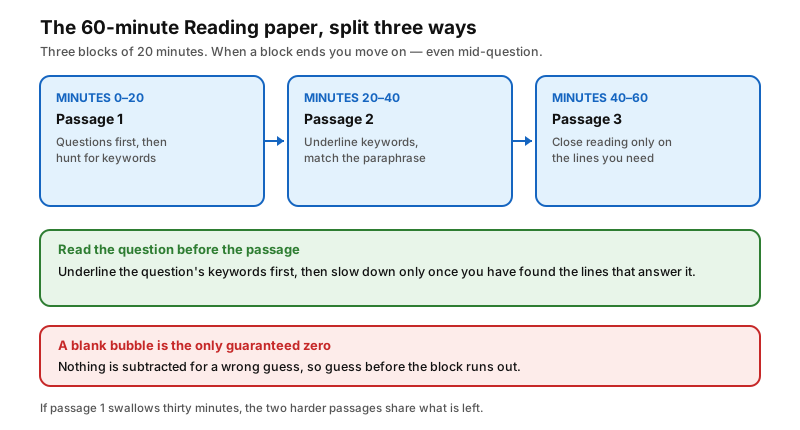
The Reading test gives you 60 minutes for three long passages and 40 questions. Under pressure, many candidates read every passage word by word, determined to understand each sentence before touching a single question. It feels thorough. It is also the fastest route to trouble: if the first passage swallows thirty minutes, the remaining two — which are usually harder — have to share whatever is left.
What it costs you
The final passage gets skimmed in a panic or abandoned altogether, careless errors pile up, and questions go blank. Blank answers are the most expensive kind: the Reading test subtracts nothing for wrong guesses, so an empty bubble is the only answer guaranteed to earn zero.
The twenty-minute discipline
Divide the hour into three blocks of 20 minutes and honour them ruthlessly; when a block ends, move on, even mid-question. Then flip your reading order entirely: read the question first, underline its keywords, and hunt through the text for matches or paraphrases of those keywords. Only when you have located the relevant lines do you slow down and read closely.
Try it now: take one practice passage, set a timer for 20 minutes, and force yourself to stop when it rings — unfinished or not. That small act of obedience trains the instinct the real hour will demand.
Mistake 2: Writing a Good Essay About the Wrong Question
Where it goes wrong
Writing Task 2 prompts often ask for several things at once — discuss both views and give your opinion, for example. Nervous writers produce a fluent, well-organised essay about the general topic while quietly ignoring one of those instructions. The prose is lovely; the response is incomplete.
What it costs you
Task Response is one of four criteria of equal weight in the official writing assessment, alongside Coherence and Cohesion, Lexical Resource, and Grammatical Range and Accuracy. If part of the task goes unanswered, examiners must treat the response as only partially addressing the question — and that drags the whole criterion down no matter how polished the sentences are.
Dissect before you draft
Consider a typical prompt:
Prompt: "Some people think the internet brings people closer together, while others believe it isolates us. Discuss both views and give your own opinion."
Before writing a word, translate the prompt into a plan:
| What the prompt demands | How your essay delivers it | Where |
|---|---|---|
| Present the view that the internet connects people | Explain it fairly, with one supporting reason | Body paragraph 1 |
| Present the view that it isolates people | Explain it fairly, with one supporting reason | Body paragraph 2 |
| Give your own opinion | Commit clearly — and echo that position in the conclusion | Introduction and conclusion |
Your thesis is where marks are won or lost here. Compare:
- Off-task: "The internet has changed our lives in many ways, such as communication, shopping, and entertainment." — pleasant, harmless, and answering a question nobody asked.
- On-task: "While the internet undoubtedly helps distant friends stay in touch, I believe it increasingly replaces deep local connection with shallow scrolling, so in that sense it isolates us more than it unites us."
Never start writing until you can state, in one sentence, exactly what the prompt asks you to do.
Mistake 3: Reciting Memorised Scripts in the Speaking Test
Why scripts backfire
Faced with the terror of live conversation, many candidates memorise beautiful paragraphs about their hometown, their hobbies, or environmental problems. The difficulty is that examiners hear hundreds of answers and are specifically trained to recognise recitation: the intonation flattens, the pacing turns mechanical, and the moment a follow-up question changes direction, the script collapses and panic walks in. Recitation also damages Fluency and Coherence — one of the four official speaking criteria — precisely because recited speech is not communication.
Build frameworks, not scripts
For Speaking Part 2 — the long turn — we use PPF: Past, Present, Future. You memorise the shape, never the sentences:
- Past: set the scene. "When I was a child, my hometown was quiet enough that we played football in the street."
- Present: describe today. "These days it has grown into a busy city, and the streets are full of traffic."
- Future: speculate. "I imagine the city will build more parks eventually, because green space is disappearing fast."
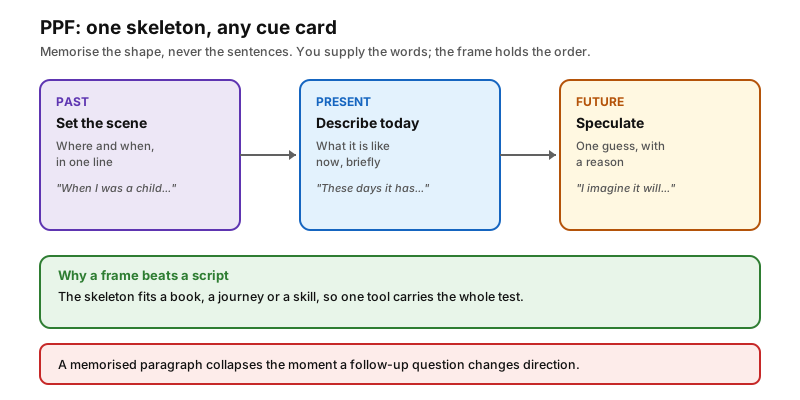
Because the skeleton fits almost any cue card — a book, a journey, a skill — you walk into the test carrying one flexible tool instead of fifty fragile speeches. When we rehearse this in lessons, the change is immediate: candidates stop hunting for memorised words and simply start talking.
Mistake 4: Wearing Vocabulary That Does Not Fit
The show-off trap
Many learners equate a high Lexical Resource score with long, impressive words downloaded from so-called C1 lists. The official descriptors reward something different: vocabulary used accurately and appropriately, not decoratively. A rare word deployed wrongly damages your score far more than a common word used well.
Think in chunks, not single words
A collocation is a partnership of words that native speakers reach for together. Record new vocabulary as chunks:
- Word: mitigate
- Meaning: to make something unpleasant less severe
- Natural partnerships: mitigate the effects, mitigate the risk, mitigate the damage
- Example: "Planting mangroves along the shore mitigated the damage when the storm hit."
Learn mitigate alone and you may soon produce sentences like "the city built new roads to mitigate the traffic." Understandable — but no native speaker says it; they would ease congestion or reduce traffic. When in doubt, check a learner's dictionary such as Oxford Learner's Dictionaries, which shows real example sentences and the words that genuinely travel with your target word. And keep this hierarchy in mind: "solve the problem" written accurately beats "mitigate the problem" written hopefully, every single time.
Mistake 5: Chasing Complex Sentences and Catching Errors Instead
Why complexity backfires
Grammatical Range and Accuracy asks for variety and control. Interpreting that as "longer is better," candidates stack clause upon clause until the subject disappears and the verb agrees with nobody.
Two structures mastered beat ten attempted
Pick two dependable structures and make them automatic:
- Second conditional, for hypothetical situations: "If governments invested more in public transport, air quality in our cities would improve within a few years."
- Concessive clauses with although or even though, for contrast: "Although electric cars cost more upfront, many drivers find that the savings on fuel make up for it over time."
Now compare two ways of expressing one idea:
- Overstuffed (technically grammatical, exhausting to read): "The decision to widen the main road, which the council announced last year after years of pressure from commuters who were tired of sitting in traffic, has failed to solve the congestion that everyone hoped it would."
- Clean and still complex: "Although the council widened the main road last year, congestion is worse than ever, because extra lanes simply attract extra cars."
The second version loses nothing in range — it still contains a concessive clause and a causal one — while collecting accuracy points the tangled version throws away. When we review timed essays together in lessons, this trade appears constantly: clarity is not the enemy of complexity; it is what makes complexity creditable.
Mistake 6: Treating the Listening Preview Time as a Break
The missed opportunity
Before each section, the recording grants you a short window to read the questions. Many candidates spend it passively pronouncing the words in their heads, then meet the audio cold and try to read, listen, and write simultaneously. Miss one answer while still processing the previous one, and panic tends to snowball: one gap becomes three.
Predict before you listen
Use the preview actively. For every gap, decide what kind of word could legally sit there:
- The library is located next to the ___________.
- Students must bring a ___________ to the examination room.
- The tour starts at ___________.
Predictions: (1) a place — a park, a sports hall; (2) a singular countable noun — an ID card, a calculator; (3) a clock time — 10:15, because "starts at" needs a point in time, not a period like "morning."
Then, when the recording says, "The library is right beside the old post office," your ear is already primed for a place, and post office lands cleanly. Two cautions: whatever you hear must fit the grammar of the sentence around the gap, and it must be copied exactly — correct spelling, correct word form — because a misspelled answer earns zero no matter how carefully you listened.
Mistake 7: Handing In Essays You Never Checked
The minutes you refuse to spend
You finish your essay with three minutes to spare, exhale, and close the booklet while the invigilator watches the clock. Understandable — but the final minutes are where easy points hide. Missing plurals, dropped articles, and comma splices are errors whose rules you already know; you simply never looked back at them.
Proofread like an editor, not a reader
Rereading from the top tricks your brain into seeing what you intended to write rather than what you actually wrote. Instead, hunt one error type per pass:
| Pass | What you hunt | Typical fix |
|---|---|---|
| Verbs | Subject–verb agreement | The student are → The student is |
| Plurals | Countable nouns left singular | many car → many cars |
| Articles | Missing a, an, or the | I went to library → I went to the library |
| Sentences | Comma splices and run-ons | It was late, I went home. → It was late, so I went home. |
Budget for this from the start: aim to finish in 35 minutes and bank the final five for these passes. Catching even two or three slips this way is often the difference between a 6.0 and a 6.5 in Writing — the cheapest half band you will ever earn.
Small Daily Repairs: Keeping All Seven Fixes Sharp
Life rarely leaves two clean hours a day for test preparation. It does not need to — the habits above survive comfortably on scraps of time:
- On the bus: swap music for an English podcast and play the prediction game from Mistake 6 — guess what type of word comes next before the speaker says it. Your listening sharpens without any desk time.
- In a queue: open a news app, read one short article, and note down three collocations on your phone — recorded chunk-first, exactly as in Mistake 4.
- At lunch: write one sentence — a single, immaculate complex sentence built on an although clause, as in Mistake 5. One perfect sentence a day outshines a page of sloppy ones.
- Before bed: reread yesterday's sentence and run the four proofreading passes from Mistake 7. Sixty seconds, no more needed.
Ten focused minutes daily beats a heroic monthly cram. Slow, steady contact with English is how scores actually move — not through occasional bursts of desperation.
Closing: Reading Your Next Score Report Differently
Look back over the seven traps and notice what they share: not one of them requires new English. Time blocks, prompt dissection, flexible frameworks, word chunks, two reliable structures, active prediction, and a proofreading routine are behaviours — trainable tonight, free of charge.
So when your next results slip arrives, treat it less like a verdict and more like a diagnostic: which habit was missing? Learners who approach preparation this way tend to move forward steadily instead of stalling on discouraging plateaus, because every study session now targets the machinery behind the marks. Pick the mistake above that stung the most, apply its fix in tomorrow's study window, and let the small wins compound.
Related Articles
✏️ The 5 Most Common Grammar Mistakes in IELTS Writing (That Are Ruining Your Band Score)
Identify and fix the most frequent grammar errors that hold back your IELTS Writing band score, from subject-verb agreement to article misuse.
✍️ IELTS Writing Task 2: The Foolproof 4-Paragraph Essay Structure for a Band 7+
Master the IELTS Writing Task 2 with a simple, foolproof 4-paragraph essay structure. Learn how to plan, write, and polish your essay for a Band 7 or higher.
🏆 10 High-Scoring Words and Phrases to Boost Your IELTS Lexical Resource Score
Discover 10 powerful words and phrases to boost your IELTS Lexical Resource score. Master less common vocabulary with correct collocation to achieve Band 7 or higher.