🕵️ Modal Verbs of Deduction: Must, Might, Could and Can't for Speculation
14 min read
2026-09-19
She must be stuck on the tram — the confidence dial, must's two obligation and conclusion jobs, modal + have + past participle, and ten sentences to re-dial.
EngSandbox Editorial Team
Written with AI assistance and reviewed by our editors — experienced PTE/IELTS tutors. Every article is fact-checked against official band descriptors, the Academic Word List and Cambridge assessment research, then field-tested with learners before publishing. Human reviewed + field tested. Questions? Contact us — see our Editorial Process.

Your friend is twenty minutes late to the café. You look at the door, then at the clock, and your mind quietly starts offering explanations: She must be stuck on the tram. Then a kinder thought arrives: Or she might have stopped to buy a card — my birthday is on Friday. Finally, reassurance: She can't still be at home; she messaged me from the platform. Without opening a grammar book, you have just produced three perfectly formed deductions, each one tuned to a different level of confidence.
That instinct is the entire topic of this article. The problem I see most often in my students' writing is not that they lack the idea — it is that they lose faith in it. Under exam pressure, many learners retreat to maybe and write Maybe she is on the tram. It is safe, but it flattens your voice, and it wastes one of the sharpest toolkits intermediate English gives you. So we will rebuild that instinct deliberately, learn how to send it into the past, sort out the other must that causes endless confusion, and finish with some proper detective work.
The Confidence Dial: One Situation, Four Settings
English signals how sure you are through the modal itself rather than through extra words. Picture a dial sitting behind the verb:
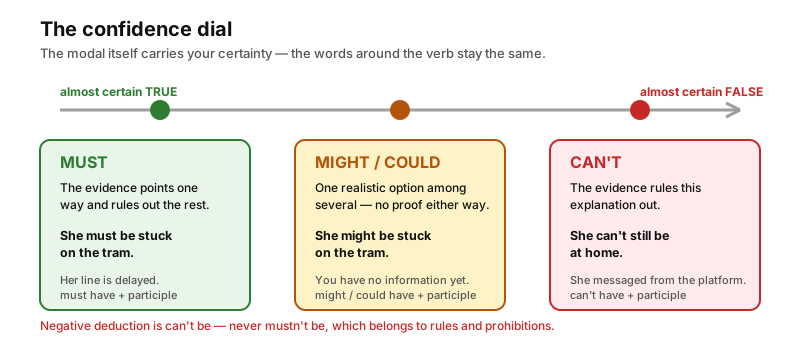
Now compare the same guess at each setting:
- She must be stuck on the tram. — The transport app showed her line delayed; everything points one way.
- She might be stuck on the tram. — It is possible, but you have no real evidence either way.
- She could be stuck on the tram. — In this guessing job, could and might are interchangeable: both present a genuine, open possibility.
- She can't still be at home. — She messaged from the platform, so home is practically impossible.
Here is the twist that catches even advanced learners: the logical opposite of must be in this sense is can't be, not mustn't be. Mustn't belongs to the world of rules and prohibitions — Passengers mustn't cross the yellow line — and has nothing to do with speculation. Saying She mustn't be at home suggests some regulation forbids her from being there. When we practise this in lessons, we repeat the pairing aloud until it sticks: must ↔ can't, certainty up against impossibility.
One more habit worth building early: these verbs report conclusions, not facts. She must be stuck on the tram really means "the evidence leads me to believe this." If new information arrives, move the dial. A message saying "trams are running normally" downgrades your guess to She might be stuck in the crowd at the festival. Flexible confidence is the whole point of the system.
"Must" Wears Two Hats: Obligation versus Conclusion
The same little word does two unrelated jobs, and readers untangle them instantly — but only if your grammar cooperates. Compare:
| Sentence | Which "must"? | The question it answers |
|---|---|---|
| You must renew your visa before the end of the month. | Obligation | What am I required to do? |
| You must be exhausted after that night shift. | Deduction | What do I conclude is true? |
| Visitors mustn't feed the animals. | Prohibition | What is forbidden here? |
| He can't be serious about selling his motorbike. | Negative deduction | What seems almost impossible? |
A reliable test I teach is to ask "Says who?" If the answer is a person, a law, or a set of rules, you are dealing with obligation: immigration officials demand the visa renewal. If the answer is "my own eyes," you are dealing with deduction: your friend's grey face and third coffee justify the exhaustion comment. Evidence creates conclusions; authority creates duties. Keeping those sources apart in your head makes the grammar fall into place.
The two hats also behave differently once you leave the present tense. Obligation's comfortable past form is had to: I had to renew my passport twice last year because of a printing error. Deduction, meanwhile, does not borrow had to at all — it builds its own past, which is exactly where we go next.
Guessing About Yesterday: Modal + Have + Past Participle
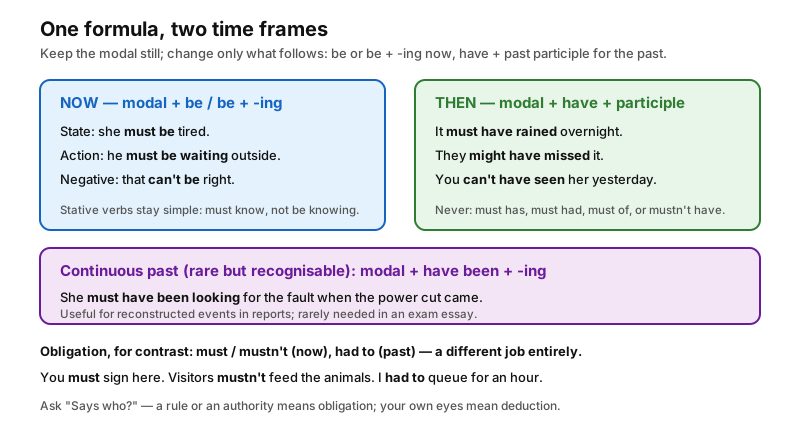
To speculate backwards in time, keep the modal where it is and change what follows it: modal + have + past participle. All four settings travel together:
- The ground is wet — it must have rained overnight.
- They might have missed the last announcement.
- He could have left his phone at the office.
- You can't have seen her yesterday — she was in Lisbon all week.
Before we continue, let us deal with the four mistakes I correct most often in homework:
- ✗ He must has forgotten. → ✓ He must have forgotten. After any modal, have stays in its base form, whatever the subject is.
- ✗ She must had left. → ✓ She must have left. No past-tense verb can follow a modal directly; the modal carries the time information.
- ✗ She must of left. — A spelling trap picked up by ear. Native speakers pronounce have weakly, so it sounds like of, but the written pattern contains only have.
- ✗ She mustn't have known. (intended meaning: "I'm sure she didn't know") → ✓ She can't have known. As with the present tense, negative deduction uses can't, never mustn't.
Two refinements will polish your past deductions further. First, couldn't have behaves like can't have for past impossibility: She couldn't have known — nobody told her. Second, watch out for could have's second life outside deduction. In You could have called me! the phrase criticises something that was possible but never happened. Context makes the job obvious — clues produce deduction, reproach produces regret — but knowing both exist stops you misreading conversations.
Guessing About Right Now: Fixed States versus Actions in Progress
Present deduction has two shapes, and the choice between them works exactly like the choice between she works and she is working. Use modal + be for a state, a quality, or a fact: She must be tired. That can't be the right platform. Use modal + be + -ing when you are picturing an action in progress: He must be waiting outside. They might be having lunch. You can't be serious about walking there in this rain.
The logic is borrowed wholesale from the ordinary present tenses — a state sits still, an activity is happening now — so if that distinction still feels slippery in plain statements, work through the present simple vs present continuous guide first and bring the same window-and-dots picture back here.
Two small warnings. Stative verbs refuse the continuous even under a modal, so write She must know the answer, never She must be knowing. And if you find yourself wanting be plus a past participle after a modal, you have wandered into the passive voice, which is a different machine with its own rules and its own four jobs: Large bags must be left at the entrance is obligation, not deduction.
Practise Like a Detective: Five Mini Cases
Deduction grammar rewards detective habits: gather the clues first, then choose the dial setting that matches their weight. When we do speaking practice in lessons, we treat sentences like tiny case files, and the same exercise works beautifully on paper. Read each set of clues below and complete the deduction using must, might/could, or can't — adding have where the past is involved.
Case 1. Ana replies to messages within minutes, always. Right now her phone rings straight to voicemail, and she never switches it off on purpose. → Her battery ______ (die).
Case 2. There are muddy paw prints leading from the back door to the sofa, the towel hanging by the door is damp, and the dog is asleep on the cushion. → The dog ______ (be) outside in the rain earlier.
Case 3. Tom keeps checking his watch, and he has refused coffee — Tom, who normally drinks five cups a day — though he will not say why. → He ______ (drive) somewhere later.
Case 4. Your flatmate swore she would spend the whole week at her parents' place, yet you have just fished last night's takeaway bag out of the kitchen bin. → She ______ (spend) the entire week away.
Case 5. The courier's tracking page says your parcel was delivered, but nothing is outside your door. The concierge in your building sometimes signs for residents' packages. → The concierge ______ (sign) for it.
Set the article down and commit to five answers before reading on — half-guessing teaches nothing.
Case Notes: How a Detective Chooses
- must have died — Every clue points the same way: the habit of instant replies, the voicemail, the never-switching-off rule. Near-certainty earns the top setting.
- must have been — Physical evidence again. Paw prints plus a damp towel make rain-duty close to unavoidable.
- must be driving — Refusing coffee for a dedicated five-cups-a-day drinker is powerful evidence, and checking his watch supports it. Notice the present situation needs only be + -ing after the modal.
- can't have spent — The takeaway bag contradicts her claim directly. When evidence collides with a story, impossibility wins.
- might have signed for it — Entirely plausible, entirely unconfirmed. With no proof, a confident must would overshoot; stay mid-dial until the concierge confirms.
Study the pattern across all five cases: clue, then weight of evidence, then dial position — never the reverse. Learners who internalise that ordering stop asking "which modal sounds right?" and start asking "how strong is my proof?", which is the question the grammar was designed to answer.
Your Turn: Ten Sentences That Need Re-Dialling
The cases above gave you the clues; now produce the modal yourself. Each sentence tells you which setting to use and whether the situation is present or past, so the only decision left is the shape of the verb that follows.
- (must, present) The lights are on and I can hear music through the wall. → They ______ at home.
- (can't, present) He is giving a talk in Berlin this week. → He ______ in the office today.
- (might, past) The path is muddy and the sky is clearing now. → It ______ during the night.
- (must, past) There is fresh white paint on your sleeve. → You ______ against the wall.
- (can't, present) She only left ten minutes ago. → She ______ at the station already; it is a thirty-minute walk.
- (might, present) Marta has not answered your message, but her phone is often on silent. → She ______ her phone on silent again.
- (must, present) The bakery queue stretches around the corner and the shelves look bare. → The bread ______ extraordinary.
- (can't, past) The tickets arrived by email yesterday; I read the confirmation twice. → You ______ the booking — the reference number is in my inbox.
- (must, past + continuous) She was still in the lab at eleven, and the freezer alarm was sounding. → She ______ for the fault when the power cut came.
- (might, past + continuous) The door was unlocked and the windows were open all afternoon. → Someone ______ in through the back.
Answer Key
- must be — a state, so no -ing: the lights are the evidence.
- can't be — compare what you know (he is abroad) with the claim (he is here); impossibility wins.
- might have rained — plausible, unconfirmed; a clear sky now says nothing about a wet path last night.
- must have been leaning — the paint is the clue, and the action was in progress, so use have been + -ing.
- can't be — the timings make the claim impossible; keep the base form for the state of being there.
- might have — or may have: you are offering one realistic option, not a conclusion.
- must be — every clue points the same way, so use the top setting. (Original sentence: The bread must be extraordinary.)
- can't have lost — the email is proof against the claim.
- must have been looking — a past continuous deduction: the modal, then have been, then the participle.
- might have come — or could have come: an open possibility with no proof attached.
If number 9 revealed a form you have not met before, that is normal — must have been + -ing is the rarest member of the family, and it appears mainly in written narration. You do not need it in an exam essay; you do need to recognise it when a news report uses it to reconstruct events.
Pocket Reference: Deduction at a Glance
Keep this summary beside your notes; it compresses the whole system into four lines.
| Meaning | Present guess | Past guess | Example pair |
|---|---|---|---|
| Almost sure it is true | must + infinitive | must have + past participle | She must be tired. / She must have overslept. |
| Possible, unconfirmed | might / could + infinitive | might / could have + past participle | He might know. / They might have missed the bus. |
| Almost sure it is false | can't + infinitive | can't have + past participle | That can't be right. / You can't have seen him today. |
| Obligation (different job!) | must / mustn't + infinitive | had to (+ didn't have to) | You must sign here. / I had to queue for an hour. |
And the single reminder worth taping above the table: when the evidence changes, change the dial — must, then might, then can't. The grammar itself never moves; only your confidence does. If you enjoy this kind of meaning-driven grammar, the four conditionals work on exactly the same principle: name the distance from reality first, then choose the form.
Quick Answers to Questions Learners Always Ask
Is might weaker than could? In deduction they are twins, and examiners treat them interchangeably: She might be on the tram and She could be on the tram express the same open possibility. The difference appears in could have, which also criticises an unused chance — you could have told me — while might have stays neutral. So when you want to guess, choose either; when you want to reproach, choose could.
Why is "she mustn't have known" wrong? Because mustn't carries prohibition, not deduction. In passengers mustn't cross the yellow line a rule forbids the action, and no rule can forbid something that already happened. For past impossibility English uses can't have or couldn't have: She can't have known — nobody told her. The pairing must ↔ can't is the one to memorise, in both tenses.
Can I use these modals in IELTS Writing Task 2? Yes, and they are one of the quickest routes to a higher Grammatical Range score, because they show you can hedge like an academic. Some parents might argue that homework is unnecessary signals a position without claiming certainty; governments must have noticed the trend years ago draws a conclusion from evidence. Keep one or two per paragraph — a modal in every sentence reads as uncertainty rather than precision.
How do I know whether to add be + -ing? Ask what your clue shows: a state or an action. Grey faces and empty coffee cups show states, so he must be exhausted. A ringing phone and a queue at the door show actions, so they must be waiting for us. When the two blur, choose the simple form — must be is never wrong, while must be -ing needs an action you can genuinely picture in progress.
Flexible Confidence Is the Whole Skill
Look back at what you already do without thinking. In your first language, you never choose between certainty and possibility by consulting a table; you choose because you know how strong your evidence is. English is asking for the same judgement, just with a different switch: must when the clues line up, might or could when they simply allow something, can't when they rule it out — and have + past participle to send the whole guess backwards in time.
So take the exercise out of the article and into your day. When a small mystery appears — a silent phone, an empty car park, a queue outside your usual café — narrate your own reasoning, out loud or on paper, in one sentence with the dial set where the evidence points. Do that three times today, then again tomorrow, and the modal stops being a grammar point and becomes what it already is for native speakers: the sound of thinking.
Related Articles
🔄 The Passive Voice: What It Is and When Native Speakers Actually Use It
Your parcel has been delivered — the four-step switch, the four jobs the passive really does, the double-object trap, and ten sentences to rewrite.
🕰️ Used To vs Be Used To vs Get Used To: Finally Clear
One sound, three grammars: used to for a past habit, be used to for present familiarity, get used to for the climb — plus the would and passive impostors.
🔀 All Four Conditionals Explained With Real-Life Examples
If I will see him is wrong — the distance-from-reality ladder for zero, first, second, third and mixed conditionals, with examples and practice.