🕰️ Used To vs Be Used To vs Get Used To: Finally Clear
10 min read
2026-09-20
One sound, three grammars: used to for a past habit, be used to for present familiarity, get used to for the climb — plus the would and passive impostors.
EngSandbox Editorial Team
Written with AI assistance and reviewed by our editors — experienced PTE/IELTS tutors. Every article is fact-checked against official band descriptors, the Academic Word List and Cambridge assessment research, then field-tested with learners before publishing. Human reviewed + field tested. Questions? Contact us — see our Editorial Process.

The taxi drops you outside a rented flat in a city where you recognise exactly three buildings. Your new job starts at 8:30 — an hour your body does not currently approve of. At the corner shop, the cashier speaks so fast that you buy milk and accidentally agree to a loyalty card you did not understand. Everything, from the pace to the lunch hour, feels slightly wrong, and you seem to be the only person who notices.
Twelve months later, you hear yourself explaining all of this to a visiting friend in one easy sentence: I used to drive everywhere back home; here I'm used to taking the tram, but it took me ages to get used to the rush-hour crowds. Three structures, three different relationships with time, delivered in a single breath. When we work on this trio in lessons, I tell students the truth: your ears cannot help you here, because all three phrases sound identical. Only the grammar around them reveals which one you mean — and that grammar is far more regular than it first appears.
One Sound, Three Grammars
Say these aloud: used to, be used to, get used to. Every one of them begins with the same swallowed sound, roughly /juːs tə/, which is precisely why learners mix them up in writing. Listening practice will not sort them for you; understanding what follows each phrase will.
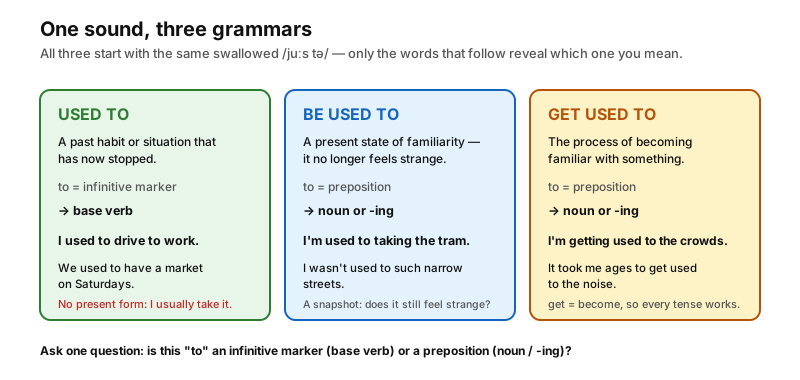
| Structure | What it tells your reader | Verb form that follows | Example |
|---|---|---|---|
| used to + base verb | a past habit or situation that has now stopped | infinitive (never -ing) | I used to drive to work. |
| be used to + -ing / noun | something familiar that no longer feels strange | gerund or noun | I'm used to taking the tram. |
| get used to + -ing / noun | the process of becoming familiar with something | gerund or noun | It took me ages to get used to the crowds. |
Here is the observation that unlocks everything else. In used to, the word to is the infinitive marker, so a bare verb follows it: used to swim, used to know. In be used to and get used to, the word to is a preposition, and prepositions demand a noun or an -ing form: am used to the cold, getting used to cooking for one. Once you ask yourself "is this to an infinitive marker or a preposition?", almost every confusion in this trio resolves itself. That same marker-versus-preposition choice is what makes stop, remember, forget and try change meaning, so the two guides are worth working through together.
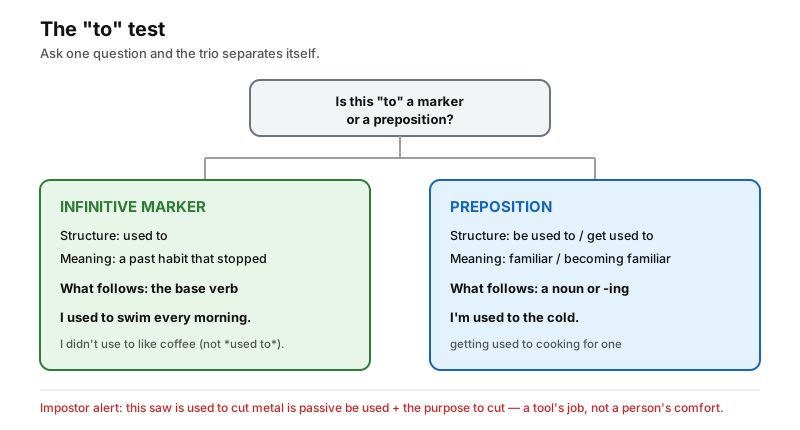
Negatives and questions follow the same logic, because each structure borrows a different helper:
- Past habit → borrow did: I didn't use to like coffee, but the night shifts changed that. Notice the spelling: after did, write use, never used. The same applies in questions: Did you use to share a desk with the whole team?
- Familiarity → change be: I'm not used to spicy food yet. / Are you used to the new booking system?
- Process → change get: She's getting used to her new timetable. / They never got used to the factory noise, so they moved.
One boundary worth marking now: used to has no present form. For habits happening today, English simply uses the present tense with an adverb — I usually take the tram — never I use to take the tram. If the habit is alive, the ordinary present does the job.
Week One: What "Be Used To" Says About You Right Now
Return to that first Monday. By Wednesday, the 6:15 alarm still feels like an ambush, and English has a precise way to report the feeling: I'm not used to starting work so early. Be used to describes a state of familiarity — a snapshot of what does or does not feel normal to you at a given moment. It carries no story about progress; it simply photographs where you stand.
That photograph sits on a scale. At one end: I'm not used to the pace of this city — everything still feels foreign. At the other: I'm used to the pace now — nobody here would surprise you anymore. Because be is an ordinary verb, you can move the snapshot anywhere in time: I wasn't used to shops closing at lunchtime looks back at week one, while I'm used to them now reports today.
The diagnostic question I give students is short: does it still feel strange? If yes, reach for not used to. If the strangeness has faded, drop the not. And remember that the thing you adapt to does not have to be an action — nouns work beautifully: I wasn't used to such narrow streets, Nobody in this office is used to silence.
Fast-forward again. Six months in, you tell that same friend, Honestly, I'm used to the noise now — quiet rooms are what keep me awake. Same structure, opposite end of the scale. Nothing new grammatically; only your reality has changed, and be used to has quietly recorded it.
The Slow Climb: "Get Used To" as a Progress Report
Where be takes a photo, get used to records the journey between photos, because get here means become: not-yet-normal transforming into normal. This is the structure for every honest middle chapter — the missed tram stops, the lunches eaten at the wrong hour, the accent you replayed twice.
Because get is a full verb, its tenses let you place the climb wherever you like:
- I'm slowly getting used to the local accent. — the climb is happening now.
- After a month of missed stops, I got used to the tram timetable. — the climb finished.
- Give it a season; you'll get used to it. — a prediction, and the sentence natives offer most often to soothe a struggling newcomer.
- I never got used to dinner at ten o'clock. — some climbs fail, and English lets you say so gracefully.
Two patterns travel with this structure constantly. Time phrases mark the effort involved: it took me two months to get used to the humidity, she gradually got used to working remotely. And the negative result deserves respect — never got used to is not a grammar exercise but a real-life outcome, useful for confessing that some parts of a new place never stop feeling foreign.
Back Home Again: "Used To" and Its Storytelling Cousin "Would"
Now cross the timeline in the other direction, to the life before the move. Used to paints that old routine effortlessly, and unlike its cousins it happily accepts states, not only actions: I used to drive everywhere — door to door, radio on, We used to have a market on Saturday mornings, There used to be a bakery on our corner. Habit, possession, location — all welcome.
English offers a second tool for the same album: would. In nostalgic storytelling, would + base verb describes repeated actions so smoothly that memoirs run on it: When we lived by the coast, we would swim before breakfast almost every morning, My grandfather would tell the same story at every family dinner, and we would laugh in all the usual places. Used well, would makes a string of memories flow like one long weekend. Both tools contrast with the tidy present simple versus present continuous picture of habit today, which is exactly why used to has no present form.
But would operates under two strict conditions, and this is where homework comes back to me covered in corrections.
First, would accepts actions only. States — living, being, having, liking, belonging — refuse it:
- ✗ I would live near the sea. → ✓ I used to live near the sea.
- ✗ We would have a dog. → ✓ We used to have a dog.
A state is a situation that simply existed, not an event that repeated itself, so the habitual-would machine has nothing to chew on. If you can replace the verb with was or had and the meaning survives, used to is your only option.
Second, would cannot open the story. Said with no earlier context, We would live in a small flat then sounds like a condition or a future plan, never a memory. Used to can establish the past scene all by itself; would needs the scenery built first, either by used to or by a time clause: When we lived in Porto, we would walk along the river every evening. Set the stage, then let would perform.
The Impostor at the Workshop Door
Before you write anything, meet one final lookalike that fools even confident learners: this saw is used to cut metal. Grammatically that is be used (the passive voice, describing a tool's function) plus to cut (purpose) — a completely different animal wearing the same fur. Compare:
- This saw is used to cut metal. — someone designed the saw for this job.
- I'm used to cutting metal by hand. — the work feels normal to me.
The test takes two seconds: does the sentence describe a tool's job or a person's comfort? Tool's job → passive is used to + infinitive. Person's comfort → be used to + -ing. When a student's sentence sounds odd, nine times out of ten it is this impostor standing in the doorway, not the structures we practised.
Your Turn: Three Things You Are Getting Used To
Reading settles the rules; writing makes them yours. Here is the prompt I set after this lesson, and it works just as well for a new job or city as for smaller shake-ups like a new keyboard layout or a shared workspace: describe three things you are getting used to right now.
Build your three sentences on these frames — each one forces a different structure from today's article:
- These days I'm getting used to ____, even though I used to ____. — process and past habit in one line.
- At first, ____ felt strange because I wasn't used to ____-ing. — the week-one snapshot.
- I hope I'll get used to ____ by ____, but right now I'm still not used to ____-ing. — prediction plus present honesty.
If your old routine wants a cameo, add one storytelling sentence: Back then, I would ____ every evening. And if you are preparing for a Cambridge exam, notice that questions like "tell me about your hometown" or "how is your life different now?" are quietly inviting exactly these structures — answering with all three is one of the most natural ways to show range.
A Sixty-Second Self-Check
Cover the answers, complete each sentence, then check yourself. Aim for six out of six before you call this settled.
- I ______ (not / like) coffee, but night shifts changed my mind.
- Marta grew up in London, so she ______ (drive) on the left.
- As a teenager, she ______ (have) a pony called Biscuit.
- ______ (you / cook) for the whole family when you were young?
- Find and fix the error: I'm used to wake up at five.
- Find and fix the error: During university, I would live with my grandparents.
Answers.
- didn't use to like — a past state that has stopped, so used to with didn't; remember the spelling after did.
- is used to driving — lifelong familiarity; the to is a preposition, so the verb takes -ing.
- used to have — have here describes possession, a state, and states reject would.
- Did you use to cook — a question about a repeated past habit, built with did + use to.
- I'm used to waking up at five. — after the preposition to, only -ing is possible.
- During university, I used to live with my grandparents. — live is a state, and would needs an action.
Six for six means the trio is yours: one phrase for the life you left, one for what feels normal now, and one for everything still climbing toward normal.
Related Articles
⏱️ Present Simple vs Present Continuous: The Complete Guide
Stop guessing between present simple and present continuous — the window-and-dots model, stative verbs, signal words, and a 20-sentence check-up.
🕵️ Modal Verbs of Deduction: Must, Might, Could and Can't for Speculation
She must be stuck on the tram — the confidence dial, must's two obligation and conclusion jobs, modal + have + past participle, and ten sentences to re-dial.
🔄 The Passive Voice: What It Is and When Native Speakers Actually Use It
Your parcel has been delivered — the four-step switch, the four jobs the passive really does, the double-object trap, and ten sentences to rewrite.