🧩 Prefixes and Suffixes: Turn 1 Word Into 5 Word Families
11 min read
2026-09-22
Happy → unhappy → happily → happiness: how prefixes tweak meaning, suffixes assign word jobs, three spelling moves, and a 10-root family table to build.
EngSandbox Editorial Team
Written with AI assistance and reviewed by our editors — experienced PTE/IELTS tutors. Every article is fact-checked against official band descriptors, the Academic Word List and Cambridge assessment research, then field-tested with learners before publishing. Human reviewed + field tested. Questions? Contact us — see our Editorial Process.

Take thirty seconds and try this before you read any further. Start with the word happy. Without opening a dictionary, how many related words can you build from it?
Here is what most learners find: happy → unhappy → happily → happiness → unhappily. Five words from one root — and the fifth one, unhappily, is the kind of word people recognize but never dare to write. This is morphology in action: the system of prefixes and suffixes that lets English stretch a single word in several directions at once.
When learners tell me their vocabulary has hit a ceiling, we usually discover the opposite. They already own hundreds of words that are hiding behind familiar endings. The problem is not memory; it is that nobody ever showed them the multiplication table. That is what this article does.
One Root, Five Words: How the Arithmetic Works
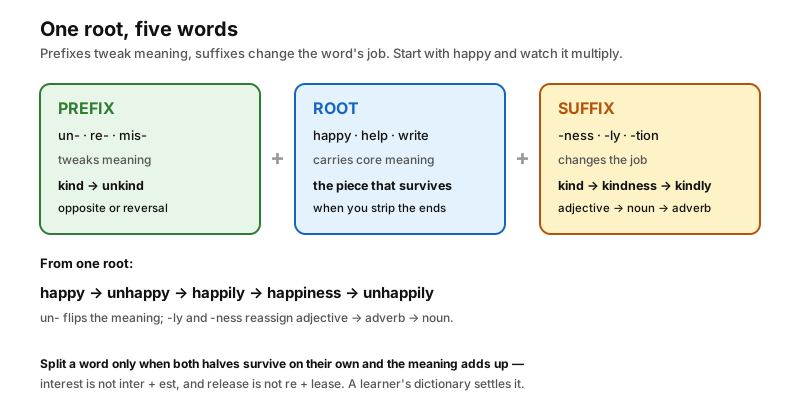
Every word family has three possible slots:
[prefix] + [root] + [suffix]
The root carries the core meaning — help, write, happy. A prefix attaches to the front and adjusts the meaning: unhelpful, rewrite, mislead. A suffix attaches to the end and changes the word's job in the sentence: helpful, writer, happiness. Together, a root and its relatives form a word family.
Notice the division of labour. Prefixes mostly tinker with meaning — kind and unkind are opposites. Suffixes mostly change the word's class — kind is an adjective, kindness is a noun, kindly is an adverb. Keep that split in mind, because almost every strategy in this article depends on it.
The noun-building half of that split is also why so many suffixed nouns refuse a plural — kindnesses sounds wrong for the same reason advice and information do: the suffix has built an uncountable noun.
One honest warning before we continue. This system works beautifully when the leftover piece is a real English word: mis + place, over + cook, hope + less. But do not force it onto every long word. Interest may look like inter + est, yet est is not a word, and release certainly does not mean "lease again". Split a word only when both halves survive on their own and the meaning adds up. When in doubt, a good learner's dictionary settles it instantly.
Twenty Prefixes That Do the Heavy Lifting
You do not need to memorize this table tonight — treat it as a reference to consult until recognition becomes automatic. What matters is that the next time you meet oversleep or postpone, you hear the prefix speaking.
| Meaning group | Prefix | Core meaning | Examples |
|---|---|---|---|
| Not / opposite | un- | not; reversal of an action | unfair, unlock |
| in- (im-, il-, ir-) | not | incorrect, impossible, illegal, irregular | |
| dis- | not; opposite action | disagree, dishonest | |
| non- | not (plain, neutral) | nonfiction, nonstop | |
| anti- | against | antisocial, antifreeze | |
| Wrong / too much / too little | mis- | wrongly | misunderstand, misspell |
| over- | too much | oversleep, overcook | |
| under- | too little | underpaid, underestimate | |
| Again / time | re- | again; back | reread, rebuild |
| pre- | before | preheat, preview | |
| post- | after | postpone, postgraduate | |
| Position / direction | inter- | between | international, interact |
| sub- | under | subtitle, subway | |
| super- | above; beyond | supermarket, supersonic | |
| trans- | across | translate, transport | |
| ex- | former | ex-boss, ex-partner | |
| Other useful jobs | de- | remove; reverse | defrost, deactivate |
| auto- | self | autopilot, autobiography | |
| semi- | half | semifinal, semicircle | |
| multi- | many | multinational, multilingual |
The Shape-Shifting Negative: in-, im-, il-, ir-
Look closely at that second row and you will spot a pattern worth its own subsection. The negative prefix in- changes its ending to match the first letter of the root — linguists call this assimilation, and it happens purely because certain letter combinations are hard to pronounce.
- im- before m, b, or p: impossible, impatient, imbalance
- il- before l: illegal, illogical
- ir- before r: irregular, irresponsible
- in- everywhere else: inactive, informal, independent
Once you know the trick, spelling this family correctly becomes almost mechanical.
A final nuance: some prefixes carry two related senses. Un- usually means "not" (unkind, unfair), but with action verbs it reverses the action: untie your shoelaces, unlock the door. Dis- behaves the same way: dishonest versus disconnect. Ask yourself whether the prefix is describing the root or undoing it.
Suffixes Are Job Tags: Read the Ending, Know the Role
If prefixes adjust meaning, suffixes assign roles. The core meaning barely moves — care, careful, and carelessly are all about care — but the word's grammatical job changes completely. This gives you two practical superpowers: you can guess the role of an unfamiliar word while reading, and you can build the correct form while writing. Many of the heavyweight nouns in the table below — information, development, possibility — are also core academic vocabulary, so this one skill pays off twice.
| Ending | Builds | Examples |
|---|---|---|
| -tion / -sion | nouns | information, decision |
| -ment | nouns | agreement, development |
| -ness | nouns (from adjectives) | kindness, happiness |
| -ity | nouns (from adjectives) | possibility, ability |
| -er / -or | nouns (people or things that do) | teacher, visitor |
| -ance / -ence | nouns | performance, difference |
| -ful / -less | adjectives (with / without) | careful, careless |
| -able / -ible | adjectives (possible to ___) | readable, visible |
| -ous, -ive, -al | adjectives | dangerous, attractive, musical |
| -ize / -ise, -ify, -en | verbs | organize, simplify, widen |
| -ly | adverbs (usually!) | slowly, quietly |
The -ly Trap: One Ending, Two Jobs
Here is the mistake I see most often with suffixes: learners meet friendly, lovely, or daily and file them under "adverbs" because of the -ly. In fact, when -ly attaches to a noun, it builds an adjective — a friend is a person, and someone who acts like one is friendly. The reliable test is not the ending but the question: what does the word describe? In my neighbour is very friendly, the word describes a person, so it is an adjective, no matter how it ends.
Meaning can betray the ending too. -Less means "without", which makes careless and homeless predictable — but priceless does not mean worthless. Something priceless is so valuable that no price can be attached to it. Endings are excellent guides; they are just not infallible ones.
This job-tag skill is tested directly in the Cambridge B2 First and C1 Advanced exams, where the Reading and Use of English paper includes a word-formation task: you receive a root word and must reshape it to fit a gap. The method that works under pressure is exactly the one in this article. First, identify which job the gap requires — after a or the, expect a noun; after very, expect an adjective; describing how an action happens, expect an adverb. Then attach the matching tag and apply the spelling rules below.
Watch it work:
- The committee made a surprising ______ (announced). → after a and an adjective, we need a noun → announcement.
- The team won a ______ (decide) victory. → after a, describing the noun victory → adjective → decisive.
Three Spelling Moves Before You Glue Anything On
When we correct writing in lessons, the same three spelling slips return again and again: hopeing, begining, happyness. Each one breaks a different rule, and together the three rules cover nearly everything you need at this level.
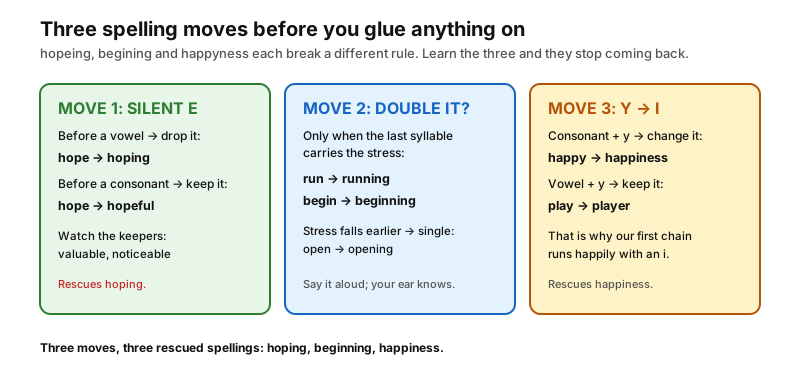
Move 1: Drop or keep the silent e. Before a suffix starting with a vowel, drop the e: hope → hoping, name → naming, create → creative. Before a suffix starting with a consonant, keep it: hopeful, careful, useless. Two famous keepers trip everyone: valuable holds onto its e (compare valuation, which drops it), and noticeable keeps it so the c stays soft.
Move 2: Double the final consonant — only when the stress demands it. If the word ends in a short vowel plus a single consonant, and the last syllable carries the stress, double the consonant: run → running, stop → stopped, begin → beginning, prefer → preferred. But when the stress falls earlier, nothing doubles: open → opening, visit → visited, happen → happening. Say the word aloud and listen for where the beat lands — your ear already knows this rule. (You will meet both travelling and traveling; each is standard in its own variety of English, British and American respectively.)
Move 3: Change y to i — unless a vowel sits in front of it. Consonant plus y becomes i before most suffixes: happy → happiness, easy → easily, carry → carried. But after a vowel, the y survives untouched: play → player, enjoy → enjoyable. That is precisely why our first chain runs happily with an i — the p before the y triggers the switch.
Three moves, three rescued spellings: hoping, beginning, happiness.
Your Turn: Ten Roots, Four Empty Columns
Time to build families yourself. Copy this skeleton, take the ten roots below, and fill in the noun, verb, adjective, and adverb for each. Where a form does not exist, write a dash — knowing that a slot is empty is genuine knowledge, because it stops you inventing words like employly. As a bonus challenge, add a sensible prefix to any cell.
Your ten roots: happy · care · agree · understand · employ · hope · luck · comfort · use · write
Done? Here is the completed table for checking.
| Root | Noun(s) | Verb | Adjective(s) | Adverb(s) |
|---|---|---|---|---|
| happy | happiness | — | (un)happy | (un)happily |
| care | care, carelessness | care | careful, careless | carefully, carelessly |
| agree | agreement, disagreement | (dis)agree | agreeable | agreeably |
| understand | understanding | (mis)understand | understandable | understandably |
| employ | employment, employer, employee | employ | employable, unemployed | — |
| hope | hope | hope | hopeful, hopeless | hopefully, hopelessly |
| luck | luck | — | lucky, unlucky | luckily, unluckily |
| comfort | comfort, discomfort | comfort | comfortable, uncomfortable | comfortably |
| use | use, usefulness | reuse, misuse, overuse | useful, useless | usefully |
| write | writer, writing | rewrite | written | — |
Notice how uneven the families are. Luck refuses to be a verb, employ has no adverb, and write offers the adjective written only in fixed phrases like written permission. Real families are lopsided, and a learner's dictionary — Oxford Learner's Dictionaries and Cambridge Dictionary both list derived forms clearly — is the authority on which members exist. If the dictionary does not recognize it, do not coin it. The same discipline applies to whole pairings: just as you should not invent employly, you should not invent combinations natives never use — which is exactly what the 75 most common collocations train your ear to hear.
A Fifteen-Minute Weekly Family Plan
If your schedule is already full, do not attempt all twenty prefixes in one sitting. Run this small weekly cycle instead, and let the families accumulate on their own.
- Monday (5 minutes): pick two roots from words you actually met this week — in an email, a news story, a chat. Own material sticks; random lists fade.
- Midweek (5 minutes): build each family table from memory, applying the three spelling moves as you go.
- Friday (5 minutes): write three sentences that each use a different family member, and check any doubtful form in a learner's dictionary.
- Weekend: return to the previous week's roots, cover the answers, and refill the table cold.
Two roots a week sounds modest, but the multiplier does the heavy lifting: dozens of roots become hundreds of usable words, each one connected to a family you built yourself. That connection — not the raw count — is what makes the words stay.
FAQ: Four Questions Learners Always Ask
Do I need to memorize all twenty prefixes?
No — treat the table as a reference, not homework. Recognition comes first: when you can hear re- in reread and mis- in misspell without thinking, production follows on its own. Two roots a week from your own reading beats one long night with the whole list.
How do I choose between un-, in- and dis-?
Mostly, you don't — the root chooses for you, and the dictionary confirms it. As a rough guide, un- is the default (unfair, unlock), in- and its shapes im-, il-, ir- attach to Latin roots (incorrect, impossible), and dis- often reverses actions (disconnect, disagree). When unsure, look it up instead of guessing.
Can I invent words with suffixes, like employly?
Only if the dictionary backs you. English families are lopsided — luck has no verb, employ has no adverb — and a coined form marks you instantly. Build the table from memory first, then check every doubtful cell in a learner's dictionary before it enters your writing.
Why doesn't priceless mean "without price"?
Because -less here means "so little it might as well be none": something priceless is so valuable that no price fits it. Suffixes are excellent guides but not infallible — careless and homeless follow the rule while priceless breaks it, and wide reading is how you learn which is which.
Related Articles
🎓 100 Academic Words Every University Student Must Know
Master 100 essential academic words every university student needs. Learn key vocabulary for lectures, essays, and exams with definitions and usage examples.
🧮 Countable and Uncountable Nouns: Much, Many, Some and Any — Without Guessing
Why advice and information refuse an -s, when much beats many, and how a piece of advice rescues an uncountable noun — plus a four-step card you can pin up.
🔗 75 Most Common English Collocations Every Learner Should Know
Master 75 essential English collocations organized by everyday topics. Learn natural word pairings that boost your IELTS and PTE vocabulary score with definitions and examples.