🌐 British vs American English: Differences That Matter for Exams and Life
12 min read
2026-11-22
Colour or color? Five spelling switches, three grammar splits and a vocabulary field guide, plus which variety to write in IELTS and PTE and why mixing hurts.
Written with AI assistance and reviewed by our editors — experienced PTE/IELTS tutors. Every article is fact-checked against official band descriptors, the Academic Word List and Cambridge assessment research, then field-tested with learners before publishing. Human reviewed + field tested. Questions? Contact us — see our Editorial Process.

A learner once handed me a practice essay that opened with this sentence: Travellers who arrive at the city center can follow colour-coded signs to the nearest bus station.
Read it twice and nothing jumps out — every word is spelled correctly somewhere in the English-speaking world. But look closer: travellers and colour-coded belong to one spelling system, while center belongs to the other. The sentence sits in two countries at once, and no dictionary endorses it as a whole.
That is the situation this article exists to prevent. When we edit practice essays together, the mistake I see most often is not wrong spelling — it is mixed spelling. By the second paragraph, forms from the other side of the Atlantic quietly leak in, and the writer rarely notices. Here we will map the differences that matter, sort the harmless from the risky, and settle the exam question once and for all: which variety should you actually use?
The Only Real Rule: Consistency Beats Preference
Before we compare anything, fix one principle in place: British and American English are two complete, equally correct systems. Neither is "proper English" with the other as a broken copy — both grew from the same roots, as the history of the English language shows, and simply drifted apart once English crossed the Atlantic. The problems begin only when the two systems share a page.
Examiners read hundreds of scripts, and a mixture reads the way a mismatched outfit looks — nothing is individually broken, yet something is clearly off. Under pressure, mixed spelling suggests shaky control of written English, even when every individual choice is legitimate. According to official scoring criteria, writers are rewarded for consistent, accurate control of the language; nobody reserves extra points for one side of the Atlantic.
So the real decision is not "which variety is better?" but "which variety am I going to commit to?" Here is the method I give learners, and it survives contact with real life because it requires no loyalty to either flag:
- Audit your inputs. Look at the last five things you studied in English — a coursebook, a podcast, a series, an app. If most of them come from British publishers or broadcasters, choose British English; if American sources dominate, choose American. Your memory will naturally absorb whatever surrounds you, so let it work for you rather than against you.
- Break ties with your exam materials. If your coursebook and practice tests lean British, go British. Your writing is trained and judged inside those pages, so matching them removes friction.
- Enforce the choice mechanically. Switch your phone, laptop and dictionary app to the matching regional setting — "English (UK)" or "English (US)". This one-time change catches leaks forever after, because spellcheckers flag the mixture long before an examiner would.
One honest warning from marking experience: commitment tends to erode in the middle of long essays. Learners start strong, then fatigue resets them to whatever spelling their memory grabbed first. The device setting matters precisely because it guards you when your own attention cannot.
Five Spelling Switches Do Most of the Work
The good news buried in all this: the spelling gap is not thousands of random words. It behaves like a small set of switches, and once you can name them, you can predict most differences on sight — including in unfamiliar words.
| Switch | British | American | More examples |
|---|---|---|---|
| -our → -or | colour, favour, neighbour | color, favor, neighbor | labour/labor, honour/honor |
| -re → -er | centre, theatre, litre | center, theater, liter | metre/meter, fibre/fiber |
| final -l doubling | travelled, cancelled, marvellous | traveled, canceled, marvelous | jewellery/jewelry |
| -ogue → -og | catalogue, dialogue | catalog, dialog | analogue/analog |
| -ise / -ize | organise or organize | only organize | realise/realize |
Four of those switches are one-directional and trouble-free. If you meet favour, you know American text will say favor; if your essay says centre, you know it must also say colour. The fifth row deserves a closer look, because it is the trap in the table.
The -ise/-ize ending is not a British-versus-American split. Both organise and organize are accepted British spellings — Oxford Learner's Dictionaries list them as variants of the same word — while American English uses -ize exclusively. This explains a confusion I meet constantly: a learner checks an essay, finds analyze flagged as "fine", concludes the checker is unreliable, and gives up on the whole system. Nothing is broken. British English simply offers two endings, and analyse alongside analyze are both legitimate there.
For exams, though, treat the pair as a consistency issue rather than a free choice. An essay containing organise in paragraph one and recognize in paragraph four is mixing styles, even though a specialist might defend each form separately. Match your endings throughout: whichever spelling you write first, repeat it. If you want to remove the decision entirely, -ise is the safe everyday default on the British side.
These switches earn their keep in academic writing especially, because high-frequency essay words sit directly on them: analyse, behaviour, centre, favour, neighbour, programme. Master five switches and you have quietly secured dozens of the words that Task 2 topics pull out again and again.
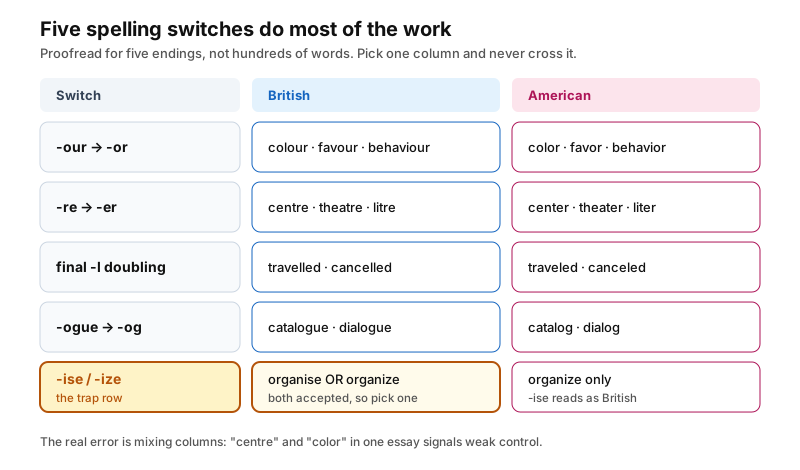
Read the diagram as a checklist, not a vocabulary list. When you proofread, you are not scanning for hundreds of words — you are scanning for five endings. Any word that ends in one of them is a word that could belong to the other system, so it earns a second look.
Where Grammar Quietly Splits
Spelling is the visible difference; grammar differences are subtler, and they matter more in speaking, where no spellchecker can rescue you. Three of them account for most of the friction learners feel.
Present Perfect vs Past Simple After Just, Already and Yet
British English strongly prefers the present perfect with these little time words: I've just sent the report. / She's already finished. / Have you eaten yet? American English frequently reaches for the past simple in the same situations: I just sent the report. / Did you eat yet?
Both versions are grammatically real English, and an examiner will understand either. If the present perfect itself still feels shaky, the interactive present perfect with just, already and yet unit lets you drill the pattern with instant feedback. But the present perfect version is accepted everywhere without comment, which makes it the low-risk choice in a speaking or writing test. When we rehearse exam answers in lessons, I encourage learners to attach just, already and yet to the present perfect automatically — it costs nothing and removes a whole category of doubt.
Collective Nouns: One Team or Many People?
A collective noun names a group as a single unit (a close cousin of the count/non-count split in countable and uncountable nouns): team, government, committee, family. American grammar treats it strictly as singular — The team is winning. British English agrees in formal writing, but happily switches to a plural verb when the focus is on the members: The team are arguing among themselves again.
Notice the direction of safety here, because it is the opposite of the last section. Singular is never wrong in either variety, so in exam conditions, default to The government has announced new measures and let British plural verbs remain something you recognise rather than something you gamble on. One boundary holds everywhere: some nouns are plural in both systems, so The police are investigating — never The police is.
Have Got Against Plain Have
For possession, spoken British English leans on have got: I've got a spare key. / Have you got a pen? / I haven't got time today. American English prefers plain have, built with do: I have a spare key. / Do you have a pen? / I don't have time today.
Again both are understood everywhere, but plain have is the cleaner tool for formal writing in either country. Save have got for conversation and informal emails; reach for I have two brothers in an essay.
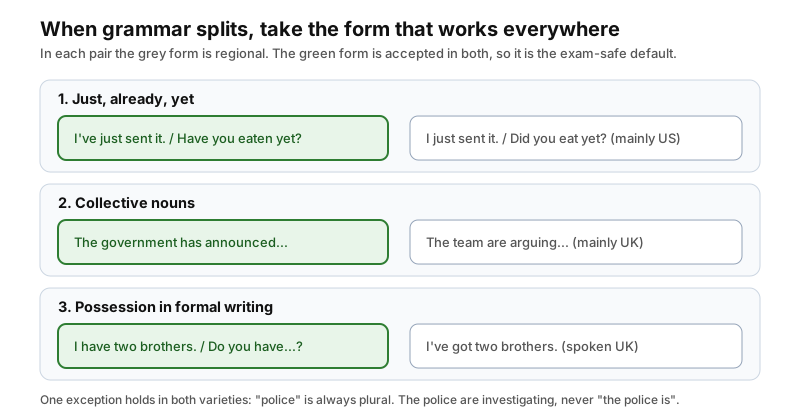
The pattern across all three splits is worth naming: in each case one form is accepted in both varieties and one is regional. Under exam pressure, take the form that works everywhere.
Two Prepositions Worth Knowing
Small, learnable, worth collecting: British English meets at the weekend while American English meets on the weekend, and British offices run Monday to Friday where American ones run Monday through Friday. Neither choice affects meaning, so simply adopt whichever variety you chose in the first section and stop revisiting the question.
A Field Guide to Two Everyday Vocabularies
Vocabulary is the fun part of the split — and the part with one genuine trap. Most differences are simple synonyms, two names for the same object: a Brit picks up the torch, an American the flashlight. But a few pairs are not synonyms at all; they are false friends hiding inside the same country's floor plan.
The famous case: the British ground floor is the American first floor. Walk into a London building and the lift button marked 1 already takes you one flight up. Translate floor numbers literally and you will arrive at the wrong office in two countries. With that warning posted, here is a compact field guide organised by where you will meet the words.
| Setting | British | American |
|---|---|---|
| At home | flat | apartment |
| At home | tap | faucet |
| Around town | lift | elevator |
| Around town | queue | line |
| Around town | car park | parking lot |
| Around town | the Underground / the Tube | the subway |
| Getting around | petrol station | gas station |
| Getting around | return ticket | round-trip ticket |
| On your plate | biscuit | cookie |
| On your plate | crisps / chips | chips / fries |
| On your plate | aubergine | eggplant |
| Study and work | term | semester |
| Study and work | revise for an exam | review for an exam |
| Time off | holiday | vacation |
Two rows deserve a footnote. Crisps versus chips versus fries form a triangle, not a pair — British chips are thick and hot, American chips are thin and cold in a bag, and ordering carelessly gets you the wrong snack in either country. And the Underground row hides another false friend: in Britain, a subway is usually an underground walkway, not a railway, so the word will not summon a train in London the way it does in New York.
You do not need to memorise this table tonight. Treat it as a recognition checklist: next time one half of a pair appears in your reading or listening, you now own both halves.
Tuning Your Ear Before Test Day
Writing differences get all the attention, but the listening sections of major exams deliberately include a range of native-speaker accents, so your ears face this split whether you write British or not. Four habits of sound cover most of the surprise value.
First, the r at the end of words. Many British accents soften or drop it — car, park and teacher end in a vowel sound — while most American accents pronounce it clearly. If a recording says paak, nothing has been swallowed; you are simply hearing one of England's most widespread features.
Second, watch the stress in longer words. Advertisement lands early in British mouths (ad-VER-tis-ment) and late in American ones (ad-ver-TIZE-ment). Third, a handful of everyday nouns simply disagree: schedule starts with a sh- sound in Britain and a sk- sound in America, and tomato splits at its middle vowel — tuh-MAH-toh against tuh-MAY-toh.
Fourth, some words carry several pronunciations in every dictionary, with one version more typical of each country — either is the classic example. The lesson underneath all four points is the same one tutors repeat before every listening test: exposure beats imitation. You are not training to sound American or British; you are training to understand both, and ten minutes of mixed-accent listening a day does more than any pronunciation chart.
Which Variety Should You Write in IELTS and PTE?
Now the question that probably brought you here. For IELTS, the organisations behind the test accept both British and American English, and the same practical stance applies to PTE Academic: according to official scoring criteria, what earns credit is accurate, consistent control of the variety you have chosen — not the passport of its spelling. There is no secret bonus for writing colour, and no penalty for writing color.
What does cost you is the mixture from our opening sentence. A script that shifts between systems mid-essay undermines the impression of control that good writing creates, and it is completely preventable. Your protection costs about thirty seconds in total:
- Choose your variety using the audit from earlier — inputs first, coursebook as tiebreaker.
- Set every device and dictionary to that regional standard.
- Before submitting any practice essay, sweep it specifically for the five spelling switches; they catch nearly everything.
One reassurance for the speaking test, because anxiety gathers there: examiners score how clearly and accurately you speak, not which accent you imitate. Plenty of successful candidates sound like themselves, from wherever themselves happens to be. Spend your preparation on clarity, grammar and vocabulary, and let your accent be yours.
Editing Challenge: Catch the Five Intruders
Close the tables, cover the answers, and try the job an editor does. The draft below intends to be consistent British English, but five American forms have crept in. Find them using only the patterns from this article.
Last month we traveled to the city center to visit the new art museum. A guide explained that the old theater nearby had reopened the previous fall, and the neighborhood association had arranged free entry for students.
Answers.
- traveled → travelled — the final -l doubling switch.
- center → centre — the -re/-er switch.
- fall → autumn — a straight vocabulary difference, not a spelling one.
- theater → theatre — the same -re/-er switch, in a word people forget is on the list.
- neighborhood → neighbourhood — the -our/-or switch.
If you caught all five, you were not remembering words — you were applying patterns (the same skill the 30 confusing word pairs guide trains for look-alike words), which is exactly how the skill behaves under exam pressure. That editorial eye, switched on for thirty seconds at the end of every practice essay, is what keeps your chosen variety steady long after this page is closed.
Related Articles
📜 A Brief History of the English Language
Trace the fascinating journey of the English language from its Germanic roots to its status as a global lingua franca.
🔀 30 Confusing Word Pairs in English (and How to Never Mix Them Again)
Affect vs effect, borrow vs lend, its vs it's: 30 pairs grouped into 6 error families, each with a two-second test and a pocket reference table.
🎯 IELTS vs. PTE: Which English Test is Right for You?
A comprehensive comparison of IELTS and PTE Academic to help test takers choose the right English proficiency exam for their study abroad or visa goals.